

The ubiquitin ligase STUB1 regulates the stability of interferon γ receptor and its function in tumor immunity


Interferon-gamma (IFNγ) plays a critical role in tumor immune responses, and the intensity of its signaling pathway is directly influenced by the expression levels of its receptor complex.
- Recent Advances
- Product Information
Interferon gamma (IFNγ) plays a pivotal role in tumor immune responses, with the intensity of its signaling pathway directly influenced by the expression levels of its receptor complex. This study systematically demonstrates that STUB1, as an E3 ubiquitin ligase, negatively regulates the IFNγ signaling pathway by mediating the ubiquitination and degradation of IFNγ receptor complex components IFNGR1 and JAK1. Further research reveals that loss of STUB1 function enhances tumor cell susceptibility to T cell killing and affects responses to immune checkpoint blockade therapy under specific conditions. These findings deepen our understanding of IFNγ signaling regulation mechanisms and provide novel molecular targets for tumor immunotherapy strategies.
1. The Role of IFNγ Signaling Pathway in Tumor Immunity and Its Regulatory Significance
IFNγ is a crucial effector cytokine secreted by cytotoxic T cells, exerting anti-tumor effects through various mechanisms including direct tumor proliferation inhibition, antigen presentation promotion, and enhanced immune cell infiltration. Although its downstream signal transduction mechanisms are relatively well-established, the regulatory mechanisms of receptor complex (particularly IFNGR1) expression remain unclear. Studies show that the cell surface abundance of IFNGR1 directly affects tumor cell sensitivity to IFNγ and downstream signaling intensity, potentially influencing immunotherapy efficacy. Therefore, elucidating IFNGR1 regulatory mechanisms holds significant theoretical and clinical value.
2. Genome-wide Screening Identifies STUB1 as a Key Negative Regulator of IFNGR1
To systematically analyze cell-autonomous regulatory mechanisms of IFNGR1 expression, researchers conducted genome-wide CRISPR/Cas9 knockout screening and identified the ubiquitin ligase STUB1 as the primary negative regulator of IFNGR1 cell surface expression. STUB1 deficiency significantly enhances the protein stability of both IFNGR1 and JAK1, strengthening IFNγ-induced signal transduction. Further mechanistic studies reveal that STUB1 interacts with the IFNGR1–JAK1 complex and promotes its degradation via the proteasome pathway.
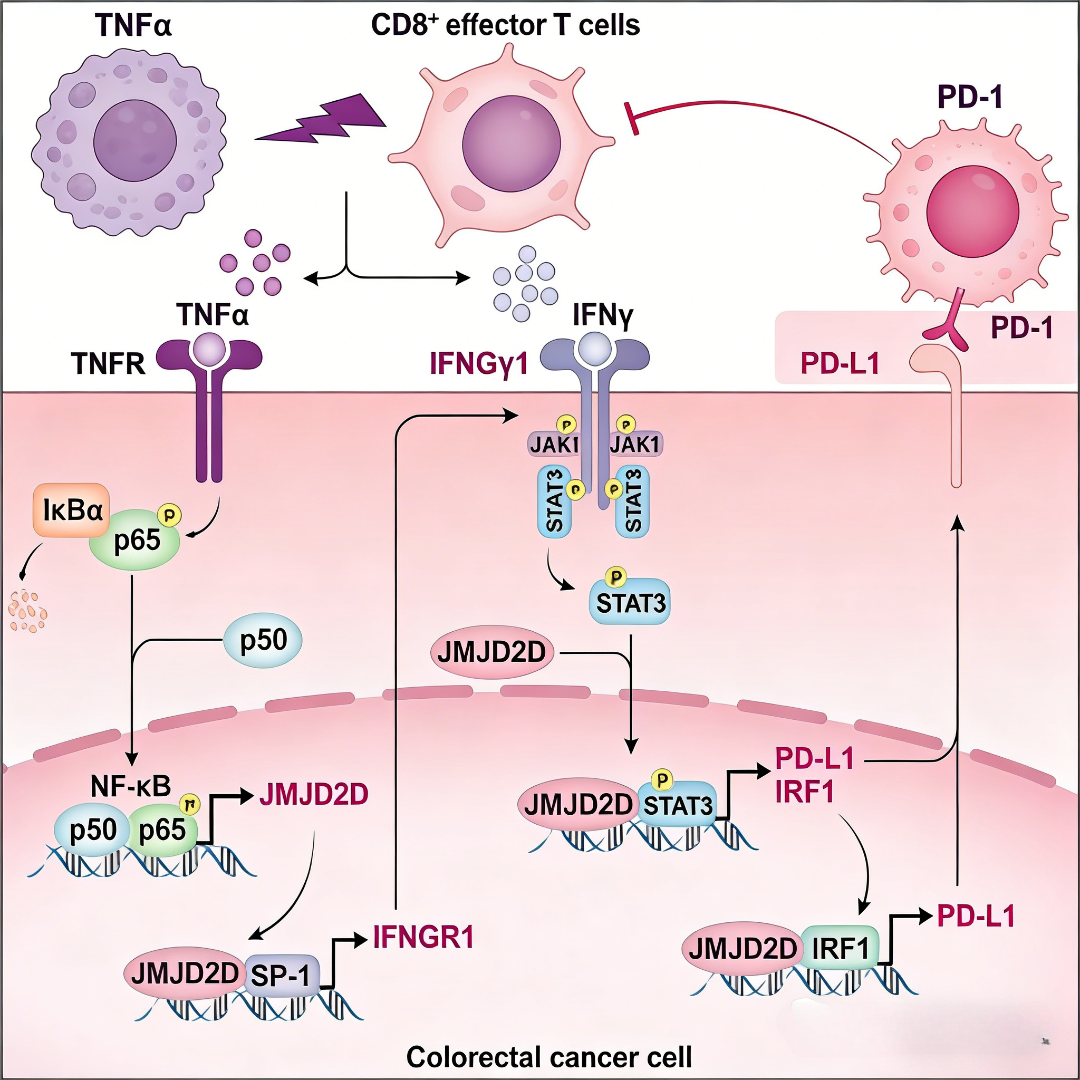
3. Molecular Mechanism of STUB1-mediated Ubiquitination and Degradation of IFNGR1–JAK1 Complex
STUB1 specifically recognizes and ubiquitinates lysine 285 (K285) of IFNGR1 and lysine 249 (K249) of JAK1, driving proteasome-dependent degradation of the complex. Notably, IFNGR1 K285 is located within its Box1 motif that interacts with JAK1, while JAK1 K249 resides in its FERM domain—both critical for complex formation and stability. These results suggest that STUB1 may expose key ubiquitination sites to disrupt IFNGR1–JAK1 interaction, thereby promoting receptor complex turnover and signal attenuation.
4. STUB1 Deficiency Enhances Tumor Cell Sensitivity to IFNγ and T Cell Killing
Functionally, STUB1 knockout significantly strengthens IFNγ downstream pathway activity and increases tumor cell susceptibility to cytotoxic T cells in vitro co-culture systems. Clinical correlation analyses further show that in patients receiving immune checkpoint blockade therapy, STUB1 expression levels in tumor tissues negatively correlate with IFNγ signaling activity, suggesting STUB1 as a potential therapeutic resistance biomarker.
5. Context-dependent Regulation of IFNγ Signaling by STUB1 and Therapeutic Implications
Notably, STUB1's regulation of IFNγ signaling and impact on immunotherapy response is context-dependent. In xenograft models, partial STUB1 loss enhances anti-PD-1 therapy efficacy, whereas complete knockout shows no significant synergistic effect, suggesting moderate IFNγ signal activation may be more favorable for immune synergy. These results emphasize that therapeutic interventions targeting the STUB1–IFNGR1 axis require precise modulation based on tumor microenvironment and overall signaling pathway status.
6. Conclusion
This study systematically elucidates STUB1 as an E3 ubiquitin ligase for the IFNGR1–JAK1 complex, negatively regulating the IFNγ signaling pathway through ubiquitin-proteasome mechanisms and consequently influencing tumor immune responses. This mechanism provides new perspectives for understanding dynamic IFNγ signal regulation and theoretical foundations for developing combination immunotherapy strategies based on receptor stability modulation. Future research should further explore STUB1's regulatory networks across different tumor types and immune microenvironments, along with clinical translation potential.
7. Which Companies Provide IFNGR1 Fc Proteins?
Nanjing Uprotein independently developed IFNGR1 Fc Chimera Protein, Human, a high-purity, high-activity recombinant fusion protein of human IFNGR1 (interferon gamma receptor alpha chain). Through genetic engineering, the extracellular domain of IFNGR1 is fused with human immunoglobulin Fc fragment to form stable homodimers. This product retains IFNGR1's native conformation and biological functions while leveraging the Fc fragment to enhance protein stability and application flexibility, making it an essential tool protein for studying IFNγ signaling pathways, immune regulation, and anti-tumor immunity mechanisms.
Core Product Advantages:
| Advantage | Details |
|---|---|
| Stable Dimeric Structure & High Affinity | Fc-mediated dimerization enables the protein to exist in a state closer to native receptor oligomerization on cell membranes, maintaining high-affinity IFN-γ binding and facilitating authentic ligand-receptor interaction studies. |
| High Purity & Intact Bioactivity | Expressed in mammalian systems and purified via affinity chromatography, yielding >95% purity with low endotoxin levels. IFN-γ binding activity has been validated to ensure functional experiment reliability. |
| Versatile Applications | Fc tag enables Protein A/G-based purification, immobilization, or detection. Applicable for receptor binding assays (e.g., ELISA/SPR/BLI), competitive inhibition, immunoprecipitation, flow cytometry, and as immunogens for antibody development. |
| Excellent Stability & Batch Consistency | Standardized production and rigorous QC ensure high inter-batch consistency in purity, activity, and stability, guaranteeing experimental reproducibility. |
| Expert Technical Support | Comprehensive technical documentation, recommended protocols, storage guidelines, and professional consultation for IFNγ signaling research and antibody screening applications. |
Nanjing Uprotein is committed to providing high-quality recombinant protein tools for immunology, tumor immunology, and biopharmaceutical R&D. For detailed specifications (IFNGR1 Fc Chimera Protein, Human, Cat#: UA011347), binding activity data, or application support, please contact us anytime.
This article is reviewed and published by the technical expert team of UA
Disclaimer: This article partially utilizes artificial intelligence assistance in its creation. If any content involves copyright or intellectual property issues, please let us know and we promise to verify and remove it as soon as possible.
Purchase recombinant protein, choose 
UA protein focuses on providing various protein reagents, raw materials, and services required for drug research and development, cell therapy, gene therapy, and basic scientific research, including drug target proteins, immune checkpoint proteins, cytokines, tool enzymes, customized protein expression, and full-length transmembrane protein development. Nanjing Univ is committed to providing customers with high-quality products and professional services, and building a High-tech Biological Enterprise with International Competitiveness.







 Business license (three certificates in one)