

The role of BAFFR/TNFRSF13C in B cell regulation


The B lymphocyte stimulator receptor (BAFFR, also known as TNFRSF13C or CD268) is a member of the TNF receptor superfamily and serves as a key regulatory receptor for B cell survival, proliferation, and differentiation.
- Recent Advances
- Product Information
Summary
The B-cell activating factor receptor (BAFFR, also known as TNFRSF13C or CD268) is a member of the TNF receptor superfamily and serves as a critical regulator of B-cell survival, proliferation, and differentiation. Its sole ligand, BAFF, plays a pivotal role in maintaining B-cell homeostasis and is closely associated with the pathogenesis of autoimmune diseases and B-cell malignancies. The biotinylated Fc fusion protein developed based on BAFFR (Biotinylated BAFFR/TNFRSF13C Fc&Avi Tag) offers advantages such as high purity, stability, and standardized labeling, making it an essential tool for studying BAFFR-related signaling pathways, drug screening, and in vitro diagnostics.
I. Molecular Structure and Expression Profile of BAFFR
BAFFR is a type I transmembrane protein featuring four cysteine-rich domains (CRDs) in its extracellular region, structurally distinct from other TNF receptor family members. It plays a vital role in B-cell development and is predominantly expressed in lymphoid tissues such as the spleen, lymph nodes, tonsils, bone marrow, and appendix, with minimal expression in non-lymphoid tissues. BAFFR is stably expressed from transitional B cells to mature peripheral B cells but is absent on plasma cells and centroblasts in the dark zone of germinal centers.
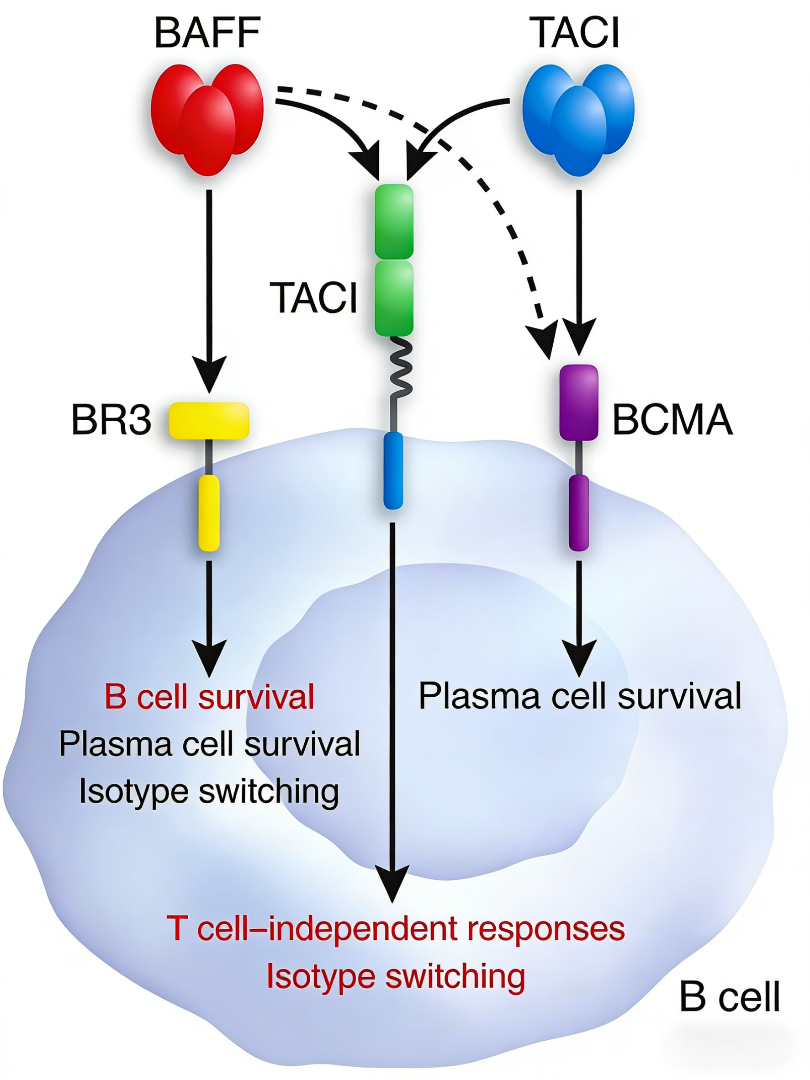
II. Ligands and Signaling Pathways of BAFFR
The sole ligand of BAFFR is BAFF (also known as BLyS or TNFSF13B), which can also bind to TACI and BCMA receptors, forming a ligand-receptor regulatory network. Upon binding to BAFF, BAFFR primarily activates the following signaling pathways:
1. Non-canonical NF-κB2 Pathway
Activates the NIK kinase and IKKα complex, promoting RelB-p100 phosphorylation and processing of p100 to p52. The RelB-p52 heterodimer translocates to the nucleus to regulate target gene expression and suppress apoptosis.
2. PI3K-AKT-mTOR Pathway
Participates in B-cell metabolic reprogramming, promoting protein synthesis, mitochondrial function, and ATP production while stabilizing the anti-apoptotic protein MCL-1 to enhance cell survival and adaptability.
III. Role of BAFFR in Diseases and Therapeutic Potential
1. Autoimmune Diseases
Overexpression of BAFF can lead to abnormal B-cell proliferation, contributing to autoimmune diseases such as systemic lupus erythematosus and rheumatoid arthritis. Targeting the BAFF/BAFFR pathway can inhibit B-cell maturation and function, with BAFFR-targeting antibodies potentially offering greater safety advantages over anti-BAFF antibodies.
2. B-Cell Lymphoma and Leukemia
BAFFR is highly expressed in various B-cell malignancies and promotes tumor survival, proliferation, and chemotherapy resistance. Blocking BAFFR can suppress tumor cell survival and enhance NK cell activity and antibody-dependent cellular cytotoxicity.
IV. Research Applications of Biotinylated BAFFR/TNFRSF13C Fc&Avi Tag Protein
This recombinant protein consists of the extracellular domain of BAFFR fused to the human IgG Fc fragment and incorporates an Avi Tag for site-specific biotinylation. Its features and applications include:
1. High Affinity and Specificity
Retains the full extracellular domain structure of BAFFR, enabling efficient binding to BAFF for ligand-receptor interaction studies, competitive binding assays, and epitope analysis.
2. Standardized Labeling and Detection Convenience
Biotinylation allows efficient binding to streptavidin-coated solid-phase carriers or fluorescent/enzyme-labeled reporter systems, making it suitable for ELISA, flow cytometry, protein microarrays, and immunohistochemistry.
3. Tool for Signaling Pathway and Functional Studies
Can serve as a decoy receptor to block BAFF/BAFFR signaling, facilitating research into the pathway's role in B-cell function, immune responses, and disease models.
4. Drug Screening and Development Platform
High-throughput binding assays using this protein can screen for BAFFR-targeting neutralizing antibodies, small-molecule inhibitors, or protein-based therapeutics, accelerating drug development.
V. Suppliers of Biotinylated BAFFR/TNFRSF13C Fc&Avi Tag Protein
Nanjing UniApeptide independently developed the Biotinylated BAFFR/TNFRSF13C Fc&Avi Tag Protein, Human (Catalog No.: UA011346), a highly active and specific biotinylated human BAFFR/TNFRSF13C recombinant fusion protein. This product is engineered by fusing the extracellular domain of BAFFR with the human IgG Fc fragment and AviTag sequence, followed by efficient and uniform biotinylation in vitro. It combines stable dimeric structure, high-affinity ligand binding, and compatibility with diverse detection systems, making it an ideal tool for studying B-cell signaling, autoimmune diseases, and antibody drug screening.
| Core Advantages |
|---|
| High Purity and Native Conformation: Expressed in mammalian cells and purified via multi-step chromatography, yielding high purity (>95%) and low endotoxin levels. The Fc-mediated dimerization mimics the natural oligomeric state of membrane receptors, ensuring high-affinity binding to BAFF. |
| Efficient and Uniform Biotinylation: Site-specific biotinylation via AviTag ensures high labeling efficiency and batch consistency, enabling direct compatibility with streptavidin- or NeutrAvidin-based detection systems for simplified workflows and enhanced sensitivity. |
| Versatile Application Compatibility: Biotinylation design supports high-sensitivity detection platforms such as ELISA, SPR, BLI, multicolor flow cytometry, immunoprecipitation, and high-throughput drug screening, providing a multifunctional tool for BAFF-BAFFR pathway research. |
| Superior Stability and Batch Consistency: Rigorous production and quality control ensure consistent purity, biotinylation efficiency, and bioactivity across batches, guaranteeing experimental reproducibility and data reliability. |
| Expert Technical Support: Comprehensive product documentation, application protocols (e.g., BAFF binding inhibition assays, receptor interaction analysis), storage guidance, and professional consultation for B-cell immunology research and drug discovery. |
Nanjing UniApeptide is committed to providing high-performance, high-quality recombinant protein tools for immunology research, autoimmune disease drug development, and antibody screening. For detailed technical specifications, binding activity data, or application support for Biotinylated BAFFR/TNFRSF13C Fc&Avi Tag Protein, Human (Catalog No.: UA011346), please feel free to contact us.
This article is reviewed and published by the technical expert team of UA
Disclaimer: This article partially utilizes artificial intelligence assistance in its creation. If any content involves copyright or intellectual property issues, please let us know and we promise to verify and remove it as soon as possible.
Purchase recombinant protein, choose 
UA protein focuses on providing various protein reagents, raw materials, and services required for drug research and development, cell therapy, gene therapy, and basic scientific research, including drug target proteins, immune checkpoint proteins, cytokines, tool enzymes, customized protein expression, and full-length transmembrane protein development. Nanjing Univ is committed to providing customers with high-quality products and professional services, and building a High-tech Biological Enterprise with International Competitiveness.







 Business license (three certificates in one)