

5-Ethynyluridine: A Nucleoside Analog with Bioorthogonal Labeling Potential for mRNA Therapeutics


To evaluate the impact of EU modification on mRNA function, the study synthesized YFP-encoding mRNAs with all uridines replaced by EU, Ψ, m1Ψ, or unmodified uridine (U).
- Recent Advances
- Product Information
I. Expression Characteristics and Mechanism Analysis of EU-Modified mRNA
To evaluate the impact of EU modification on mRNA function, researchers synthesized yellow fluorescent protein (YFP)-encoding mRNAs with all uridines replaced by EU, Ψ, m1Ψ, or unmodified uridine (U). After electroporation transfection into human macrophages, flow cytometry revealed that EU-modified mRNA exhibited significantly lower YFP protein expression levels compared to other groups (m1Ψ > U > Ψ > EU). However, the expression levels remained stable over the observation period, indicating that EU modification did not lead to rapid degradation of protein products.
Further mechanistic investigations revealed multiple factors contributing to the expression differences. First, quantitative PCR analysis showed that the intracellular abundance of EU-modified mRNA was approximately one-tenth of other modified forms, suggesting potential differences in transfection or intracellular stability. Second, results from a cell-free in vitro translation system ruled out interference from cell-specific factors, confirming that EU-modified mRNA itself had the lowest translation efficiency (about 1/10 of unmodified mRNA). Collectively, these findings indicate that the lower protein yield of EU-modified mRNA results from the combined effects of transfection/stability and inherent translation efficiency.
II. Low Immunogenicity of EU-Modified mRNA
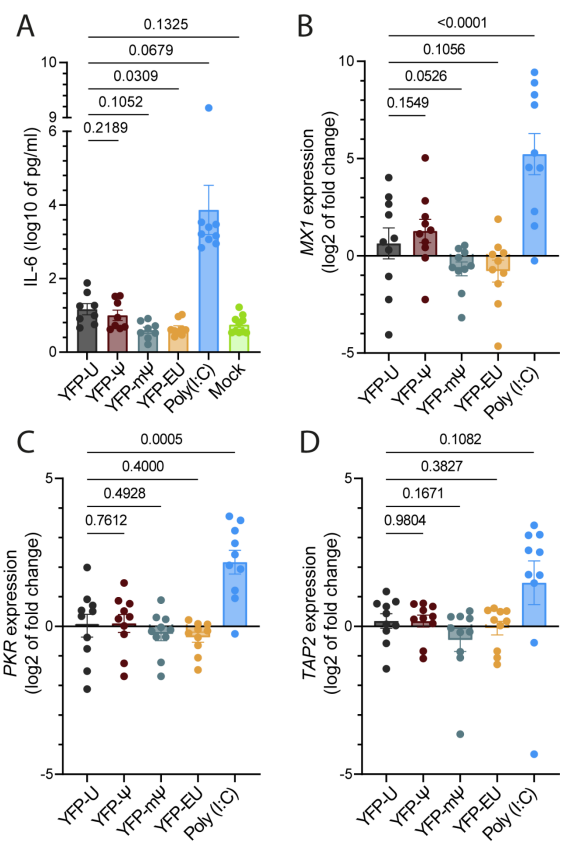
Assessing the immunostimulatory potential of nucleoside analogs is critical. The study evaluated innate immune responses by measuring key inflammatory cytokines and interferon-stimulated gene expression. Enzyme-linked immunosorbent assays (ELISA) showed that 24 hours post-transfection, all modified mRNAs (EU, Ψ, m1Ψ) induced low levels of interleukin-6 (IL-6), with the EU-modified group showing statistically significant differences compared to the unmodified U group, demonstrating its effective immune-silencing capability.
Transcriptional analysis of downstream interferon pathway gene MX1 and immune-related genes PKR and TAP2 further confirmed this observation. Unmodified and Ψ-modified mRNAs induced some upregulation of MX1 expression, whereas EU and m1Ψ-modified mRNAs showed no significant changes. For PKR and TAP2, EU and m1Ψ modifications also displayed no activation effects and even slight suppression. These data consistently indicate that EU modification, like m1Ψ, effectively avoids triggering innate immune recognition pathways by mRNA.
III. Impact of EU Modification on mRNA Secondary Structure
To investigate whether the observed phenotypes stem from altered mRNA folding, the study employed SHAPE-MaP technology to analyze the secondary structures of differently modified mRNAs. Results showed that Ψ and m1Ψ-modified mRNAs had highly similar structures, which differed significantly from unmodified U mRNA. In contrast, EU-modified mRNA exhibited global folding closest to unmodified U mRNA. In-depth analysis revealed that Ψ and m1Ψ likely influence structure by enhancing base-pairing stability, whereas EU has a relatively weaker impact on base pairing, with reactivity profiles differing from natural uridine but distinct from Ψ/m1Ψ. This suggests that while EU, Ψ, and m1Ψ all alter the local chemical environment, they induce different structural consequences, with EU's phenotype largely independent of reshaping the overall folding of natural mRNA.
IV. Conclusions and Future Perspectives
This study systematically characterizes the properties of 5-ethynyluridine (EU) as a uridine substitute in mRNA. Key findings include:
1. Low Immunogenicity: EU modification effectively prevents innate immune activation in macrophages, with efficacy comparable to the widely used m1Ψ.
2. Unique Expression and Folding Properties: EU modification reduces mRNA transfection/stability and translation efficiency but maintains stable protein expression. Its modified mRNA secondary structure more closely resembles the natural form, distinct from Ψ/m1Ψ.
3. Bioorthogonal Labeling Potential: The alkyne group in EU is a key advantage, enabling specific mRNA labeling and tracking via click chemistry, which holds significant value for imaging, localization, or affinity purification applications.
In summary, 5-ethynyluridine is not only an effective immune-silencing modification but also, due to its unique chemical and structural properties—particularly the chemical handle it provides for bioorthogonal labeling—holds broad prospects for basic research and the refined development of next-generation mRNA therapeutics and vaccines.
V. Which Manufacturers Provide EU Labeling Products?
Nanjing U-Protein自主研发的 Protein labeling EU (5-ethynyluridine) (Product No.: UA086024) is a high-efficiency, specific protein labeling tool developed based on 5-ethynyluridine (EU) click chemistry labeling technology. This product utilizes EU as a uridine analog, which can be incorporated into nascent RNA strands during RNA synthesis and then efficiently conjugated with fluorescent dyes or biotin reporters via click chemistry, enabling RNA labeling and visualization. It is suitable for RNA transcription and metabolic tracking, cell proliferation assays, imaging analysis, and high-throughput screening.
| Core Product Advantages |
|---|
| Designed for RNA Labeling: The EU-based click chemistry labeling strategy achieves specific, high-sensitivity labeling of nascent RNA, avoiding nonspecific interference from DNA or proteins. It is particularly suitable for RNA transcription dynamics, localization, and metabolic studies. |
| High Labeling Efficiency and Low Cytotoxicity: EU exhibits excellent cell membrane permeability, efficiently incorporating into RNA at low concentrations with minimal impact on cell metabolism, making it suitable for long-term tracking in live or fixed cells. |
| Flexible Reporter Conjugation: Labeled EU-RNA can undergo signal amplification via efficient click chemistry reactions (e.g., conjugation with fluorescent dye-azides), supporting multiple fluorescence channels (e.g., Alexa Fluor, Cy series) for multicolor imaging and flow cytometry. |
| User-Friendly and Workflow-Compatible: Provides optimized EU labeling solutions and matching click chemistry reagents with standardized protocols, compatible with routine cell culture, fixation, permeabilization, and imaging workflows for easy integration into existing systems. |
| Broad Application Scenarios: Suitable for cell proliferation assays (replacing EdU), real-time RNA transcription monitoring, RNA-protein colocalization, high-throughput drug screening (e.g., transcription inhibitors), and single-cell RNA imaging. |
| Excellent Stability and Batch Consistency: Rigorous production and quality control ensure high purity, stability, and batch-to-batch consistency, guaranteeing reliable and reproducible results. |
Nanjing U-Protein is committed to providing innovative and efficient labeling and detection tools for cell biology, transcriptomics, and drug development. For detailed technical information, protocols, or application support regarding Protein labeling EU (5-ethynyluridine) (Product No.: UA086024), please feel free to contact us.
This article is reviewed and published by the technical expert team of UA
Disclaimer: This article partially utilizes artificial intelligence assistance in its creation. If any content involves copyright or intellectual property issues, please let us know and we promise to verify and remove it as soon as possible.
Purchase recombinant protein, choose 
UA protein focuses on providing various protein reagents, raw materials, and services required for drug research and development, cell therapy, gene therapy, and basic scientific research, including drug target proteins, immune checkpoint proteins, cytokines, tool enzymes, customized protein expression, and full-length transmembrane protein development. Nanjing Univ is committed to providing customers with high-quality products and professional services, and building a High-tech Biological Enterprise with International Competitiveness.







 Business license (three certificates in one)