

Advances in the Role of Acetyl-CoA Carboxylase in Metabolic Regulation of CD8+ T Cells in Tumors and Its Labeling Techniques


In the tumor microenvironment, CD8+ T cell exhaustion is closely associated with metabolic dysregulation, particularly lipid metabolism disorder.
- Recent Advances
- Product Information
Abstract
The functional exhaustion of CD8+ T cells in the tumor microenvironment is closely associated with metabolic dysregulation, particularly lipid metabolism disorders. Acetyl-CoA carboxylase (Acc), a key rate-limiting enzyme in fatty acid synthesis, is specifically upregulated in tumor-infiltrating CD8+ T cells. By promoting lipid synthesis and lipid droplet accumulation while inhibiting fatty acid oxidation, Acc leads to metabolic dysfunction in T cells. Inhibiting Acc activity can reshape the metabolic program of CD8+ T cells, enhancing their persistence and anti-tumor capabilities. Relevant studies suggest that developing effective Acc activity markers and detection techniques is crucial for elucidating its regulatory mechanisms and evaluating targeted strategies.
1. Research Background and Significance
In the solid tumor microenvironment, CD8+ T cells often experience functional exhaustion due to nutrient deprivation and metabolic reprogramming. Studies have shown that T cells with higher fatty acid oxidation capacity can better maintain survival and function. However, most tumor-infiltrating T cells exhibit impaired fatty acid oxidation. As a core enzyme in fatty acid synthesis, how Acc expression and activity regulate T cell metabolic adaptation and functional maintenance in the tumor environment remains to be elucidated.
2. Acc Expression and Lipid Accumulation in Tumor CD8+ T Cells
In multiple solid tumor models, compared to spleen-derived CD8+ T cells, tumor-infiltrating CD8+ T cells exhibit significant lipid accumulation features, including increased levels of triglycerides, phospholipids, and other lipid categories, accompanied by lipid droplet formation. RNA sequencing and proteomics analyses further reveal that Acc1 is specifically induced in tumor-infiltrating T cells, indicating its close association with T cell lipid metabolism abnormalities.
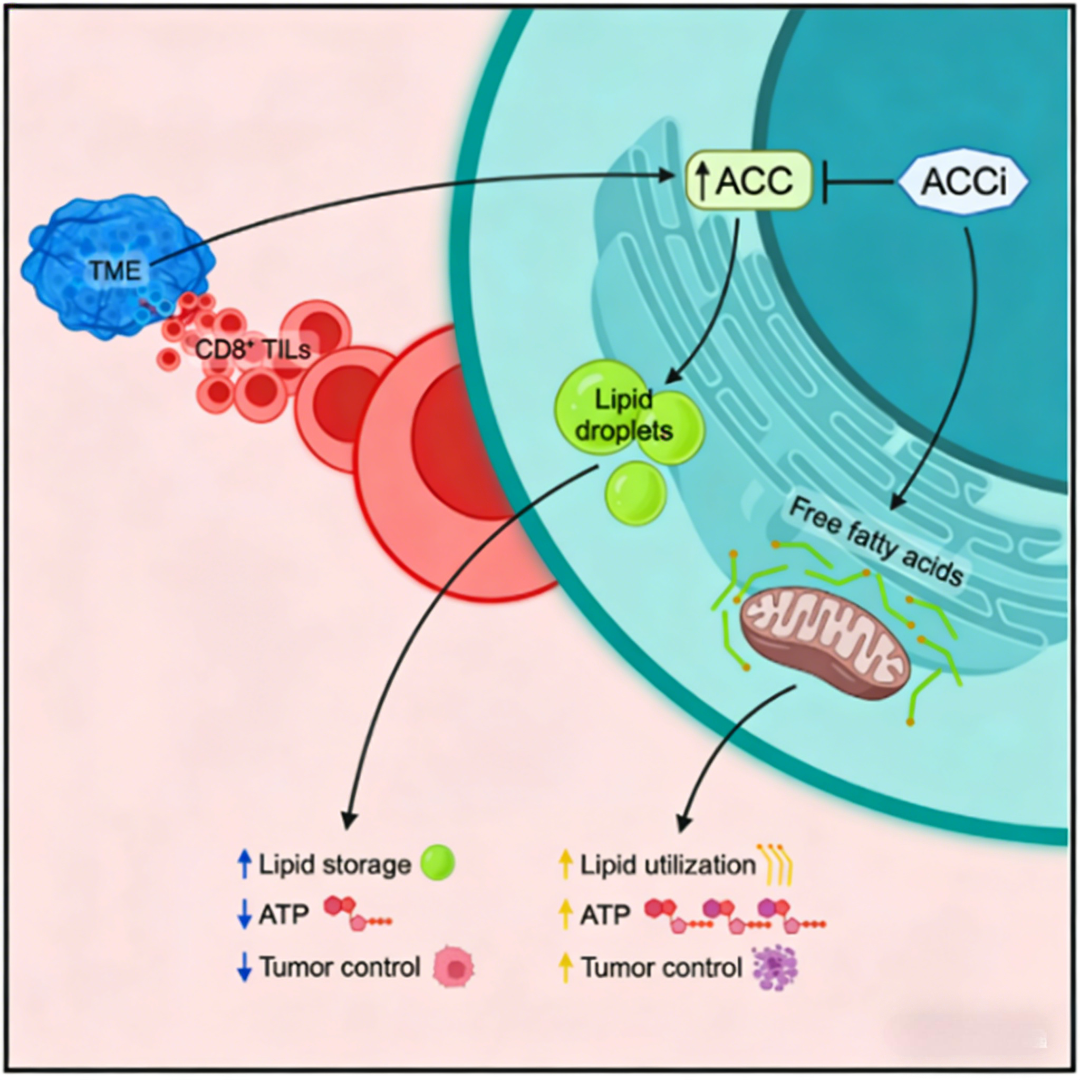
3. Regulatory Role of Acc Activity on CD8+ T Cell Lipid Synthesis and Oxidative Metabolism
By inhibiting Acc activity, lipid synthesis in CD8+ T cells is significantly reduced, while the mitochondrial fatty acid oxidation metabolic pathway is activated, manifested by increased intermediates of fatty acid β-oxidation, elevated levels of tricarboxylic acid cycle metabolites, and enhanced ATP production. These results demonstrate that Acc activity plays a key role in regulating the metabolic balance between lipid synthesis and oxidation in CD8+ T cells.
4. Impact of Acc Inhibition on CD8+ T Cell Function and Anti-Tumor Immunity
In vitro and in vivo models show that inhibiting Acc activity promotes the formation of CD8+ T cells with stronger stemness, persistence, and multifunctionality. Genetic deficiency or pharmacological inhibition of Acc significantly enhances T cell clearance of solid tumors such as melanoma, improving tumor immunotherapy outcomes. This provides a new strategy for enhancing T cell immune responses through metabolic intervention.
5. Application and Prospects of Acc Labeling Technology in This Research
1. Activity Detection and Labeling Methods
This study employed lipidomics and metabolomics combined with Acc inhibitor treatment to indirectly assess Acc's impact on lipid metabolism. Direct detection of Acc activity still relies on radiolabeled substrates, immunoblotting, or mass spectrometry-based enzyme activity assays, highlighting the need for more sensitive and dynamic labeling technologies.
2. Value of Labeling Technology in Mechanism Research
Developing specific fluorescent probes or chemical reporters for Acc activity could enable dynamic monitoring of Acc activity and lipid metabolism at the single-cell level, helping to reveal the spatiotemporal regulatory network of Acc in T cell differentiation, exhaustion, and functional recovery.
3. Clinical Application Prospects
Acc activity labeling technology can be used to assess the metabolic state of patient T cells, screen populations suitable for Acc inhibition strategies in immunotherapy, and serve as a biomarker for treatment response.
6. Conclusion
Acc plays a critical role in the metabolic dysregulation and functional exhaustion of tumor CD8+ T cells by promoting lipid synthesis and inhibiting fatty acid oxidation. Targeting Acc can effectively reshape T cell metabolism and enhance their anti-tumor function, offering promising therapeutic translation potential. Developing precise and dynamic Acc labeling and detection technologies will facilitate in-depth analysis of its metabolic regulatory mechanisms and advance the clinical translation and personalized application of Acc-based tumor immunotherapy strategies.
7. Which Manufacturers Provide Labeling for Acc?
Nanjing YouAi Protein independently developed Protein labeling Acc (Product No.: UA086025), an efficient and convenient protein labeling kit designed to provide users with stable and reliable protein labeling solutions. This product has been carefully optimized for various applications, including fluorescent labeling, biotinylation, and isotope labeling, supporting research in immunodetection, flow cytometry, protein interactions, and drug development.
| Core Advantages of the Product |
|---|
| High Labeling Efficiency and Mild Conditions: An optimized chemical modification system achieves high-specificity labeling under mild reaction conditions, effectively preserving the native conformation and biological activity of proteins. The labeling efficiency is high, with strong batch-to-batch stability. |
| Compatibility with Multiple Labels: Supports efficient coupling with commonly used labels (e.g., fluorescent dyes, biotin, enzymes), allowing users to flexibly choose based on experimental needs. The kit enables multiple uses, saving optimization time and costs. |
| Simple Operation and Rapid Workflow: Provides ready-to-use reagents and detailed operating instructions. The labeling steps are simple and quick, requiring no complex purification steps, enabling high-quality labeling in a short time and significantly improving experimental efficiency. |
| Broad Application Compatibility: Suitable for labeling various types of proteins, including antibodies, recombinant proteins, and enzymes. The labeled products can be directly used in downstream experiments such as Western blot, ELISA, immunofluorescence, flow cytometry, and immunoprecipitation. |
| Excellent Stability and Reproducibility: Strict quality control ensures stable performance of all kit components, with consistent labeling efficiency across batches and high reproducibility of experimental results, ensuring continuity in long-term research. |
| Comprehensive Technical Support: We provide detailed manuals, labeling protocol optimization suggestions, and solutions to common problems. Professional technical consultation and support are also available based on users' specific experimental needs. |
Nanjing YouAi Protein is committed to providing high-performance, high-quality reagents and tools for life science research, diagnostic reagent development, and drug discovery. For detailed technical parameters, application examples, or specific operating instructions for Protein labeling Acc (Product No.: UA086025), please feel free to contact us.
This article is reviewed and published by the technical expert team of UA
Disclaimer: This article partially utilizes artificial intelligence assistance in its creation. If any content involves copyright or intellectual property issues, please let us know and we promise to verify and remove it as soon as possible.
Purchase recombinant protein, choose 
UA protein focuses on providing various protein reagents, raw materials, and services required for drug research and development, cell therapy, gene therapy, and basic scientific research, including drug target proteins, immune checkpoint proteins, cytokines, tool enzymes, customized protein expression, and full-length transmembrane protein development. Nanjing Univ is committed to providing customers with high-quality products and professional services, and building a High-tech Biological Enterprise with International Competitiveness.







 Business license (three certificates in one)