The role of CRBN ligands in targeted protein degradation technology and research progress in novel ligand development


Among various E3 ligases, Cereblon (CRBN) stands out as a central recruitment platform for targeted degrader design due to its unique advantages.
- Recent Advances
- Product Information
I. The Central Role of CRBN E3 Ubiquitin Ligase
Among various E3 ligases, Cereblon (CRBN) has emerged as a core recruitment platform for targeted degrader design due to its unique advantages. As the substrate recognition component of the CRL4 E3 ubiquitin ligase complex, its ligands play a pivotal role in degrader design.
Preferred E3 Ligase for Molecular Glues: Currently marketed and clinically studied molecular glue degraders, such as Lenalidomide and Pomalidomide, bind and modulate CRBN activity to induce ubiquitination and degradation of specific neosubstrates (e.g., transcription factors IKZF1/3). Thus, CRBN is the only validated E3 ligase for molecular glue drug development.
Key Component of PROTACs: In heterobifunctional PROTAC design, CRBN ligands, along with VHL ligands, are the most commonly used E3 ligase ligand modules. Compared to VHL ligands, CRBN-based PROTACs typically exhibit superior chemical space in oral bioavailability, with molecular weight, lipophilicity, and hydrogen bond donors/rotatable bonds more aligned with drug-like properties, facilitating oral formulation development.
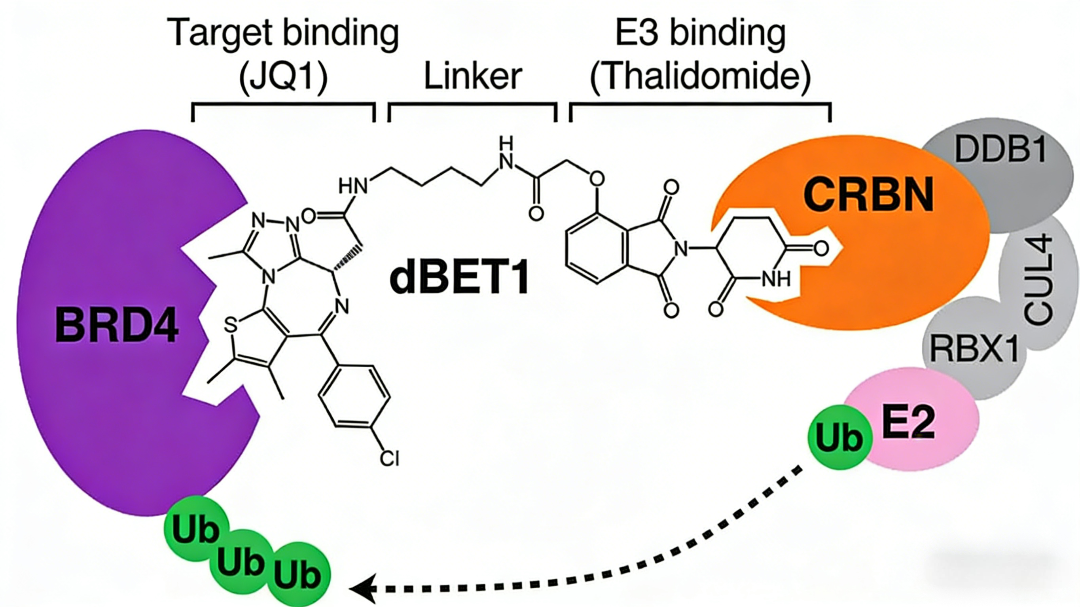
II. Applications and Limitations of Classical CRBN Ligands
Currently, CRBN ligands used in PROTACs and molecular glue designs are primarily derived from first-generation immunomodulatory drugs (IMiDs), such as Lenalidomide, Thalidomide, and their derivatives. These ligands have successfully advanced multiple candidates into clinical trials, including CRBN-based PROTACs like ARV-110 (targeting AR) and ARV-471 (targeting ER), the latter of which has entered Phase III clinical studies.
However, classical IMiDs ligands have inherent limitations, including:
1. Chemical Stability Issues: For example, Thalidomide has a chiral center prone to racemization.
2. Off-Target Degradation Activity: May non-specifically recruit and degrade unintended neosubstrate proteins, leading to potential off-target toxicity.
3. Limited Structural Modification Space: Their core structures restrict further chemical optimization to improve pharmacokinetics or selectivity.
These limitations drive the ongoing exploration of novel, high-performance CRBN ligands.
III. Advances in Novel CRBN Ligand Development
To overcome the drawbacks of classical ligands, multiple research institutions and companies are committed to developing novel CRBN ligands with enhanced properties (e.g., higher binding affinity, better selectivity, improved stability) for next-generation degraders.
Clinical-Stage Applications of Novel Ligands: In recent academic conferences like AACR, several companies disclosed PROTAC projects using novel CRBN ligands, such as Arvinas' ARV-766, C4 Therapeutics' CFT8634 and CFT1946, and Kymera Therapeutics' KT474. These advances indicate rapid clinical translation of novel ligands.
Designs Based on CC-122 (Avadomide) Analogues: CC-122 itself is a CELMoD with anticancer activity. Its structural derivatives have been used to design novel PROTACs, such as TD-428 for BET protein degradation, which demonstrated effective target protein degradation and anti-proliferative activity in prostate cancer cell models.
Phenyl-Glutarimides (PG) Series: Developed by St. Jude Children's Research Hospital, PG ligands maintain high CRBN binding activity while significantly improving chemical stability. BET PROTACs (e.g., compound 4c) constructed with these ligands showed picomolar degradation potency (DC50 = 0.87 nM) in cell models. These ligands were also used to design JAK2/3 PROTAC (SJ10542), which reduced off-target degradation of GSPT1 compared to IMiDs, enhancing selectivity.
Amide-Linked Novel Ligands: Tianjin University and others reported a class of novel CRBN ligands with amide bonds bridging the phenyl ring and glutarimide (e.g., YJ1b, YJ2c, YJ2e). Validated by techniques like time-resolved fluorescence resonance energy transfer (TR-FRET), these compounds exhibit strong CRBN binding and have been used to construct efficient BET protein degraders.
Novel Ligands with Three-Membered Ring Structures: Professor Shaomeng Wang's group developed a series of novel CRBN ligands with three-membered rings (e.g., cyclopropane). These ligands have been successfully applied in degraders targeting androgen receptor (AR) (e.g., compound 495) and estrogen receptor (ER) (e.g., E453), both showing excellent degradation activity.
IV. Key Tools for CRBN Ligand Screening and Characterization: CRBN Ligand Screening Assay Kit
In the discovery and optimization of novel CRBN ligands, rapid, accurate, and high-throughput assessment of compound binding to CRBN is critical. The CRBN Ligand Screening Assay Kit is a core research tool designed for this purpose.
The kit is typically based on biochemical detection principles like homogeneous time-resolved fluorescence (HTRF) or fluorescence polarization (FP), enabling direct, quantitative measurement of test molecule binding affinity and competition with CRBN (or CRBN-DDB1 complex). Its advantages include:
High Sensitivity and Specificity: Accurately distinguishes binding strengths of different ligands to CRBN.
High-Throughput Compatibility: Suitable for automated platforms, enabling rapid screening of large compound libraries to accelerate hit discovery.
Functional Relevance: Results directly reflect binding events to the E3 ligase target, serving as a key precursor for predicting cellular activity and degradation efficacy.
Using such kits, researchers can systematically evaluate the binding performance of novel CRBN ligands (e.g., PG series, amide-linked series, three-membered ring series) compared to classical IMiDs, rationally guiding structural optimization to obtain targeted protein degradation candidates with superior activity, selectivity, and druggability.
V. Vendors Offering CRBN Ligand Screening Assay Kits
Nanjing U-Protein's independently developed "Human CRBN Ligand Screening Assay Kit" (Catalog No.: UA086023) is a high-sensitivity, high-throughput screening platform based on advanced biomolecular interaction detection technology, specifically designed for rapid screening and evaluation of compound binding to CRBN E3 ubiquitin ligase. This kit is suitable for molecular glue drug discovery, PROTAC design, immunomodulator screening, and CRBN-dependent protein degradation mechanism research, providing a stable, efficient, and standardized in vitro screening solution.
| Core Product Advantages |
|---|
| Highly Specific CRBN Binding Detection: The kit uses rigorously validated human recombinant CRBN protein (containing key domains) to directly simulate compound-CRBN interactions, efficiently distinguishing CRBN binders from non-binders and significantly improving screening specificity. |
| High Sensitivity and Low Background Noise: Based on optimized homogeneous or solid-phase detection principles (e.g., TR-FRET, fluorescence polarization), it offers excellent signal-to-noise ratio and wide dynamic range, enabling sensitive detection of weak-affinity compounds, especially for high-throughput screening and low-abundance signal detection. |
| Ready-to-Use Flexible Screening Platform: Provides pre-coated or pre-labeled CRBN protein, detection reagents, and optimized buffer systems. The streamlined workflow is compatible with automated workstations and supports 96/384-well plate formats, significantly enhancing screening throughput and efficiency. |
| Broad Application Compatibility: Suitable for screening various compound types, including small molecule libraries, fragment libraries, natural products, and PROTAC/molecular glue candidates, supporting primary screening, dose-dependent experiments, and competitive binding analysis. |
| Exceptional Stability and Batch Consistency: Manufactured using standardized processes and strict quality control, ensuring high stability and excellent batch-to-batch consistency for reliable long-term screening projects and data comparability. |
| Comprehensive Solutions and Expert Support: We provide detailed protocols, data analysis guides, and typical screening cases, along with customized screening design, result validation, and follow-up strategy consultation based on your R&D needs. |
Nanjing U-Protein is committed to providing cutting-edge, high-performance screening tools and solutions for targeted protein degradation, molecular glue drug development, and immunomodulation research. For detailed technical information, validation data, or application support for the "Human CRBN Ligand Screening Assay Kit" (Catalog No.: UA086023), please feel free to contact us.
This article is reviewed and published by the technical expert team of UA
Disclaimer: This article partially utilizes artificial intelligence assistance in its creation. If any content involves copyright or intellectual property issues, please let us know and we promise to verify and remove it as soon as possible.
Purchase recombinant protein, choose 
UA protein focuses on providing various protein reagents, raw materials, and services required for drug research and development, cell therapy, gene therapy, and basic scientific research, including drug target proteins, immune checkpoint proteins, cytokines, tool enzymes, customized protein expression, and full-length transmembrane protein development. Nanjing Univ is committed to providing customers with high-quality products and professional services, and building a High-tech Biological Enterprise with International Competitiveness.







 Business license (three certificates in one)