Biological functions of VAV1, disease associations, and targeted therapeutic strategies: focusing on PROTAC technology


VAV1 (Vav Guanine Nucleotide Exchange Factor 1) is an important intracellular signaling protein, belonging to the guanine nucleotide exchange factor (GEF) family.
- Recent Advances
- Product Information
I. Structure and Cellular Localization of VAV1
VAV1 (Vav guanine nucleotide exchange factor 1) is a crucial intracellular signal transduction protein belonging to the guanine nucleotide exchange factor (GEF) family. It is predominantly and specifically expressed in hematopoietic lineage cells, including T cells, B cells, natural killer (NK) cells, dendritic cells, and macrophages, serving as a key hub molecule in immune cell signaling networks.
II. Core Signal Transduction Functions of VAV1
The primary biological function of VAV1 is to act as a signal integrator and amplifier between extracellular stimuli and intracellular effects. By activating small GTPases (e.g., Rac1, Cdc42), it regulates a series of complex cellular biological processes:
1. Immune Synapse Formation and Cytoskeletal Reorganization: Upon activation of immune receptors such as the T-cell receptor (TCR) or B-cell receptor (BCR), VAV1 is recruited to signaling complexes. Through activation of Rac1 and others, it drives cytoskeletal rearrangement, promoting the stable formation of immune synapses, which is critical for effective antigen recognition and immune response initiation.
2. Transcription Factor Activation and Immune Gene Expression: The VAV1-mediated signaling pathway effectively activates key transcription factors such as nuclear factor-κB (NF-κB), nuclear factor of activated T cells (NFAT), and activator protein-1 (AP-1), thereby regulating the expression of various immune-related genes and influencing the activation, proliferation, and differentiation of T/B cells.
3. Regulation of Cellular Metabolism and Inflammatory Responses: VAV1 signaling also participates in regulating pathways such as MAPK and PI3K/AKT, affecting cell proliferation and survival. Additionally, it promotes reactive oxygen species (ROS) production and enhances NLRP3 inflammasome activity, thereby modulating the release of pro-inflammatory cytokines like interleukin-1β (IL-1β).
III. Regulatory Mechanisms of VAV1 Activity
VAV1 activity is precisely and dynamically regulated, primarily through:
Positive Activation: When immune receptors (e.g., TCR, BCR, FcR) bind to ligands, Src family kinases (e.g., Lck, Fyn) or Syk/ZAP-70 kinases phosphorylate specific tyrosine residues on VAV1, inducing conformational changes that activate its GEF activity. Simultaneously, VAV1 interacts via its domains with adaptor proteins such as LAT, SLP-76, and Grb2, recruiting and localizing it to signaling microclusters at immune synapses, forming efficient signal transduction complexes.
Negative Regulation: To maintain signal balance and prevent overactivation, VAV1 activity is downregulated through multiple mechanisms, including dephosphorylation mediated by protein tyrosine phosphatases (PTPs), ubiquitination and proteasomal degradation mediated by E3 ubiquitin ligases, and post-transcriptional regulation of its mRNA by microRNAs (e.g., miR-29, miR-142).
IV. Role of VAV1 in Diseases
Dysregulation of VAV1 expression or function is closely associated with various human diseases, highlighting its potential as a therapeutic target:
1. Autoimmune and Inflammatory Diseases: In patients with rheumatoid arthritis (RA), systemic lupus erythematosus (SLE), multiple sclerosis (MS), and inflammatory bowel disease (IBD), upregulated or persistently activated VAV1 is often observed in peripheral blood or affected tissues (e.g., synovium). Its excessive activation enhances abnormal immune cell activation and pro-inflammatory cytokine production, driving pathological progression.
2. Hematologic Malignancies: In certain T-cell lymphomas and acute myeloid leukemia (AML), gain-of-function mutations or chromosomal translocations (e.g., VAV1-THAP4 fusion gene) of the VAV1 gene have been identified. These genetic alterations result in constitutive activation of VAV1 independent of upstream receptor signals, continuously driving pro-proliferative and anti-apoptotic signaling pathways, promoting tumorigenesis and development.
V. Application of VAV1/CRBN PROTAC Kit in Pharmacodynamic Evaluation
Developing PROTAC degraders targeting VAV1 requires pharmacodynamic evaluation as a core step in the research process. The specialized VAV1/CRBN PROTAC Kit provides standardized and efficient research tools for this purpose. The kit's applications focus on the following key evaluation dimensions:
1. Target Binding and Ternary Complex Formation Validation:
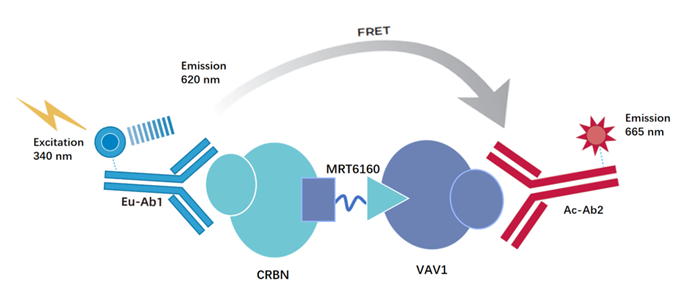
Using detection systems based on time-resolved fluorescence resonance energy transfer (TR-FRET) or fluorescence polarization (FP), the binding affinity of PROTAC molecules to VAV1 protein and CRBN E3 ligase can be quantitatively assessed.
Through in vitro reconstitution experiments, validate whether the PROTAC can effectively promote the formation of the VAV1-CRBN-ligand ternary complex, a critical prerequisite for triggering subsequent ubiquitination and degradation.
2. VAV1 Protein Degradation Efficiency and Kinetics Measurement:
In immune cell lines (e.g., Jurkat T cells) or primary cells expressing VAV1, use standardized detection methods provided in the kit (e.g., Western Blot with quantitative analysis or homogeneous immunoassays) to precisely measure the reduction in intracellular VAV1 protein levels after PROTAC treatment.
Calculate the half-maximal degradation concentration (DC50) and maximum degradation depth (Dmax), and plot degradation time-kinetic curves to comprehensively characterize the degradation efficacy and properties of the PROTAC.
3. Downstream Signaling Pathway Inhibition Assessment:
After confirming successful VAV1 degradation, use the accompanying functional detection modules to evaluate the inhibition of downstream signaling pathways. For example, detect changes in hallmark readouts such as phosphorylated ERK (p-ERK), NF-κB nuclear translocation, or IL-2 production following TCR activation.
These functional data directly link VAV1 protein degradation to its biological inactivation, providing mechanistic evidence for the PROTAC's pharmacodynamic effects.
VI. Which Manufacturers Provide VAV1/CRBN PROTAC Kits?
Nanjing U-Protein自主研发的 "TR-FRET Human VAV1/CRBN PROTAC Binding Kit" (Product No.: UA086022) is a high-performance detection platform developed using advanced time-resolved fluorescence resonance energy transfer (TR-FRET) technology, specifically designed for research on CRBN-based PROTAC molecules targeting VAV1 protein. This kit enables precise and efficient detection and quantification of the ternary complex formation mediated by PROTAC molecules between VAV1 and CRBN E3 ubiquitin ligase, providing a sensitive, homogeneous standardized solution for T-cell signaling regulation, immunometabolism research, and PROTAC drug development.
| Core Product Advantages |
|---|
| Specialized Design Targeting VAV1 Signaling Pathway: Directly detects the efficiency of PROTAC molecules bridging VAV1 signal transduction protein and CRBN E3 ligase to form ternary complexes, accurately reflecting the compound's specificity for VAV1 recruitment and degradation induction potential, aiding in the development of immunomodulatory PROTACs. |
| High Sensitivity and Low Background Interference: Based on TR-FRET technology, it offers time-resolved and dual-wavelength detection advantages, significantly reducing compound autofluorescence and matrix interference, enabling high signal-to-noise ratio detection suitable for high-throughput screening and precise analysis of weak binding interactions. |
| Ready-to-Use Homogeneous Detection Workflow: Features a "mix-incubate-detect" homogeneous operation mode without washing steps, simplifying procedures and improving efficiency, compatible with automated workstations, greatly enhancing experimental efficiency and data reproducibility. |
| Rigorously Validated Functional Protein Components: The kit provides high-purity, high-activity human recombinant VAV1 protein and key components of CRBN complexes, maintaining correct conformations and biological functions, ensuring physiological relevance and reliability of ternary complex detection data. |
| Exceptional Stability and Batch-to-Batch Consistency: Through advanced expression systems and stringent quality control processes, the protein products exhibit high purity, excellent long-term stability, and outstanding batch-to-batch consistency, supporting continuity in long-term research projects. |
| Comprehensive Solutions and Professional Support: We provide detailed optimized protocols, standard curve examples, data analysis guidelines, and professional technical support and customized services tailored to specific needs in VAV1-targeted PROTAC development. |
Nanjing U-Protein is committed to providing cutting-edge, high-performance research tools for immune signaling regulation, targeted protein degradation, and innovative drug development. For detailed technical information, validation data, or application inquiries regarding the "TR-FRET Human VAV1/CRBN PROTAC Binding Kit" (Product No.: UA086022), please feel free to contact us.
```This article is reviewed and published by the technical expert team of UA
Disclaimer: This article partially utilizes artificial intelligence assistance in its creation. If any content involves copyright or intellectual property issues, please let us know and we promise to verify and remove it as soon as possible.
Purchase recombinant protein, choose 
UA protein focuses on providing various protein reagents, raw materials, and services required for drug research and development, cell therapy, gene therapy, and basic scientific research, including drug target proteins, immune checkpoint proteins, cytokines, tool enzymes, customized protein expression, and full-length transmembrane protein development. Nanjing Univ is committed to providing customers with high-quality products and professional services, and building a High-tech Biological Enterprise with International Competitiveness.







 Business license (three certificates in one)