

The Dual Biological Roles of the IL-17A/IL-17RA Signaling Pathway and Precision Research Strategies


Interleukin-17A is the hallmark member of the IL-17 cytokine family, playing a central role in host immune defense by binding to the IL-17 receptor A (IL-17RA).
- Recent Advances
- Product Information
I. Core Biological Functions of the IL-17A Signaling Pathway
Interleukin-17A (IL-17A), the hallmark member of the IL-17 cytokine family, plays a central role in host immune defense by binding to the IL-17 receptor A (IL-17RA). Its primary function is to rapidly initiate and amplify innate immune responses:
1. Recruitment of Neutrophils and Induction of Acute Inflammation: IL-17A significantly induces epithelial cells, fibroblasts, and other cells to produce chemokines such as CXCL1, CXCL2, and CXCL8 (IL-8), strongly recruiting neutrophils to sites of infection or injury. Simultaneously, it promotes the production of cytokines like G-CSF and IL-6, collectively amplifying inflammatory responses to clear pathogens.
2. Induction of Antimicrobial Peptide Production: IL-17A signaling upregulates the expression of various antimicrobial peptides (e.g., β-defensins, S100 protein family members, lipocalin-2), directly enhancing the intrinsic defense capacity of epithelial barriers.
3. Antifungal and Antibacterial Immunity: This pathway is critical for defending against fungi like Candida and Cryptococcus, as well as extracellular bacteria such as Staphylococcus aureus and Klebsiella pneumoniae. Individuals with IL-17 signaling defects often exhibit severe chronic mucocutaneous candidiasis, underscoring its irreplaceable protective role.
II. Protective Roles of IL-17A in Maintaining Physiological Homeostasis
Beyond its defensive functions in acute infections, IL-17A also contributes to tissue homeostasis under specific physiological conditions, with its activity finely regulated locally:
1. Skin Barrier Homeostasis and Wound Healing: In healthy skin, commensal bacteria (e.g., Staphylococcus epidermidis) can induce non-classical Tc17 cells to produce IL-17 locally. This homeostatic level of IL-17 helps maintain skin barrier integrity and promotes keratinocyte proliferation post-injury to aid wound healing without triggering significant inflammation.
2. Intestinal Mucosal Barrier Defense: The healthy gut harbors numerous IL-17-producing cells. Under the regulation of gut microbiota, IL-17 produced by these cells is essential for maintaining epithelial tight junctions and inducing local antimicrobial responses, forming part of intestinal homeostasis.
3. Metabolic Regulation: Under healthy conditions, IL-17A directly acts on adipocytes, influencing their metabolic functions—such as increasing the expression of thermogenesis-related enzymes—and participating in glucose homeostasis and suppression of abnormal adipogenesis.
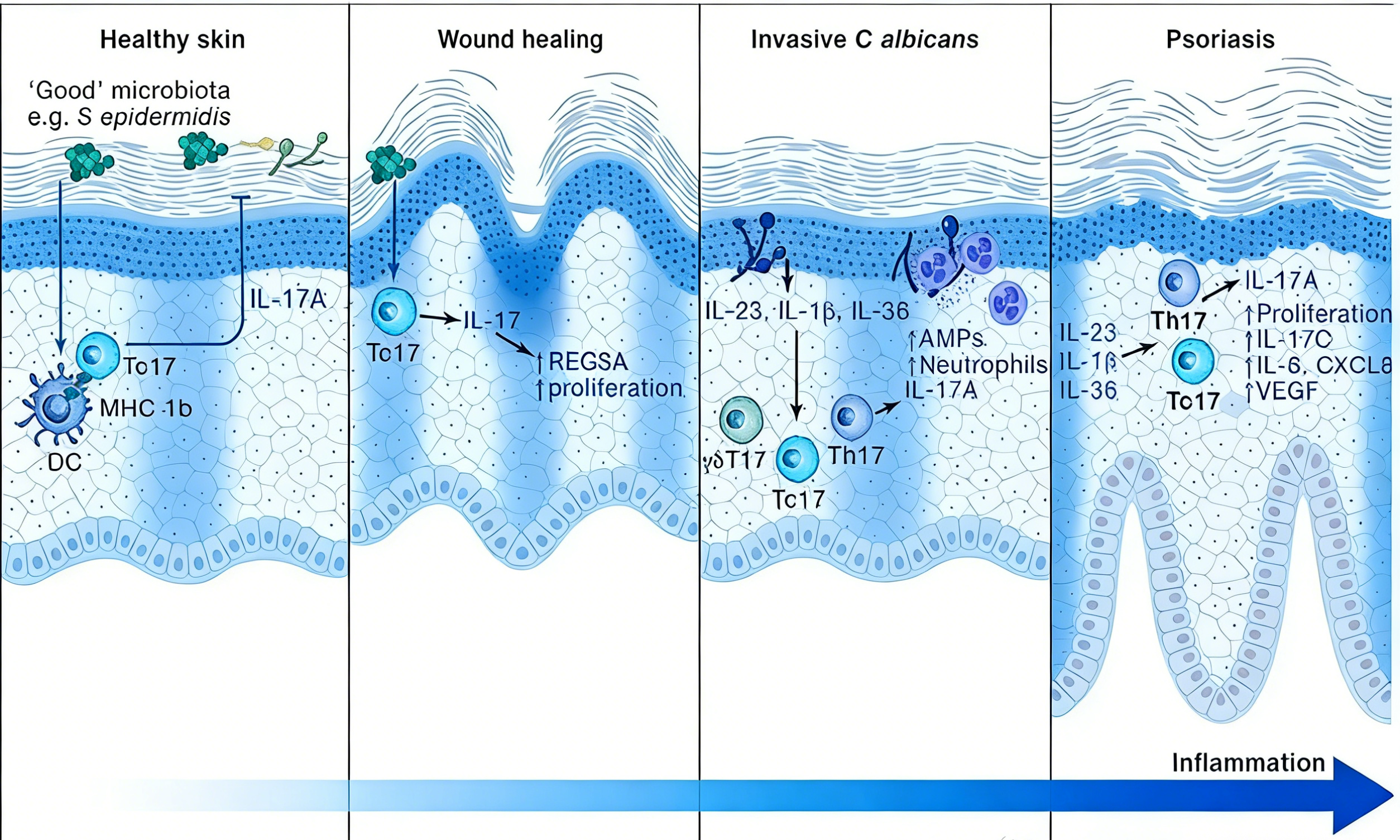
III. Pathogenic Mechanisms of IL-17A Signaling Dysregulation in Diseases
When IL-17A signaling is inappropriately prolonged or overactivated, its potent pro-inflammatory potential transforms into a pathogenic driver, contributing to the development of various chronic inflammatory and autoimmune diseases:
1. Autoimmune Inflammatory Diseases:
• Psoriasis and Psoriatic Arthritis: IL-17A is the central cytokine driving skin inflammation and joint pathology in psoriasis. Monoclonal antibodies targeting IL-17A/IL-17RA have become effective treatments.
• Ankylosing Spondylitis: IL-17A plays a pivotal role in the pathogenesis of this disease, and its inhibitors have shown significant efficacy.
• Multiple Sclerosis: In mouse models and patient studies, IL-17A promotes central nervous system inflammation and neurodegeneration.
2. Kidney Diseases: IL-17A participates in immune complex-mediated glomerulonephritis, such as lupus nephritis. However, in specific injury models, it may also exert antifibrotic protective effects by inducing matrix metalloproteinases, highlighting the complexity of its functions.
3. Neurological Disorders: Beyond multiple sclerosis, IL-17A has been implicated in poor recovery post-cerebral ischemia, seizure activity, and depression-like behaviors, suggesting its potential role in neuroinflammation and neuropsychiatric disorders.
IV. Applications of IL17A/IL17RA Assay Kits in Mechanistic Research and Targeted Therapy Development
Given the highly context-dependent dual roles of the IL-17A signaling pathway in health and disease, precise quantification and functional analysis are crucial. The IL17A/IL17RA Assay Kit provides a standardized research platform to advance both basic and translational research.
1. Pathway Activation and Signal Transduction Analysis:
• The kit detects key downstream signaling events following IL-17A stimulation, such as NF-κB activation, MAPK phosphorylation, or the activity of specific reporter genes (e.g., CXCL1 promoter-driven luciferase), enabling quantitative assessment of IL-17A signal strength. This is critical for comparing pathway responsiveness under different stimuli or genetic backgrounds.
2. Functional Assessment of Target Cell Responses:
• Chemokine/Cytokine Release: Using ELISA or multiplex immunoassays, the kit precisely measures the levels of effector molecules (e.g., CXCL8, IL-6, G-CSF) induced by IL-17A in keratinocytes, fibroblasts, or epithelial cells.
• Antimicrobial Peptide Expression Analysis: Quantitative PCR or specific protein detection methods evaluate IL-17A's regulation of antimicrobial peptides like β-defensins.
• Impact on Cell Function: In co-culture systems, the kit assesses the effects of IL-17A pretreatment on neutrophil chemotaxis or phagocytic function.
V. Which Vendors Provide IL17A/IL17RA Assay Kits?
Nanjing U-Protein's independently developed TR-FRET Human IL17A/IL17RA Binding Kit (Catalog No.: UA086014) is a high-performance detection platform based on advanced time-resolved fluorescence energy transfer (TR-FRET) technology, designed for accurately quantifying the binding activity between interleukin-17A (IL-17A) and its specific receptor IL-17RA. This kit is suitable for mechanistic studies in autoimmune diseases, chronic inflammation, cancer immunology, and drug development, as well as antibody/antagonist screening and affinity evaluation, offering a sensitive, rapid, and homogeneous in vitro detection solution.
| Core Advantages of the Product |
|---|
| High Sensitivity and Low Background Noise: Utilizing TR-FRET technology with time-resolved and dual-wavelength detection, the kit effectively minimizes sample autofluorescence and compound interference, achieving high signal-to-noise ratios—ideal for high-precision analysis of low-affinity binding. |
| Native Conformation and High-Affinity Binding: The kit provides rigorously validated high-purity, high-activity human IL-17A and IL-17RA proteins, both maintaining correct spatial conformations and full biological functionality to authentically simulate high-affinity ligand-receptor binding under physiological conditions. |
| Homogeneous Detection and Operational Convenience: Featuring a "mix-incubate-detect" homogeneous workflow without washing steps, the kit simplifies operations and is compatible with automated workstations, enabling high-throughput screening and significantly improving experimental efficiency. |
| Exceptional Stability and Batch Consistency: Advanced recombinant expression systems and stringent quality control ensure high purity, excellent long-term stability, and outstanding batch-to-batch consistency, providing reliable support for continuous long-term research. |
| Comprehensive Solutions and Expert Support: We offer detailed optimized protocols, standard curve examples, result interpretation guides, and professional technical support for diverse applications such as antibody/antagonist screening, affinity measurement, competitive binding assays, and signaling pathway studies. |
Nanjing U-Protein is dedicated to providing cutting-edge, high-quality core reagents and tools for immunology, inflammation research, and innovative drug development. For detailed technical specifications, validation data, or specific application inquiries regarding the TR-FRET Human IL17A/IL17RA Binding Kit (Catalog No.: UA086014), please feel free to contact us.
This article is reviewed and published by the technical expert team of UA
Disclaimer: This article partially utilizes artificial intelligence assistance in its creation. If any content involves copyright or intellectual property issues, please let us know and we promise to verify and remove it as soon as possible.
Purchase recombinant protein, choose 
UA protein focuses on providing various protein reagents, raw materials, and services required for drug research and development, cell therapy, gene therapy, and basic scientific research, including drug target proteins, immune checkpoint proteins, cytokines, tool enzymes, customized protein expression, and full-length transmembrane protein development. Nanjing Univ is committed to providing customers with high-quality products and professional services, and building a High-tech Biological Enterprise with International Competitiveness.







 Business license (three certificates in one)