

The IL-4/IL-4R Signaling Pathway: A Core Driver and Therapeutic Target in Allergic Inflammation


Interleukin-4 and its receptor are key molecules in regulating type 2 immune responses. IL-4R is a transmembrane protein belonging to the erythropoietin receptor superfamily, and the formation of its functional complex depends on binding to IL-4.
- Recent Advances
- Product Information
I. Biological Basis of the IL-4/IL-4R Pathway
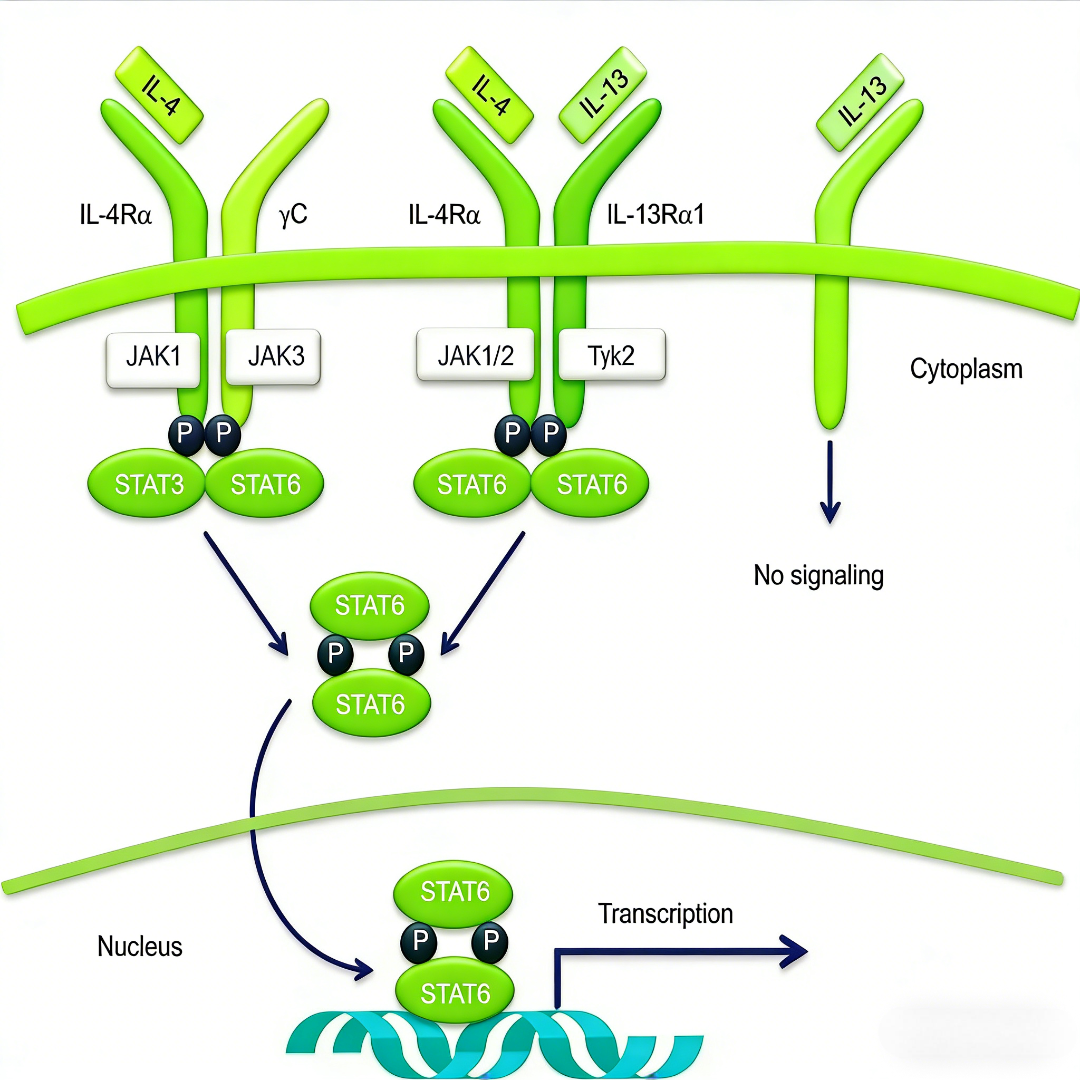
Interleukin-4 (IL-4) and its receptor are key molecules regulating type 2 immune responses. IL-4R is a transmembrane protein belonging to the erythropoietin receptor superfamily, whose functional complex formation depends on binding with IL-4. IL-4 primarily binds with high affinity to the IL-4 receptor α subunit, subsequently recruiting different co-subunits to form two types of functional receptors:
1. Type I Receptor: Composed of the IL-4Rα subunit and the common γc chain subunit, primarily expressed in hematopoietic cells such as T cells and B cells, mediating the core functions of IL-4 in the adaptive immune system.
2. Type II Receptor: Composed of the IL-4Rα subunit and the IL-13Rα1 subunit, expressed on various non-hematopoietic cells (e.g., epithelial cells, endothelial cells). This receptor serves as a common pathway for IL-4 and IL-13 signal transduction, mediating effects on tissue barrier cells.
In addition to membrane-bound receptors, natural soluble IL-4 receptors exist in bodily fluids. These receptors consist of the extracellular domain and act as "decoy" molecules that competitively bind IL-4, inhibiting its interaction with membrane receptors.
II. The Central Role of IL-4 Signaling in Allergic Inflammation
IL-4 is the initiating and core cytokine driving the cascade of allergic inflammatory reactions, with pathological effects spanning multiple stages of the immune response:
1. Initiating Th2 Immune Responses: IL-4 is the key instructional signal inducing naive CD4+ T cells to differentiate into Th2 effector cells. Activated Th2 cells further secrete effector factors such as IL-4, IL-5, and IL-13, establishing and maintaining a type 2 inflammatory environment.
2. Driving IgE Production in B Cells: IL-4 directly acts on B cells, inducing antibody class switching and the production of allergen-specific immunoglobulin E (IgE). Simultaneously, it upregulates the high-affinity IgE receptor on mast cells and basophils, laying the foundation for allergic reactions.
3. Recruiting and Activating Inflammatory Cells: IL-4 induces vascular endothelial cells to express adhesion molecules, promoting the migration and infiltration of inflammatory cells (e.g., eosinophils, basophils) into target tissues (e.g., airways, skin). Notably, IL-4 synergizes with IL-13 to inhibit eosinophil apoptosis, significantly prolonging their survival in inflammatory sites and exacerbating tissue damage.
III. Targeting the IL-4/IL-4R Pathway: Core Strategy for Treating Asthma and Atopic Dermatitis
Given the central role of IL-4 signaling in allergic inflammation, disrupting its function has become a core therapeutic strategy for Th2-mediated diseases such as asthma and atopic dermatitis. Key intervention approaches include:
1. Blocking IL-4Rα Signaling: Monoclonal antibodies targeting the IL-4Rα subunit are currently the most successful strategy. These drugs simultaneously block IL-4 and IL-13 signaling through Type I and Type II receptors, comprehensively inhibiting downstream inflammatory cascades. They have demonstrated significant efficacy in clinical trials for moderate-to-severe asthma and atopic dermatitis.
2. Utilizing Soluble Receptors: Recombinant soluble IL-4R serves as a natural IL-4 antagonist. Administered via nebulization or other localized methods, it competitively binds IL-4 in specific tissues (e.g., airways), neutralizing its activity and offering an alternative approach for localized intervention.
IV. IL4/IL4R Assay Kits: Standardized Platforms for Studying Pathological Mechanisms and Evaluating Targeted Therapies
To deeply analyze the complex regulatory mechanisms of the IL-4/IL-4R pathway and efficiently evaluate the effects of targeted drugs, standardized research tools are essential. The IL4/IL4R Research Assay Kit provides a comprehensive solution.
1. IL-4 Signaling Pathway Activity Detection:
• The kit can quantify IL-4 pathway activation by measuring STAT6 phosphorylation (a key downstream signaling molecule) or using a STAT6 reporter gene system, enabling precise comparisons of different stimuli or inhibitors.
2. Receptor Expression and Cell Typing Analysis:
• Using optimized flow cytometry protocols, the kit can simultaneously quantify surface expression of IL-4Rα, IL-13Rα1, and γc chains, clarifying the expression profiles of Type I and Type II receptors.
• Combined with cell-subset-specific markers (e.g., CD4, CD19), it can precisely analyze dynamic changes in IL-4R expression across immune cell subsets (e.g., Th2 cells, B cells, eosinophils).
3. Functional Effect Assessment:
• B Cell Function: Evaluates IL-4 effects on B cell proliferation, activation, and antibody class switching (particularly to IgE).
• Th2 Cell Differentiation: Quantifies Th2 differentiation by detecting expression of Th2-characteristic transcription factors (e.g., GATA3) and cytokines (e.g., IL-4) in naive CD4+ T cells under IL-4 induction.
V. Which Manufacturers Provide IL4/IL4R Assay Kits?
Nanjing U-Protein Biotechnology independently developed the TR-FRET Human IL4/IL4RA Binding Kit (Catalog No.: UA086012), a high-performance detection platform based on advanced time-resolved fluorescence energy transfer (TR-FRET) technology, designed for accurately quantifying the binding activity between interleukin-4 (IL-4) and its specific receptor IL-4RA. This kit is suitable for mechanistic studies, inhibitor screening, and affinity evaluation in fields such as allergic diseases, autoimmune disorders, type 2 immune responses, and antibody drug development, offering a sensitive, rapid, and homogeneous in vitro detection solution.
| Core Advantages of the Product |
|---|
| High Sensitivity and Low Background Noise: The TR-FRET detection technology employs time-resolved and dual-wavelength measurements, effectively reducing sample autofluorescence and compound interference, significantly improving signal-to-noise ratio, and enabling high-precision analysis of low-affinity interactions. |
| Native Conformation and High-Affinity Binding: The kit provides rigorously validated high-purity, high-activity human IL-4 and IL-4RA proteins, both maintaining correct spatial conformations and full biological functionality, authentically simulating high-affinity ligand-receptor interactions under physiological conditions. |
| Homogeneous Detection and User-Friendly Operation: The "mix-incubate-detect" homogeneous workflow eliminates washing steps, simplifying procedures and enabling automation compatibility for high-throughput screening, greatly enhancing experimental efficiency. |
| Exceptional Stability and Batch Consistency: Advanced recombinant expression systems and stringent quality control ensure high purity, excellent long-term stability, and outstanding batch-to-batch consistency, providing reliable support for continuous long-term research. |
| Comprehensive Solutions and Professional Support: We provide detailed optimized protocols, standard curve examples, result interpretation guides, and specialized technical support for various applications, including antibody/antagonist screening, affinity measurement, competitive binding assays, and signaling pathway studies. |
Nanjing U-Protein Biotechnology is dedicated to providing cutting-edge, high-quality core reagents and tools for immunology, allergy and autoimmune disease research, and innovative drug development. For detailed technical information, validation data, or specific application inquiries regarding the TR-FRET Human IL4/IL4RA Binding Kit (Catalog No.: UA086012), please feel free to contact us.
This article is reviewed and published by the technical expert team of UA
Disclaimer: This article partially utilizes artificial intelligence assistance in its creation. If any content involves copyright or intellectual property issues, please let us know and we promise to verify and remove it as soon as possible.
Purchase recombinant protein, choose 
UA protein focuses on providing various protein reagents, raw materials, and services required for drug research and development, cell therapy, gene therapy, and basic scientific research, including drug target proteins, immune checkpoint proteins, cytokines, tool enzymes, customized protein expression, and full-length transmembrane protein development. Nanjing Univ is committed to providing customers with high-quality products and professional services, and building a High-tech Biological Enterprise with International Competitiveness.







 Business license (three certificates in one)