

IL-3/IL-3R signaling pathway polymorphisms regulate leukemia stem cell fate: mechanisms and targeted research strategies


The refractoriness and high relapse rate of acute myeloid leukemia are largely attributed to a population of leukemia stem cells with self-renewal capacity.
- Recent Advances
- Product Information
I. The Core Role of IL-3/IL-3R Signaling Pathway in Acute Myeloid Leukemia
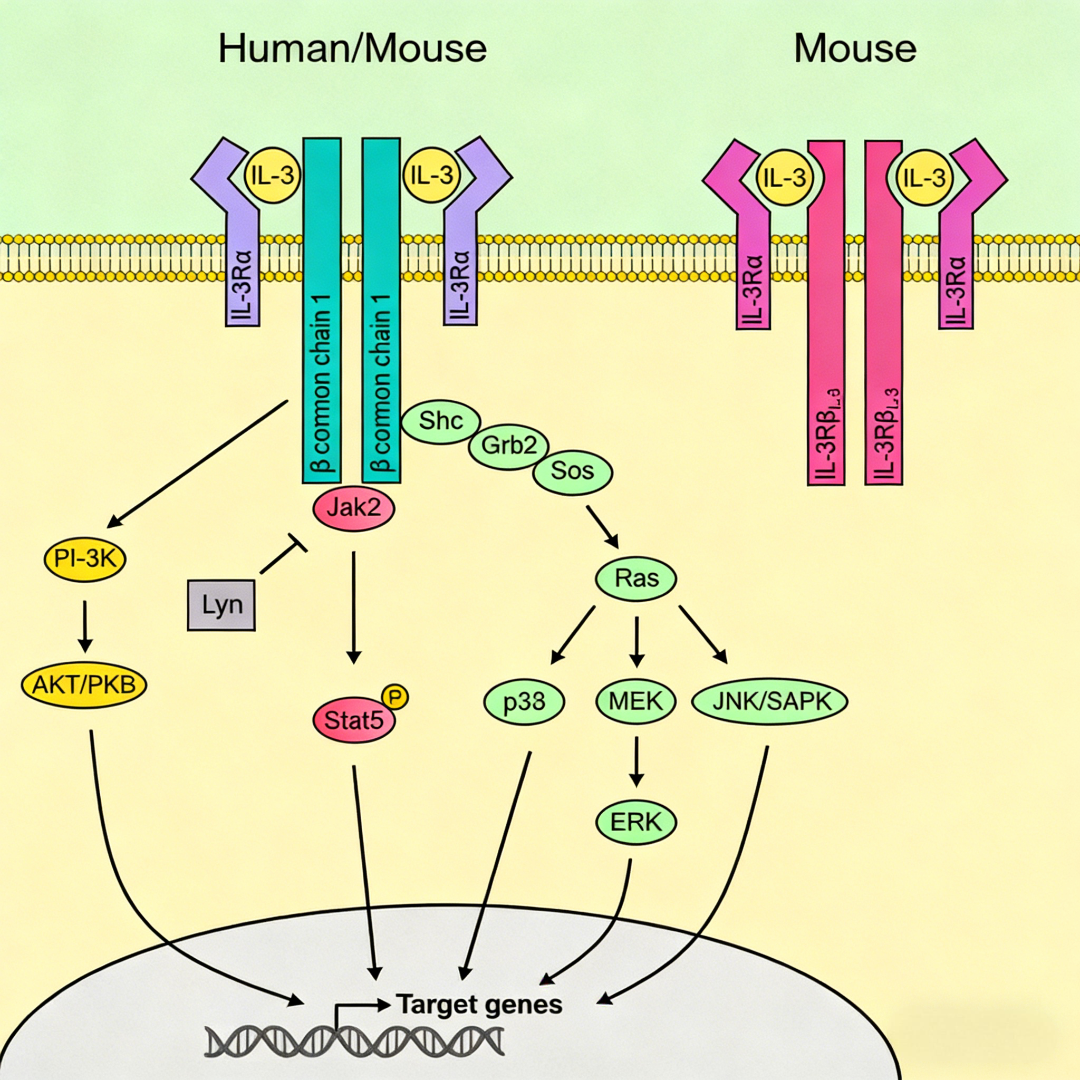
The refractoriness and high relapse rate of acute myeloid leukemia (AML) are largely attributed to a population of leukemia stem cells (LSCs) with self-renewal capacity. Studies indicate that the interleukin-3 (IL-3) and its receptor pathway play a pivotal role in regulating the stemness maintenance, survival, and differentiation of LSCs. The IL-3 receptor is a heterodimer lacking endogenous tyrosine kinase activity, composed of a specific α subunit and a common βc subunit. Upon ligand binding, it activates downstream signaling pathways such as JAK-STAT, PI3K-AKT, and MAPK.
Clinical data analysis reveals a significant phenomenon: in over 90% of AML patients, the expression of the IL-3Rα subunit on LSCs and myeloid cells is markedly upregulated. This high expression is closely associated with abnormal leukocyte counts, poor prognosis, and low remission rates. However, there is notable heterogeneity among patients, raising a thought-provoking question: How does the overexpression of a single receptor subunit finely regulate the截然不同的细胞命运 (stemness maintenance or differentiation) of LSCs?
II. IL-3R Subunit Ratio Determines Receptor Polymorphism and Functional Differences
Recent studies have uncovered the core mechanism of this regulatory process: the relative expression ratio of IL-3R's α and βc subunits on the cell surface directly determines the receptor's higher-order assembly forms, thereby encoding distinct biological instructions.
1. Receptor Polymorphism: Hexamers and Dodecamers: Structural biology studies show that IL-3, IL-3Rα, and βc subunits can assemble into two different higher-order complexes. When the subunit ratio is balanced, they tend to form dodecamers composed of two hexamers in a "head-to-head" configuration. In contrast, when IL-3Rα is overexpressed relative to the βc subunit (high α/βc ratio), hexamers predominantly form.
2. Functional Output Determines Cell Fate:
- High α/βc Ratio and Hexamers: Drive stem-like programs, promoting LSC self-renewal, cell cycle arrest in the G0 phase, and enhanced survival, directly correlating with poorer patient survival rates.
- Low α/βc Ratio and Dodecamers: Direct differentiation programs, inducing leukemia cells to differentiate toward monocytic/granulocytic lineages.
III. IL-3/IL-3R Pathway as an Emerging Therapeutic Target for AML
These findings not only elucidate the intricate molecular logic of IL-3 signaling in regulating LSC fate but also provide new insights for AML treatment. Targeting IL-3R, especially the LSC population with high IL-3Rα expression, or modulating receptor subunit ratios to drive differentiation, may become effective strategies to overcome drug resistance and prevent relapse. Understanding the relationship between receptor polymorphism and functional output lays a theoretical foundation for designing therapeutic antibodies or small molecules that specifically influence particular receptor assembly forms.
IV. IL3/IL3R Research Kit: A Core Tool for Analyzing Receptor Polymorphism and Function
In-depth study of the complex regulation of the IL-3/IL-3R pathway, particularly the precise quantification of receptor subunit expression, analysis of assembly polymorphism, and evaluation of downstream signaling and functional output, relies on standardized research methods. The IL3/IL3R Research Kit provides an integrated solution for this purpose.
| Functional Module | Technical Methods and Detection Targets |
|---|---|
| 1. Receptor Subunit Expression and Ratio Quantification | Optimized flow cytometry or cell surface immunofluorescence protocols enable simultaneous precise quantification of IL-3Rα and βc subunit expression levels on individual cells. Calculating their ratio is a key initial indicator for assessing their tendency to form higher-order complexes. |
| 2. Higher-Order Receptor Assembly State Analysis | Using fluorescence lifetime imaging-based fluorescence resonance energy transfer (FLIM-FRET) technology, the kit provides standardized protocols to probe interactions between βc subunits on live cell surfaces. This experiment directly distinguishes hexamer (no interaction between βc subunits) and dodecamer (tight interaction between βc subunits) formation, dynamically linking subunit ratios to actual receptor physical assembly states. |
| 3. Downstream Signaling Pathway Activation Detection | By measuring phosphorylation levels of key signaling molecules (e.g., STAT5, AKT, ERK) after IL-3 stimulation, the kit quantitatively evaluates signal intensity and kinetic differences triggered by different receptor assembly states (e.g., simulated by mutant expression). |
| 4. Cell Fate and Functional Assessment | Stemness Program Analysis: Evaluates the impact of IL-3 signaling on LSC or leukemia cell stemness marker expression, cell cycle distribution (particularly G0 phase cell proportion), and in vitro long-term culture-initiating cell frequency. Differentiation Program Analysis: Assesses IL-3-induced myeloid differentiation by detecting changes in surface differentiation antigen expression (e.g., CD14, CD11b). Survival and Proliferation: Uses cell viability and proliferation assays to evaluate IL-3's survival support for cell populations with different receptor ratios. |
V. Which Manufacturers Provide IL3/IL3R Research Kits?
Nanjing U-Protein自主研发的 TR-FRET Human IL3/IL3R Binding Kit (Catalog No.: UA086011) is a high-performance detection platform based on advanced time-resolved fluorescence energy transfer (TR-FRET) technology, specifically designed for precise quantification of interleukin-3 (IL-3) binding activity to its specific receptor IL-3R. This kit is suitable for mechanistic studies in hematopoietic regulation, immune cell differentiation, inflammatory signaling pathways, and antibody drug development, offering sensitive, rapid, and homogeneous in vitro detection solutions.
| Core Product Advantages |
|---|
| High Sensitivity and Low Background Interference: Utilizing TR-FRET technology with time-resolved and dual-wavelength detection, it effectively reduces sample autofluorescence and compound interference, significantly improving signal-to-noise ratio for high-precision analysis of low-affinity binding. |
| Native Conformation Simulation and High-Affinity Binding: The kit provides rigorously validated high-purity, high-activity human IL-3 and IL-3R proteins, both maintaining correct spatial conformation and full biological function, accurately simulating high-affinity ligand-receptor interactions under physiological conditions. |
| Homogeneous Detection and Operational Convenience: Featuring a "mix-incubate-detect" homogeneous operation mode without washing steps, the protocol is simple and fast, compatible with automated workstations for high-throughput screening, greatly enhancing experimental efficiency. |
| Exceptional Stability and Batch Consistency: Advanced recombinant expression systems and stringent quality control processes ensure high purity, excellent long-term stability, and outstanding batch-to-batch consistency, providing reliable support for continuous long-term research. |
| Comprehensive Solutions and Professional Support: We provide detailed optimized protocols, standard curve examples, result interpretation guides, and professional technical support for various applications such as antibody/antagonist screening, affinity measurement, competitive binding assays, and signaling pathway studies. |
Nanjing U-Protein is committed to providing cutting-edge, high-quality core reagents and tools for immunology, hematology research, and innovative drug development. For detailed technical information, validation data, or specific application inquiries regarding the TR-FRET Human IL3/IL3R Binding Kit (Catalog No.: UA086011), please feel free to contact us.
This article is reviewed and published by the technical expert team of UA
Disclaimer: This article partially utilizes artificial intelligence assistance in its creation. If any content involves copyright or intellectual property issues, please let us know and we promise to verify and remove it as soon as possible.
Purchase recombinant protein, choose 
UA protein focuses on providing various protein reagents, raw materials, and services required for drug research and development, cell therapy, gene therapy, and basic scientific research, including drug target proteins, immune checkpoint proteins, cytokines, tool enzymes, customized protein expression, and full-length transmembrane protein development. Nanjing Univ is committed to providing customers with high-quality products and professional services, and building a High-tech Biological Enterprise with International Competitiveness.







 Business license (three certificates in one)