

IL-2/IL-2R Signaling Pathway: Dual Regulation of Immune Balance and Targeted Drug Development


Interleukin-2 is a cytokine that plays a central role in immune regulation. The realization of its biological effects depends on precise binding with the cell surface interleukin-2 receptor.
- Recent Advances
- Product Information
I. Structural and Functional Complexity of the IL-2/IL-2R Signaling Pathway
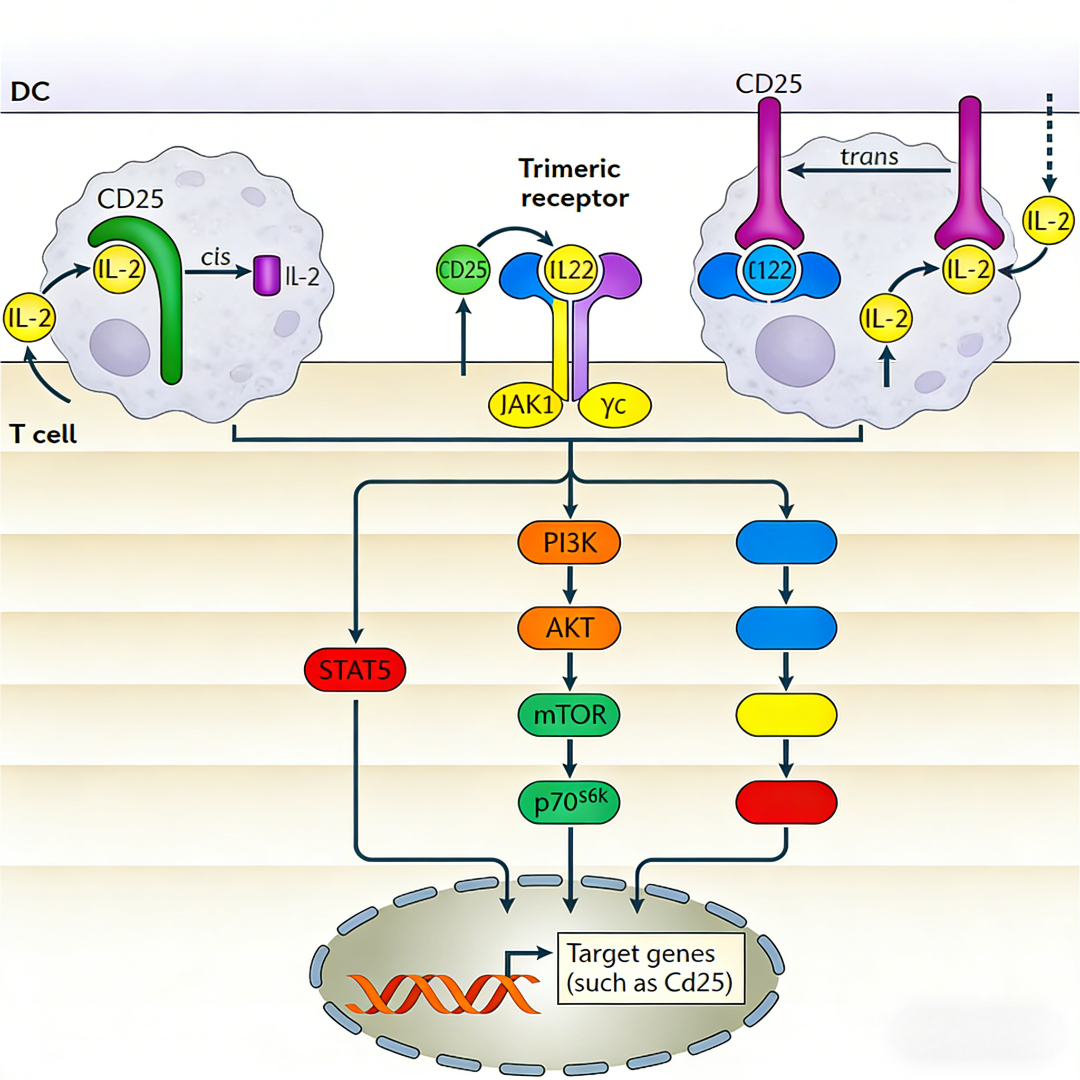
Interleukin-2 (IL-2) is a cytokine that plays a central role in immune regulation. Its biological effects depend on precise binding with cell surface interleukin-2 receptors. IL-2R consists of three subunits arranged in different combinations, resulting in highly diverse binding affinities and signal specificity:
1. High-affinity trimeric receptor: This complex comprises IL-2Rα, IL-2Rβ, and the common γ chain. IL-2 first binds to the highly expressed IL-2Rα subunit, then recruits IL-2Rβ and γc chains to form a stable signal transduction complex. This receptor is primarily expressed on activated T cells and regulatory T cells, exhibiting extremely high affinity for IL-2.
2. Intermediate-affinity dimeric receptor: Consisting of IL-2Rβ and γc chains, mainly expressed on natural killer cells and resting T cells. IL-2 can directly bind to this receptor but with lower affinity.
3. Cis and trans signaling: Beyond classical cis-binding activation, IL-2 can also be "trans-presented" by antigen-presenting cells like dendritic cells via surface IL-2Rα to adjacent T cells, forming an intercellular communication mode.
After binding to receptors, IL-2 primarily activates the JAK-STAT5 signaling pathway, regulating transcription of numerous target genes including Cd25 (IL-2Rα gene), profoundly influencing T cell proliferation, differentiation, and function.
II. Dual Roles of IL-2 in Immunotherapy and Development Challenges
The complexity of IL-2 signaling confers unique dual immunoregulatory functions, which constitute both the core contradiction and opportunity in clinical development:
1. Pro-effector function: At high concentrations, IL-2 strongly activates CD8+ T cells and natural killer cells via intermediate-affinity receptors, promoting their proliferation and cytotoxic functions, thereby driving potent antitumor immune responses.
2. Pro-tolerance function: At low concentrations, IL-2 preferentially activates high-affinity receptors, selectively stimulating and expanding regulatory T cells. This can be utilized to treat autoimmune diseases but may suppress antitumor immunity in the tumor microenvironment while causing severe systemic toxicity.
3. Major development challenges: Natural IL-2 has an extremely short half-life and faces difficulties in precise delivery to specific cell subsets. Current drug development strategies focus on protein engineering to modify IL-2 molecules or delivery methods, altering their affinity for different receptor subtypes to "bias" activation of desired immune cell populations (e.g., effector T cells or regulatory T cells) while avoiding off-target toxicity and rapid clearance.
III. Engineered IL-2 Strategies: Achieving Cell-Selective Activation
To overcome natural IL-2 limitations, researchers have developed various engineering strategies. Mutations altering IL-2's binding affinity for IL-2Rα are a key direction. For example, IL-2 variants with enhanced IL-2Rα binding can more specifically expand regulatory T cells, showing potential in preclinical models for treating autoimmune diseases. Such molecules' selectivity is typically validated by assessing their ability to activate STAT5 signaling in different T cell subsets (e.g., effector T cells vs. Tregs), ensuring specificity in target populations.
IV. IL2/IL2R Research Kits: Enabling Targeted Drug Screening and Evaluation
Developing safe and effective IL-2-targeted therapies requires precise assessment of candidate molecules' binding properties to different receptor complexes, signal activation capacity, and cellular selectivity. IL2/IL2R research kits provide a standardized in vitro research platform for key stages of drug discovery and optimization.
| Functional Module | Technical Methods and Detection Targets |
|---|---|
| 1. Receptor Binding Property Analysis | - The kit can employ surface plasmon resonance to quantitatively measure binding affinity and kinetic parameters between engineered IL-2 molecules and recombinant IL-2Rα, IL-2Rβ, and γc proteins, elucidating the molecular basis of affinity "bias". - Competitive binding assays evaluate candidates' ability to block natural IL-2 binding to different receptor complexes. |
| 2. Signal Pathway Activation Detection (Core Application) | - STAT5 Phosphorylation Detection: Using flow cytometry or immunoblotting to quantitatively measure STAT5 phosphorylation levels in specific cells (e.g., primary T cell subsets, reporter cell lines) after stimulation with IL-2 or variants. This is the gold standard for assessing IL-2 biological activity. - Reporter Gene Assay: Using cell lines stably transfected with STAT5-responsive element-driven luciferase reporters (e.g., Ba/F3-STAT5-Luc2) enables high-throughput, homogeneous activity screening. Luciferase signals allow rapid, sensitive comparison of different candidates' potency in activating IL-2 signaling pathways. |
V. Which Manufacturers Provide IL2/IL2R Research Kits?
Nanjing U-Protein's independently developed TR-FRET Human IL2/IL2R Binding Kit (Catalog No.: UA086010) is a high-performance detection platform based on advanced time-resolved fluorescence energy transfer (TR-FRET) technology, specifically designed for accurately quantifying binding activity between interleukin-2 (IL-2) and its specific receptor IL-2R. This kit is suitable for T cell immunoregulation, cancer immunotherapy, autoimmune diseases, and antibody drug development, providing sensitive, rapid, and homogeneous in vitro detection solutions for mechanism studies, inhibitor screening, and affinity evaluation.
| Core Product Advantages |
|---|
| High Sensitivity and Low Background Noise: Utilizing TR-FRET technology with time-resolved and dual-wavelength detection effectively reduces sample autofluorescence and compound interference, significantly improving signal-to-noise ratio for high-precision analysis of low-affinity binding. |
| Native Conformation Simulation and High-Affinity Binding: The kit provides rigorously validated high-purity, high-activity human IL-2 and IL-2R proteins, both maintaining correct spatial conformations and full biological functions to authentically simulate high-affinity ligand-receptor interactions under physiological conditions. |
| Homogeneous Detection and Operational Convenience: Featuring a "mix-incubate-detect" homogeneous operation mode without washing steps, the streamlined workflow is automation-compatible and supports high-throughput screening, greatly enhancing experimental efficiency. |
| Excellent Stability and Batch Consistency: Advanced recombinant expression systems and strict quality control processes ensure high purity, superior long-term stability, and exceptional batch-to-batch consistency, providing reliable support for continuous long-term research. |
| Comprehensive Solutions and Professional Support: We provide detailed optimized protocols, standard curve examples, result interpretation guides, and professional technical support for various applications including antibody/antagonist screening, affinity determination, competitive binding assays, and signaling pathway studies. |
Nanjing U-Protein remains committed to providing cutting-edge, high-quality core reagents and tools for immunology, cell therapy, and innovative drug development. For detailed technical documentation, validation data, or specific application inquiries regarding the TR-FRET Human IL2/IL2R Binding Kit (Catalog No.: UA086010), please feel free to contact us.
This article is reviewed and published by the technical expert team of UA
Disclaimer: This article partially utilizes artificial intelligence assistance in its creation. If any content involves copyright or intellectual property issues, please let us know and we promise to verify and remove it as soon as possible.
Purchase recombinant protein, choose 
UA protein focuses on providing various protein reagents, raw materials, and services required for drug research and development, cell therapy, gene therapy, and basic scientific research, including drug target proteins, immune checkpoint proteins, cytokines, tool enzymes, customized protein expression, and full-length transmembrane protein development. Nanjing Univ is committed to providing customers with high-quality products and professional services, and building a High-tech Biological Enterprise with International Competitiveness.







 Business license (three certificates in one)