

The role and mechanism of BRD4 signaling pathway in stress-induced osteoarthritis and targeted degradation therapy strategies


Temporomandibular joint osteoarthritis is a chronic disease characterized by degenerative changes in articular cartilage, subchondral bone resorption, and extracellular matrix damage, with excessive mechanical stress considered a key pathogenic factor in its development and progression.
- Recent Advances
- Product Information
I. Pathological Mechanisms and Research Background of Stress-Induced Temporomandibular Joint Osteoarthritis
Temporomandibular joint osteoarthritis (TMJ OA) is a chronic disease characterized by degenerative changes in articular cartilage, subchondral bone resorption, and extracellular matrix damage. Excessive mechanical stress is considered a key pathogenic factor in its development. In addition to these structural changes, recent studies have increasingly focused on the central role of inflammatory responses. However, how stress precisely regulates the inflammatory cascade within joint tissues and its epigenetic regulatory mechanisms remain incompletely understood.
In this context, bromodomain protein 4 (BRD4), as an important epigenetic "reader," has attracted significant attention due to its central role in recognizing histone acetylation modifications and regulating the transcription of inflammation-related genes. Previous studies have confirmed that BRD4 is involved in regulating various inflammatory diseases and osteoclast differentiation processes. Therefore, investigating whether BRD4 mediates mechanical stress-induced joint inflammation and tissue destruction has become a key scientific question in understanding the pathogenesis of TMJ OA and identifying new therapeutic approaches.
II. Protective Effects of BRD4 Inhibitors in Stress-Induced TMJ OA
To test this hypothesis, the research team employed comprehensive in vivo and in vitro models. In vivo experiments involved applying excessive mechanical compression load to the rat temporomandibular joint to simulate pathological conditions, while locally administering the classic BRD4 small-molecule inhibitor JQ1 as an intervention.
1. Improvement of Joint Structural Damage: The results showed that excessive stress significantly caused thinning of articular cartilage, reduced chondrocyte numbers, and abnormal subchondral bone resorption. JQ1 treatment effectively alleviated these structural damages, maintained cartilage thickness, increased chondrocyte numbers, and improved bone microstructural parameters, demonstrating the protective role of BRD4 inhibition on joint tissues.
2. Suppression of Inflammatory Responses: At the molecular level, excessive stress significantly upregulated the expression of key pro-inflammatory factors such as tumor necrosis factor-α (TNF-α), interleukin-1β (IL-1β), and interleukin-6 (IL-6) in articular cartilage. JQ1 treatment effectively inhibited the production of these inflammatory factors. In vitro experiments further confirmed that in IL-1β-stimulated chondrocytes, both JQ1 and BRD4 knockdown using specific small interfering RNA (siRNA) suppressed the expression of pro-inflammatory genes.
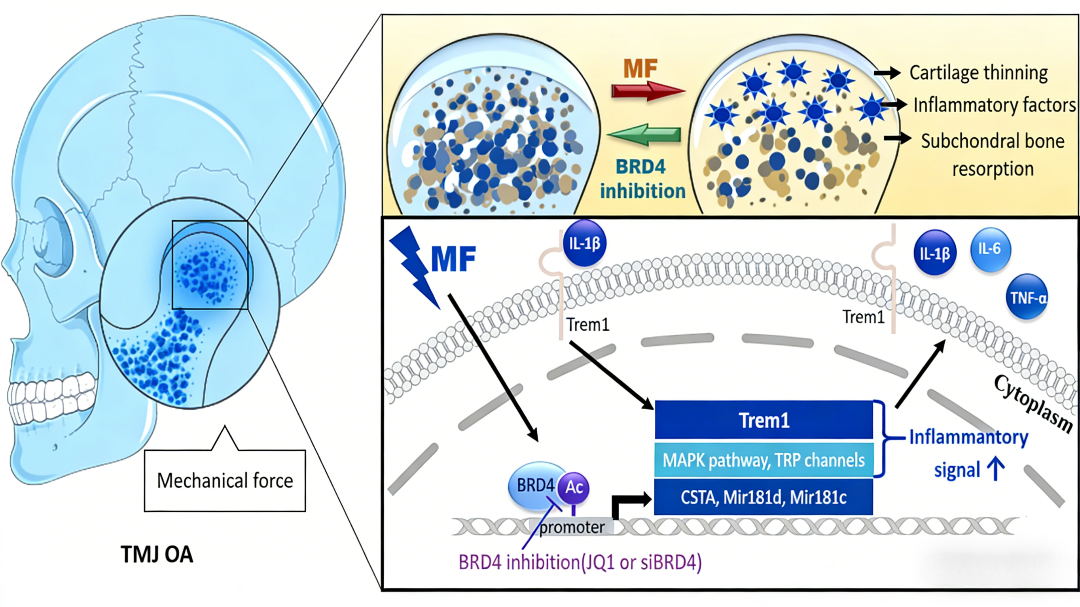
III. Molecular Mechanism Exploration: BRD4 Drives Inflammation via Epigenetic Regulation of TREM1
To elucidate the downstream targets of BRD4 in regulating inflammation, researchers used chromatin immunoprecipitation sequencing (ChIP-seq) to analyze changes in BRD4 and its recognized histone mark H3K27ac binding across the genome in articular chondrocytes under mechanical stress.
The analysis revealed that after stress stimulation, multiple gene promoter regions exhibited significant increases in BRD4 and H3K27ac binding. Among these, the triggering receptor expressed on myeloid cells-1 (TREM1) gene stood out. TREM1 is a recently discovered inflammatory receptor expressed on myeloid cell surfaces and plays an important role in innate immunity. ChIP-seq data clearly showed that mechanical stress enhanced BRD4 binding to the TREM1 gene promoter region.
Further mechanistic validation experiments demonstrated that both JQ1 and siRNA-mediated BRD4 knockdown effectively suppressed stress- or IL-1β-induced TREM1 upregulation in vivo and in vitro. More importantly, when TREM1 was knocked down using siRNA, the production of IL-1β, TNF-α, and IL-6 induced by IL-1β was also significantly inhibited. This revealed a clear signaling axis: excessive mechanical stress enhances BRD4-mediated epigenetic regulation at the TREM1 gene promoter, promoting TREM1 expression; TREM1 activation further amplifies downstream inflammatory cascades, ultimately leading to inflammatory damage and destruction of joint tissues.
IV. BRD4 as a Therapeutic Target and the Advantages of PROTAC Technology
This study not only reveals the central role of the BRD4-TREM1 axis in stress-induced joint disease but also highlights BRD4 as a potential therapeutic target. However, traditional small-molecule inhibitors may face challenges such as off-target effects, drug resistance, and the need for continuous dosing to maintain inhibitory effects.
Proteolysis-targeting chimera (PROTAC) technology offers a more promising strategy for targeting BRD4. PROTAC molecules simultaneously recruit the target protein and an E3 ubiquitin ligase, inducing ubiquitination and proteasomal degradation of the target protein. Unlike inhibitors that merely block function, PROTACs can completely eliminate the target protein, potentially offering more potent and durable efficacy while overcoming certain resistance mechanisms.
V. Which Vendors Provide BRD4/CRBN PROTAC Kits?
Nanjing U-Protein independently developed the TR-FRET Human BRD4/CRBN PROTAC Binding Kit (Catalog No.: UA086009), a high-performance detection platform based on advanced time-resolved fluorescence energy transfer (TR-FRET) technology, specifically designed for accurately detecting and quantifying the ternary complex formed by PROTAC-mediated BRD4 and CRBN E3 ubiquitin ligase. This kit is suitable for mechanistic analysis, molecular screening, and affinity evaluation in epigenetic target research, cancer therapy, and PROTAC drug development, providing a sensitive, rapid, and homogeneous in vitro detection solution.
| Core Product Advantages |
|---|
| High Sensitivity and Low Background Noise: Utilizing TR-FRET detection technology, the kit employs time-resolved and dual-wavelength detection to effectively reduce sample autofluorescence and compound interference, significantly improving the signal-to-noise ratio, particularly for high-precision analysis of ternary complex formation. |
| Physiological Ternary Complex Conformation Simulation: The kit provides rigorously validated high-purity, high-activity human BRD4 protein and CRBN complex, both maintaining correct spatial conformations and full biological functionality, accurately simulating PROTAC-induced target protein-E3 ligase ternary complex assembly. |
| Homogeneous Detection and Operational Convenience: Featuring a "mix-incubate-detect" homogeneous workflow, the kit eliminates washing steps, simplifies procedures, and is compatible with automated workstations, enabling high-throughput screening and significantly improving experimental efficiency. |
| Exceptional Stability and Batch Consistency: Through advanced recombinant expression systems and stringent quality control processes, the protein products exhibit high purity, excellent long-term stability, and outstanding batch-to-batch consistency, providing reliable support for continuous drug screening and mechanistic research. |
| Comprehensive Solutions and Professional Support: We provide detailed optimized protocols, standard curve examples, and result interpretation guides, along with professional technical support for various applications such as PROTAC molecule screening, linker optimization, and degradation activity correlation analysis. |
Nanjing U-Protein is committed to providing cutting-edge, high-quality core reagents and tools for targeted protein degradation, epigenetics, and innovative drug development. For detailed technical information, validation data, or specific application inquiries regarding the TR-FRET Human BRD4/CRBN PROTAC Binding Kit (Catalog No.: UA086009), please feel free to contact us.
This article is reviewed and published by the technical expert team of UA
Disclaimer: This article partially utilizes artificial intelligence assistance in its creation. If any content involves copyright or intellectual property issues, please let us know and we promise to verify and remove it as soon as possible.
Purchase recombinant protein, choose 
UA protein focuses on providing various protein reagents, raw materials, and services required for drug research and development, cell therapy, gene therapy, and basic scientific research, including drug target proteins, immune checkpoint proteins, cytokines, tool enzymes, customized protein expression, and full-length transmembrane protein development. Nanjing Univ is committed to providing customers with high-quality products and professional services, and building a High-tech Biological Enterprise with International Competitiveness.







 Business license (three certificates in one)