

TNF-α/TNFR2 Signaling Pathway: The Dual Role in Inflammation Regulation and Precision Research Strategies


Tumor necrosis factor-α (TNF-α) is a pivotal hub molecule in the innate and adaptive immune responses, primarily produced by activated immune cells such as macrophages and T lymphocytes.
- Recent Advances
- Product Information
I. TNF-α: The Core Regulatory Factor in Inflammatory Responses
Tumor necrosis factor-alpha (TNF-α) is a pivotal hub molecule in both innate and adaptive immune responses, primarily produced by activated immune cells such as macrophages and T lymphocytes. As an early initiator signal in inflammatory cascades, TNF-α plays an indispensable role in defending against pathogen invasion and tissue damage repair. However, its functions exhibit typical concentration- and time-dependence: moderate TNF-α release is essential for effective host defense and homeostasis maintenance, while persistent or excessive TNF-α production becomes the core pathological mediator driving various autoimmune diseases, chronic inflammation, and tissue destruction. Therefore, precise regulation of TNF-α signaling is crucial for maintaining immune balance.
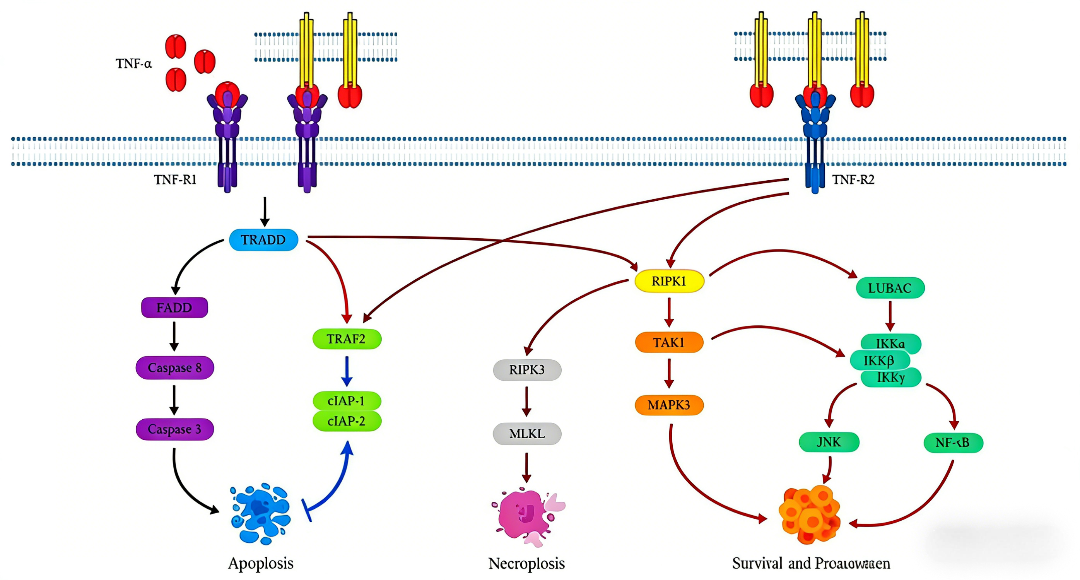
II. Biological Functions and Complex Effects of TNF-α
TNF-α mediates a wide range of biological effects through its receptors, influencing multiple aspects of inflammatory processes:
1. Initiating and Amplifying Inflammatory Responses:
- TNF-α can rapidly activate vascular endothelial cells, induce adhesion molecule expression, and increase vascular permeability, thereby promoting leukocyte (e.g., neutrophils, monocytes) recruitment to inflammatory sites—a hallmark of acute inflammation.
- It significantly induces the production of other key pro-inflammatory cytokines (e.g., IL-1β, IL-6) and chemokines, synergistically amplifying inflammatory signals, which in extreme cases may contribute to pathological "cytokine storms."
2. Regulating Immune Cell Functions:
- TNF-α promotes the activation and proliferation of T and B lymphocytes, enhancing antigen-specific immune responses.
- It activates innate immune cells such as natural killer cells and dendritic cells, improving their pathogen clearance and antigen presentation capabilities, which are critical in anti-infection immunity.
3. Dual Effects in Tissue Damage and Repair:
- Damaging Effects: At high concentrations or under sustained stimulation, TNF-α can directly cause tissue damage by inducing apoptosis, necrosis, or promoting matrix metalloproteinase production. This is prominently observed in joint destruction in rheumatoid arthritis and intestinal mucosal barrier damage in inflammatory bowel disease.
- Reparative Effects: At low concentrations or in specific microenvironments, TNF-α participates in tissue repair and wound healing by stimulating fibroblast proliferation, collagen deposition, and angiogenesis, reflecting its pleiotropic complexity.
III. Differential Signal Transduction by TNF Receptor Subtypes
The diverse biological effects of TNF-α largely stem from its mediation through two distinct membrane receptors—TNF receptor 1 (TNFR1) and TNF receptor 2 (TNFR2)—which trigger differential downstream signaling.
- TNFR1: Widely expressed in most nucleated cells, primarily mediates pro-inflammatory and pro-apoptotic signals, often regarded as the main executor of the classical "inflammation and death" pathway.
- TNFR2: Its expression is more restricted, mainly found on immune cells (e.g., regulatory T cells, myeloid cells) and some endothelial cells. TNFR2 activation is typically associated with promoting cell survival, proliferation, tissue repair, and immunoregulatory functions. For example, on regulatory T cells, TNFR2 signaling is crucial for maintaining and expanding their suppressive functions. Thus, targeting TNFR2, particularly selectively agonizing TNFR2 to harness its anti-inflammatory and tissue-protective effects, has emerged as a novel strategy for treating autoimmune and inflammatory diseases.
IV. TNF-α/TNFR2 Research Kits: Key Tools for Deciphering Complex Signaling and Evaluating Targeting Strategies
Given the central role of TNF-α/TNFR2 signaling in inflammatory balance and its potential as a therapeutic target, precise molecular and functional analysis is essential. Dedicated TNF-α/TNFR2 research kits provide a standardized research solution for this purpose.
| Functional Module | Technical Methods and Detection Targets |
|---|---|
| 1. TNFR2 Expression and Activation Analysis | - Through optimized flow cytometry protocols, the kit can accurately detect TNFR2 expression levels and dynamic changes on specific cell subsets (e.g., Tregs, macrophages). - By measuring downstream signaling events (e.g., NF-κB activation [non-canonical pathway] or specific phosphorylation events) after TNF-α stimulation, the kit quantitatively assesses TNFR2 pathway activity. |
| 2. Ligand-Receptor Interaction Studies | Using enzyme-linked immunosorbent assays or surface plasmon resonance, the kit quantifies the binding affinity and kinetics between TNF-α (or its engineered variants) and recombinant TNFR2 protein, aiding in screening or evaluating TNFR2-targeting agonists/antagonists. |
| 3. Functional Effect Evaluation | - Immunomodulatory Functions: In co-culture systems, assess the impact of TNFR2 signaling on regulatory T cell suppressive functions or macrophage polarization toward anti-inflammatory (M2) phenotypes. - Cell Survival and Proliferation: Detect the effects of TNF-α via TNFR2 on the survival rate, anti-apoptotic capacity, and proliferation of specific target cells (e.g., endothelial cells, certain T cell subsets). - Inflammatory Cytokine Profile Analysis: Evaluate the regulatory effects of TNFR2 signaling activation or inhibition on TNF-α itself and other downstream pro-/anti-inflammatory cytokines. |
V. Which Manufacturers Provide TNF-α/TNFR2 Research Kits?
Nanjing UniProtein independently developed the TR-FRET Human TNF-α/TNFR2 Binding Kit (Catalog No.: UA086008), a high-performance detection platform based on advanced time-resolved fluorescence energy transfer (TR-FRET) technology, specifically designed for accurately quantifying the binding activity between tumor necrosis factor-alpha (TNF-α) and its specific receptor TNFR2. This kit is suitable for mechanistic studies, inhibitor screening, and affinity evaluation in fields such as inflammatory diseases, autoimmune disorders, tumor immunology, and antibody drug development, offering a sensitive, rapid, and homogeneous in vitro detection solution.
| Core Product Advantages |
|---|
| High Sensitivity and Low Background Noise: Utilizing TR-FRET technology with time-resolved and dual-wavelength detection, the kit effectively reduces sample autofluorescence and compound interference, significantly improving the signal-to-noise ratio, making it ideal for high-precision analysis of low-affinity binding. |
| Native Conformation Simulation and High-Affinity Binding: The kit provides rigorously validated high-purity, high-activity human TNF-α and TNFR2 proteins, both maintaining correct spatial conformations and full biological functions, faithfully simulating high-affinity ligand-receptor interactions under physiological conditions. |
| Homogeneous Detection and User-Friendly Operation: Featuring a "mix-incubate-detect" homogeneous workflow without washing steps, the kit simplifies operations, is compatible with automated workstations, and supports high-throughput screening, greatly enhancing experimental efficiency. |
| Exceptional Stability and Batch Consistency: Through advanced recombinant expression systems and stringent quality control processes, the protein products exhibit high purity, excellent long-term stability, and outstanding batch-to-batch consistency, ensuring reliable support for continuous long-term research. |
| Comprehensive Solutions and Professional Support: We provide detailed optimized protocols, standard curve examples, result interpretation guides, and professional technical support for various applications, including antibody/antagonist screening, affinity determination, competitive binding assays, and signaling pathway studies. |
Nanjing UniProtein is committed to providing cutting-edge, high-quality core reagents and tools for immunology, inflammation research, and innovative drug development. For detailed technical information, validation data, or specific application inquiries regarding the TR-FRET Human TNF-α/TNFR2 Binding Kit (Catalog No.: UA086008), please feel free to contact us.
This article is reviewed and published by the technical expert team of UA
Disclaimer: This article partially utilizes artificial intelligence assistance in its creation. If any content involves copyright or intellectual property issues, please let us know and we promise to verify and remove it as soon as possible.
Purchase recombinant protein, choose 
UA protein focuses on providing various protein reagents, raw materials, and services required for drug research and development, cell therapy, gene therapy, and basic scientific research, including drug target proteins, immune checkpoint proteins, cytokines, tool enzymes, customized protein expression, and full-length transmembrane protein development. Nanjing Univ is committed to providing customers with high-quality products and professional services, and building a High-tech Biological Enterprise with International Competitiveness.







 Business license (three certificates in one)