
IRAK4在先天免疫信号通路中的核心作用与靶向治疗策略


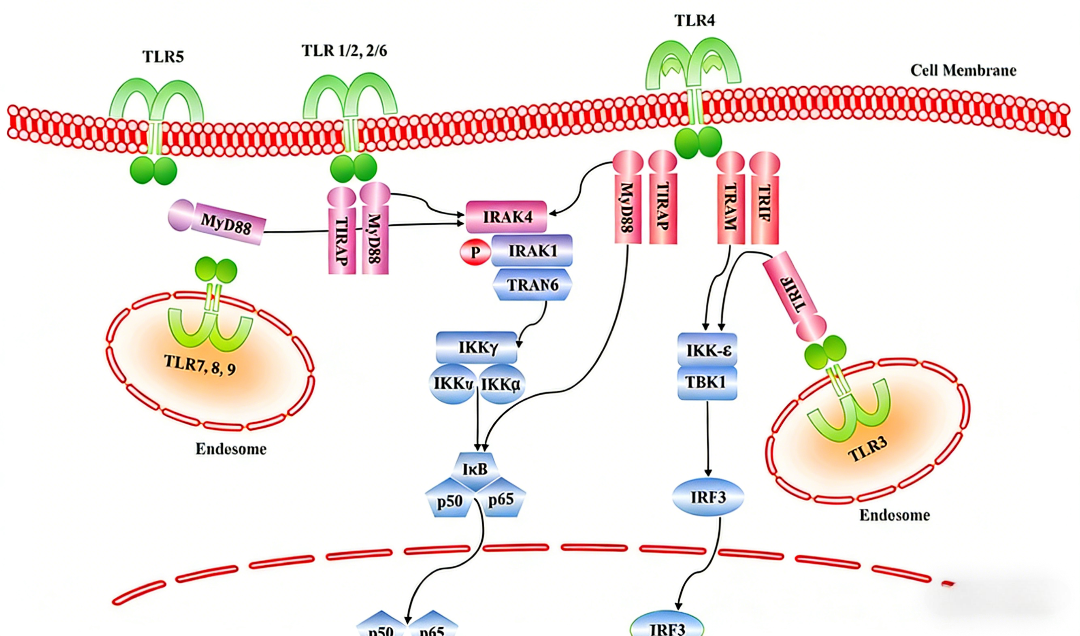
白细胞介素-1受体相关激酶(IRAK)家族是Toll样受体(TLR)和白细胞介素-1受体(IL-1R)介导的先天免疫信号通路中的关键调节因子。
- Recent Advances
- Product Information
I. Structure and Function of the IRAK Family
Interleukin-1 receptor-associated kinases (IRAKs) are key regulators in the innate immune signaling pathways mediated by Toll-like receptors (TLRs) and interleukin-1 receptors (IL-1Rs). The family consists of four members: IRAK-1, IRAK-2, IRAK-4, and IRAK-M. Structurally, they all possess a serine/threonine kinase domain and a conserved death domain, which interacts with the adaptor protein MyD88, determining their functional direction in signal transduction.
In the MyD88-dependent signaling pathway, IRAK-4 plays a crucial positive regulatory role. Upon ligand recognition and binding by TLR/IL-1R, MyD88 is recruited to the receptor complex and further recruits IRAK-4 via its death domain. Subsequently, IRAK-4 activates its kinase activity through autophosphorylation, phosphorylating and activating downstream substrates such as IRAK-1. Activated IRAK-1 forms a complex with TRAF6, triggering a cascade of reactions that ultimately lead to the activation of transcription factors like nuclear factor-κB (NF-κB) and activator protein-1 (AP-1), driving the expression of genes encoding pro-inflammatory cytokines, chemokines, and other immune mediators.
Beyond classical inflammatory signaling, studies have revealed that IRAK-4 is involved in regulating other cellular processes, such as the p38 mitogen-activated protein kinase (MAPK) signaling pathway and reactive oxygen species production, indicating its broad functionality as a hub in intracellular signaling networks.
II. Drug Development Directions Targeting IRAK4
Given the central role of IRAK-4 in inflammation and tumorigenesis, it has become an important target for drug development. Current strategies primarily focus on developing small-molecule compounds that efficiently inhibit IRAK-4 function, categorized as follows:
1. Small-Molecule Kinase Inhibitors: These include single-target inhibitors specific to IRAK-4 and multi-target inhibitors that simultaneously act on IRAK-4 and other related kinases. These drugs aim to block IRAK-4's kinase activity and its downstream signaling.
2. Proteolysis-Targeting Chimera (PROTAC) Technology: Compared to traditional inhibitors, the development of IRAK-4 degraders using PROTAC technology represents an emerging and highly promising strategy. This technology employs bifunctional molecules to bring the target protein (e.g., IRAK-4) into proximity with an E3 ubiquitin ligase (e.g., CRL4CRBN, whose core components are the DDB1-CRBN complex), inducing ubiquitination and subsequent proteasomal degradation of the target protein. This approach offers a novel solution to potential resistance issues associated with traditional inhibitors.
III. Application Value of the DDB1-CRBN & IRAK4 PROTAC Kit
Focusing on PROTAC technology, the DDB1-CRBN & IRAK4 PROTAC Kit is a powerful tool for studying IRAK-4 protein function and validating degradation strategies. The kit's core lies in the use of CRBN E3 ligase ligands to specifically design PROTAC molecules that simultaneously bind IRAK-4 and CRBN.
- Mechanism of Action: One end of the PROTAC molecule binds to IRAK-4, while the other end binds to the CRBN component of the DDB1-CRBN E3 ubiquitin ligase complex, forming a ternary complex. This prompts the E3 ligase to ubiquitinate IRAK-4, leading to its recognition and degradation by the cellular proteasome system.
- Research Advantages: Compared to traditional small-molecule inhibitors, IRAK-4 degradation induced by this kit offers the potential for more thorough and sustained effects, effectively interrupting the entire signaling axis it mediates. This provides a precise research tool for in-depth exploration of IRAK-4's role in TLR/IL-1R signaling pathways, downstream inflammatory cytokine production, and related cellular phenotypes (e.g., tumor cell proliferation and survival).
- Development Significance: The successful application of such tools not only validates IRAK-4 as a therapeutic target but also provides critical preclinical data and conceptual support for developing next-generation anti-inflammatory or anti-tumor candidates based on protein degradation strategies.
In summary, IRAK-4 is a core molecule linking innate immune recognition and inflammatory responses. Developing inhibitors and PROTAC degraders targeting IRAK-4 is an important research direction. Among these, PROTAC technology based on the DDB1-CRBN E3 ligase offers an innovative protein-level intervention tool with broad translational medicine prospects.
IV. Which Manufacturers Provide the DDB1-CRBN & IRAK4 PROTAC Kit?
Nanjing UniProtein independently developed the TR-FRET Human DDB1-CRBN & IRAK4 PROTAC Binding KIT (Catalog No.: UA086005), a high-performance detection platform based on advanced time-resolved fluorescence resonance energy transfer (TR-FRET) technology. It is specifically designed for the precise quantification of ternary complex formation between the CRBN E3 ubiquitin ligase complex (DDB1-CRBN) and the substrate protein IRAK4 mediated by PROTAC molecules. This kit is suitable for targeted protein degradation research, molecular screening, and mechanism analysis in fields such as innate immune signaling regulation, inflammatory diseases, and cancer therapy, offering a sensitive, rapid, and homogeneous in vitro detection solution.
| Core Advantages of the Product |
|---|
| High Sensitivity and Low Background Noise: Utilizing TR-FRET detection technology, the kit employs time-resolved and dual-wavelength detection to effectively reduce sample autofluorescence and compound interference, significantly improving the signal-to-noise ratio, particularly for high-precision analysis of ternary complex formation. |
| Simulation of Physiological Ternary Complex Conformation: The kit provides rigorously validated high-purity, high-activity human DDB1-CRBN complex and IRAK4 protein, both maintaining correct spatial conformations and full biological functionality, accurately simulating the assembly process of PROTAC-induced E3 ligase-substrate protein ternary complexes. |
| Homogeneous Detection and User-Friendly Operation: The "mix-incubate-detect" homogeneous operation mode eliminates washing steps, simplifying the workflow and making it compatible with automated workstations for high-throughput screening, greatly enhancing experimental efficiency. |
| Exceptional Stability and Batch Consistency: Advanced recombinant expression systems and stringent quality control processes ensure high purity, excellent long-term stability, and outstanding batch-to-batch consistency, providing reliable support for long-term drug screening and mechanistic studies. |
| Comprehensive Solutions and Professional Support: We provide detailed and optimized experimental protocols, standard curve examples, and result interpretation guidelines, along with professional technical support for various applications such as PROTAC molecule screening, linker optimization, and degradation activity correlation analysis. |
Nanjing UniProtein is committed to providing cutting-edge, high-quality core reagents and tools for innate immune regulation, targeted protein degradation, and innovative drug development. For detailed technical information, validation data, or specific application inquiries regarding the TR-FRET Human DDB1-CRBN & IRAK4 PROTAC Binding KIT (Catalog No.: UA086005), please feel free to contact us.
This article is reviewed and published by the technical expert team of UA
Disclaimer: This article partially utilizes artificial intelligence assistance in its creation. If any content involves copyright or intellectual property issues, please let us know and we promise to verify and remove it as soon as possible.
Purchase recombinant protein, choose 
UA protein focuses on providing various protein reagents, raw materials, and services required for drug research and development, cell therapy, gene therapy, and basic scientific research, including drug target proteins, immune checkpoint proteins, cytokines, tool enzymes, customized protein expression, and full-length transmembrane protein development. Nanjing Univ is committed to providing customers with high-quality products and professional services, and building a High-tech Biological Enterprise with International Competitiveness.







 Business license (three certificates in one)