Research Progress on GSPT1 Protein Degraders and the Application Value of DDB1-CRBN&GSPT1 PROTAC Reagent Kits


Targeted protein degradation (TPD) is a promising new direction in anticancer therapy, with molecular glues and PROTAC strategies demonstrating significant potential in inducing the degradation of disease-causing proteins.
- Recent Advances
- Product Information
Abstract
Targeted protein degradation (TPD) technology represents a significant new direction in anticancer therapy, with molecular glue and PROTAC strategies demonstrating immense potential in inducing the degradation of disease-causing proteins. GSPT1 (G1 to S phase transition 1), as a key factor in translation termination, is overexpressed in various malignancies and has become a hotspot in TPD research. Currently, multiple GSPT1 degraders based on the CRBN E3 ligase are under development, showing clinical promise in hematological tumors. The DDB1-CRBN&GSPT1 PROTAC Kit developed based on this provides a standardized and efficient in vitro evaluation system for related mechanism studies, drug screening, and molecular glue development, significantly advancing research and translation in this field.
I. Biological Functions of GSPT1 and Its Relevance to Tumors
GSPT1 is a core component of the eukaryotic translation termination complex, regulating the termination process of protein synthesis through its interaction with eRF1. This protein plays a critical role in cell cycle progression, proliferation regulation, and signal transduction. Studies have shown that GSPT1 is overexpressed in various malignancies such as acute myeloid leukemia, multiple myeloma, gastric cancer, and colorectal cancer. Its expression levels are significantly correlated with tumor progression, invasive capacity, and patient prognosis, making it an important target for anticancer drug development.
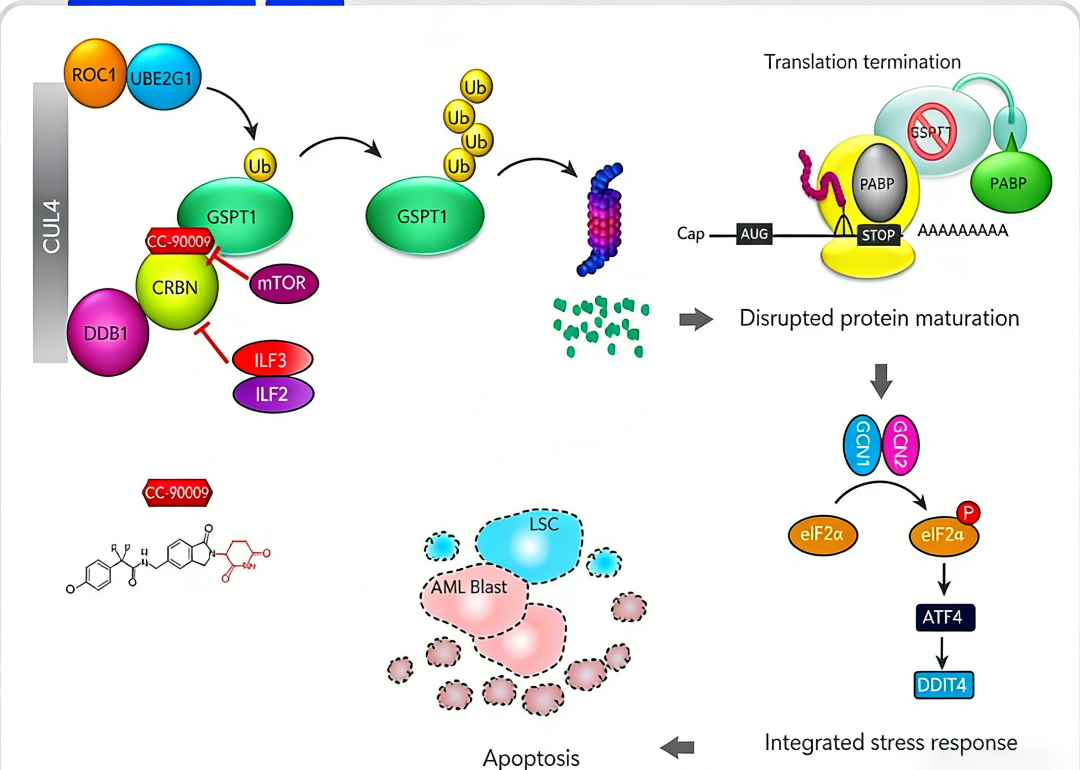
II. Current Development of CRBN-Based GSPT1 Degraders
Current drug development targeting GSPT1 primarily employs protein degradation strategies, particularly utilizing the CRL4CRBN E3 ubiquitin ligase system to induce its ubiquitination and proteasomal degradation. This strategy offers advantages over traditional inhibitors, such as targeting "undruggable" proteins and sustained effects. Several international pharmaceutical companies have entered this field, with early candidate molecules like CC-90009 demonstrating antitumor activity in preclinical and early clinical studies. However, subsequent development faces challenges such as selectivity, drug resistance, and limited efficacy in solid tumors.
III. Construction and Applications of the DDB1-CRBN&GSPT1 PROTAC Kit
1. Kit Components and Principles
The kit typically includes the following core components:
- Recombinant DDB1-CRBN E3 ligase complex
- GSPT1 target protein or its functional domains
- Positive control degraders (e.g., lenalidomide derivatives)
- Reaction buffer system and detection reagents
Its mechanism is based on the formation of a ternary complex mediated by PROTAC or molecular glue, mimicking the physiological process of CRBN recruiting and ubiquitinating GSPT1.
2. Main Applications
- Degradation Activity Assessment: Quantitative detection of the efficiency of candidate molecules in inducing GSPT1 ubiquitination and degradation.
- Structure-Activity Relationship Studies: Systematic analysis of the impact of structural modifications on degradation activity and selectivity to guide molecular optimization.
- Mechanism Validation: Verification of CRBN-dependent degradation pathways and competitive inhibition experiments.
- High-Throughput Screening: Supports large-scale compound library screening to accelerate lead compound discovery.
3. Technical Advantages
- Highly mimics the in vivo E3-substrate interaction environment, providing more physiologically relevant data.
- Standardized operation, compatible with multiple detection platforms, and excellent reproducibility.
- Can be combined with other omics technologies for in-depth analysis of degradation mechanisms and off-target effects.
IV. Challenges and Prospects in GSPT1 Degrader Development
Although GSPT1 degraders show promise in hematological tumors, several key challenges remain:
1. Limited Tissue Selectivity: GSPT1 has physiological functions in normal tissues, requiring improved selectivity for tumor cells.
2. Complex Resistance Mechanisms: Long-term treatment may lead to CRBN downregulation, mutations, or degradation pathway evasion.
3. Lack of Biomarkers: Urgent need to develop predictive biomarkers for patient stratification to achieve precision therapy.
4. Limited Efficacy in Solid Tumors: Strategies such as optimized delivery systems and combination therapies are needed to enhance penetration and efficacy in solid tumors.
V. Conclusion
GSPT1, as a key protein in translation regulation, has emerged as a new strategy for cancer treatment through degrader development. PROTAC and molecular glue strategies based on the CRBN E3 ligase have made significant progress in this field, but challenges such as selectivity and drug resistance remain. The DDB1-CRBN&GSPT1 PROTAC Kit, as a standardized in vitro research tool, plays a pivotal role in mechanism elucidation, drug screening, and molecular optimization, facilitating the development and clinical translation of next-generation GSPT1-targeted drugs.
VI. Which Manufacturers Provide the DDB1-CRBN&GSPT1 PROTAC Kit?
Nanjing U-APEX Biotech's independently developed TR-FRET Human DDB1-CRBN&GSPT1 PROTAC Binding KIT (Catalog No.: UA086006) is a high-performance detection platform based on advanced time-resolved fluorescence energy transfer (TR-FRET) technology, specifically designed for the precise quantification of ternary complex formation between the CRBN E3 ubiquitin ligase complex (DDB1-CRBN) and the substrate protein GSPT1 mediated by PROTAC molecules. This kit is suitable for mechanism analysis, molecular screening, and affinity assessment in fields such as targeted protein degradation, cancer therapy, and immunomodulatory drug development, providing a sensitive, rapid, and homogeneous in vitro detection solution.
| Core Advantages |
|---|
| High Sensitivity and Low Background Noise: Utilizing TR-FRET detection technology with time-resolved and dual-wavelength measurements, it effectively reduces sample autofluorescence and compound interference, significantly improving the signal-to-noise ratio, especially for high-precision analysis of ternary complex formation. |
| Physiological Ternary Complex Conformation: The kit provides rigorously validated high-purity, high-activity human DDB1-CRBN complex and GSPT1 protein, both maintaining correct spatial conformations and intact biological functions, accurately simulating PROTAC-induced ternary complex assembly of E3 ligase and substrate protein. |
| Homogeneous Detection and Easy Operation: Features a "mix-incubate-detect" homogeneous operation mode without washing steps, simplifying the workflow and enabling high-throughput screening with automation compatibility, greatly enhancing experimental efficiency. |
| Excellent Stability and Batch Consistency: Advanced recombinant expression systems and stringent quality control ensure high purity, superior long-term stability, and outstanding batch-to-batch consistency, providing reliable support for continuous drug screening and mechanism studies. |
| Comprehensive Solutions and Professional Support: We provide detailed optimized protocols, standard curve examples, and result interpretation guidelines, along with expert technical support for various applications such as PROTAC screening, linker optimization, and degradation activity correlation analysis. |
Nanjing U-APEX Biotech is committed to providing cutting-edge, high-quality core reagents and tools for targeted protein degradation, molecular glue drugs, and innovative drug development. For detailed technical information, validation data, or specific application inquiries regarding the TR-FRET Human DDB1-CRBN&GSPT1 PROTAC Binding KIT (Catalog No.: UA086006), please feel free to contact us.
This article is reviewed and published by the technical expert team of UA
Disclaimer: This article partially utilizes artificial intelligence assistance in its creation. If any content involves copyright or intellectual property issues, please let us know and we promise to verify and remove it as soon as possible.
Purchase recombinant protein, choose 
UA protein focuses on providing various protein reagents, raw materials, and services required for drug research and development, cell therapy, gene therapy, and basic scientific research, including drug target proteins, immune checkpoint proteins, cytokines, tool enzymes, customized protein expression, and full-length transmembrane protein development. Nanjing Univ is committed to providing customers with high-quality products and professional services, and building a High-tech Biological Enterprise with International Competitiveness.







 Business license (three certificates in one)