Advances in Novel TCR Therapies Targeting KRAS G12V Mutation and Prospects for Protein Degradation Strategies


The KRAS gene is one of the most commonly mutated driver genes in various solid tumors, with the G12V mutation being the second most frequent subtype at codon 12 after G12D, frequently occurring in malignancies such as pancreatic cancer and colorectal cancer.
- Recent Advances
I. KRAS G12V Mutation as a Novel Target for Immunotherapy
The KRAS gene is one of the most commonly mutated driver genes in various solid tumors, with G12V being the second most frequent mutation subtype at codon 12 after G12D, frequently occurring in pancreatic cancer, colorectal cancer, and other malignancies. Unlike the G12C mutation, G12V (glycine→valine) also lacks a cysteine residue for covalent binding, making traditional small-molecule inhibitor development challenging. Therefore, exploring novel therapeutic approaches, particularly immune system-based specific recognition strategies, holds significant importance. Recent research published in Nature Communications by a team from the University of Chinese Academy of Sciences demonstrated the feasibility of targeting KRAS G12V neoantigens through T cell receptor therapy.
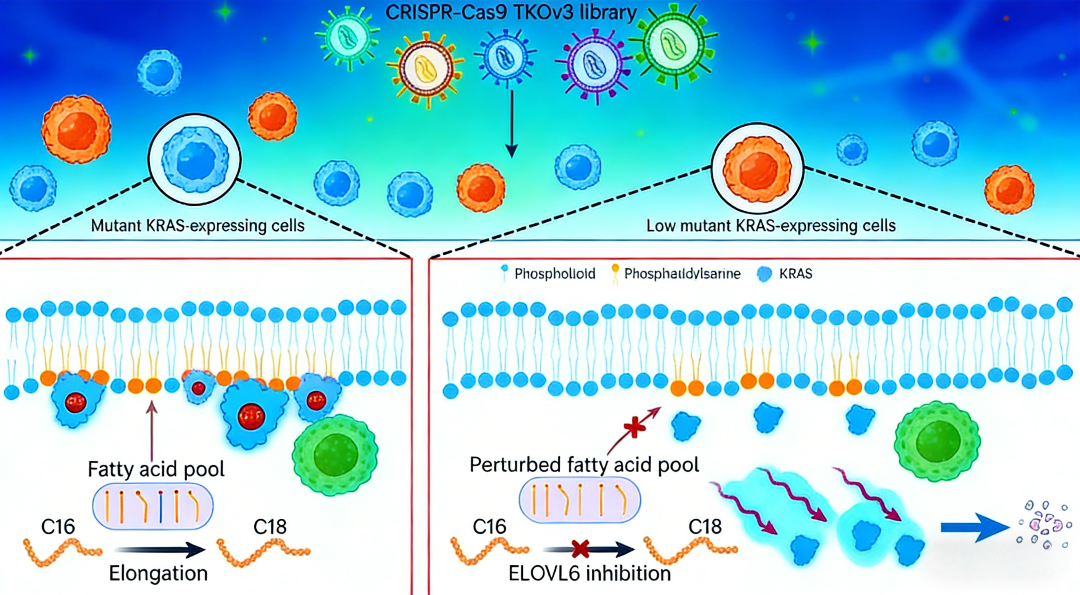
II. Research Overview: Discovery and Validation of G12V-Specific TCR
This study focused on the "neoantigens" generated by the KRAS G12V mutation and successfully identified T cell receptors capable of specifically recognizing these antigens.
1. TCR Discovery and Functional Validation: Using HLA-A*11:01 transgenic mice for immunization, researchers identified two TCRs that specifically recognize the 9-amino acid KRAS G12V mutant peptide presented by this HLA molecule. Among them, the 1-2C TCR was repeatedly identified across multiple individuals, belonging to the "public TCR" category. When engineered into chimeric antigen receptor T cells, 1-2C TCR demonstrated specific recognition and killing of various tumor cell lines harboring the KRAS G12V mutation in vitro.
2. In Vivo Efficacy and Combination Potential: In animal models, 1-2C TCR-T cells exhibited significant anti-tumor activity. Further studies revealed synergistic effects when combined with anti-PD-1 antibodies, enhancing tumor growth suppression.
3. Structural Biology Insights: By resolving the crystal structure of the TCR-peptide-HLA ternary complex, the study uncovered the unique presentation conformation of the G12V mutant peptide and elucidated how the TCR's complementarity-determining regions specifically interact with the mutant residue (valine). This provides crucial mechanistic understanding of immune system recognition of KRAS mutations.
This research confirms the potential feasibility of developing "off-the-shelf" TCR-T cell therapies targeting the shared KRAS G12V mutation, offering a new immunological approach to overcome therapeutic challenges for this mutation subtype.
III. Parallel Exploration: PROTAC Technology for Targeting KRAS G12V via Protein Degradation
While cell therapies like TCR-T show promise, they face challenges including HLA restriction, cell preparation complexity, and potential toxicity. Meanwhile, protein degradation targeting chimera (PROTAC) technology offers another promising pathway by directly eliminating oncogenic proteins. The KRAS[G12V]/CRBN PROTAC Kit represents a cutting-edge tool developed based on this strategy.
1. Mechanism of Action: The bifunctional molecules in this kit selectively bind to KRAS G12V mutant protein at one end and efficiently recruit the E3 ubiquitin ligase CRL4^CRBN at the other. This induces ternary complex formation, leading to polyubiquitination and subsequent proteasomal degradation of KRAS G12V, thereby eliminating its oncogenic signaling at the protein level.
2. Strategic Advantages and Complementarity:
- Direct Action: Unlike TCR-T cells that rely on indirect immune system killing, PROTAC directly removes the oncogenic protein itself, offering a more fundamental mechanism.
- No HLA Restriction: PROTAC activity is independent of specific HLA types, theoretically applicable to all tumor cells harboring KRAS G12V mutations, potentially benefiting a broader population.
- Combination Potential: Protein degradation-induced antigen release may enhance tumor immunogenicity, creating opportunities for synergy with immune therapies like TCR-T or checkpoint inhibitors.
3. Research Value: The KRAS[G12V]/CRBN PROTAC Kit provides researchers with a core tool to validate KRAS G12V degradation feasibility in cellular and animal models. This enables systematic evaluation of protein degradation effects on downstream signaling pathways, cellular functions, and tumor growth, accelerating discovery of next-generation targeted drugs.
IV. Conclusion and Outlook
As a crucial oncogenic driver, KRAS G12V mutation targeting is approaching breakthroughs through multiple technological pathways. The University of Chinese Academy of Sciences study provides strong candidate molecules and theoretical foundations for TCR-based adoptive cell immunotherapy. Meanwhile, protein degradation technologies exemplified by the KRAS[G12V]/CRBN PROTAC Kit are opening new fronts in directly eliminating oncoproteins from a chemoproteomics perspective. Future patient stratification through genomic sequencing and comprehensive evaluation of cell immunotherapies, protein degradation therapies, and other novel modalities may establish a multi-layered, precision treatment system for KRAS G12V mutation patients, ultimately overcoming this long-standing clinical challenge.
V. Which Manufacturers Provide KRAS[G12V]/CRBN PROTAC Kits?
Nanjing U-Protein has independently developed the TR-FRET Human KRAS[G12V]/CRBN PROTAC Binding Kit (Catalog No.: UA086003), a high-performance detection platform based on advanced time-resolved fluorescence energy transfer (TR-FRET) technology, specifically designed for accurate quantification of ternary complex formation between PROTAC-mediated KRAS[G12V] mutant protein and CRBN E3 ubiquitin ligase. This kit provides sensitive, rapid, and homogeneous in vitro detection solutions for KRAS G12V protein degradation therapy development, drug screening, and mechanism research.
| Core Product Advantages |
|---|
| High Sensitivity and Low Background: Utilizing TR-FRET technology with time-resolved and dual-wavelength detection effectively reduces sample autofluorescence and compound interference, significantly improving signal-to-noise ratio, especially suitable for high-precision analysis of low-abundance ternary complexes. |
| Physiological Ternary Complex Simulation: The kit provides rigorously validated high-purity, high-activity human KRAS[G12V] mutant protein and CRBN complex, both maintaining correct spatial conformation and complete biological functions, accurately simulating PROTAC-induced target protein-E3 ligase ternary complex assembly. |
| Homogeneous Detection and Operational Convenience: Featuring a "mix-incubate-detect" homogeneous operation mode without washing steps, the workflow is simple and fast, compatible with automated workstations for high-throughput screening, greatly improving experimental efficiency. |
| Excellent Stability and Batch Consistency: Advanced recombinant expression systems and strict quality control ensure high purity, superior long-term stability, and outstanding batch-to-batch consistency, providing reliable support for continuous drug screening and mechanism studies. |
| Complete Solutions and Professional Support: We provide detailed optimized protocols, standard curve examples, result interpretation guides, and professional technical support for various applications including PROTAC molecule screening, linker optimization, and degradation activity correlation analysis. |
Nanjing U-Protein is dedicated to providing cutting-edge, high-quality core reagents and tools for undruggable target degradation, precision cancer therapy, and innovative drug development. For detailed technical information, validation data, or specific application inquiries regarding the TR-FRET Human KRAS[G12V]/CRBN PROTAC Binding Kit (Catalog No.: UA086003), please feel free to contact us.
This article is reviewed and published by the technical expert team of UA
Disclaimer: This article partially utilizes artificial intelligence assistance in its creation. If any content involves copyright or intellectual property issues, please let us know and we promise to verify and remove it as soon as possible.
Purchase recombinant protein, choose 
UA protein focuses on providing various protein reagents, raw materials, and services required for drug research and development, cell therapy, gene therapy, and basic scientific research, including drug target proteins, immune checkpoint proteins, cytokines, tool enzymes, customized protein expression, and full-length transmembrane protein development. Nanjing Univ is committed to providing customers with high-quality products and professional services, and building a High-tech Biological Enterprise with International Competitiveness.







 Business license (three certificates in one)