

A novel strategy for tumor photothermal therapy based on Furin protease response


Photothermal therapy (PTT), as a non-invasive tumor treatment method, has its efficacy highly dependent on the performance of photothermal agents (PTA).
- Recent Advances
- Product Information
I. Research Background and Design Concept
Photothermal therapy (PTT), as a non-invasive tumor treatment method, relies heavily on the performance of photothermal agents (PTAs). Gold nanoparticles (AuNPs) have emerged as a significant class of PTAs due to their excellent biocompatibility and tunable optical properties. However, the photothermal conversion efficiency of traditional AuNPs is limited, particularly with weak absorption in the near-infrared window. Studies have found that when AuNPs (with diameters less than 8 nm) undergo specific aggregation within tumor cells, their surface plasmon resonance effect is significantly enhanced, thereby greatly improving photothermal conversion efficiency. Therefore, developing an intelligent responsive system that can be specifically activated in tumor cells and induce AuNP aggregation is key to enhancing PTT efficacy and selectivity.
Furin (also known as PCSK3) is a convertase highly expressed in various malignant tumors (such as breast and lung cancers), with its activity significantly upregulated in tumor tissues, making it an ideal biomarker for tumor microenvironment responsiveness. Based on this, Professor Wang Guangfeng from Anhui Normal University and Professor Liang Gaolin from the University of Science and Technology of China innovatively designed and constructed a Furin-responsive intelligent gold nanoplatform, achieving enzyme-controlled AuNP aggregation in tumor cells and significantly enhancing photothermal therapeutic effects.
II. Key Role of Furin/PCSK3 His Tag Protein in Design and Validation
In constructing this intelligent responsive system, high-purity and high-activity Furin protease is the core tool for in vitro mechanism validation and condition optimization. Furin/PCSK3 His Tag Protein, as a recombinant protease containing a histidine tag, facilitates purification via affinity chromatography, ensuring accuracy and reproducibility in enzymatic experiments. Its specific applications include:
1. In Vitro Responsiveness Validation: Researchers used Furin/PCSK3 His Tag Protein to simulate physiological conditions in vitro, verifying that the designed nanoprobe (AuNP@1) could be specifically cleaved by Furin and trigger subsequent molecular condensation reactions, directly proving the feasibility of the system's response mechanism.
2. Enzymatic Kinetics and Condition Optimization: Using this purified protein, the cleavage efficiency and kinetic parameters of Furin on the substrate peptide modified on AuNP@1 were precisely determined, providing critical quantitative data support for the final design of the nanoplatform (e.g., peptide chain length and linkage sites).
III. Mechanism and Therapeutic Effects of the Intelligent Nanoplatform
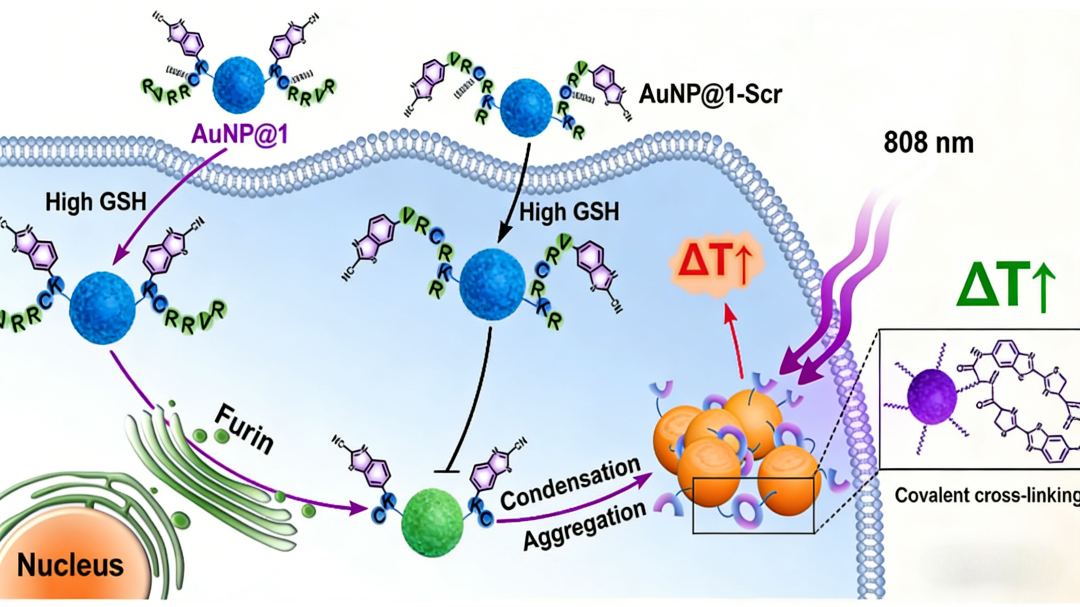
The Furin-responsive AuNP platform (AuNP@1) designed in this study features a surface-modified peptide containing a Furin-specific recognition cleavage sequence and a 2-cyanobenzothiazole group.
1. Intracellular Activation and Aggregation Mechanism: When AuNP@1 is endocytosed by tumor cells with high Furin expression (e.g., MDA-MB-468 cells), intracellular Furin cleaves the surface peptide, exposing cysteine residues. Subsequently, under the action of intracellular glutathione, a rapid 2-cyanobenzothiazole-cysteine condensation reaction occurs, forming a rigid dimer structure. These dimers act as "molecular glue," crosslinking adjacent AuNP@1 particles and ultimately forming large AuNP aggregates within the cells.
2. Enhanced Photothermal Effect: Compared to the dispersed state, intracellular AuNP aggregates exhibit significantly enhanced near-infrared light absorption and photothermal conversion efficiency.
3. Excellent Anti-Tumor Effects: In vitro cell experiments demonstrated that AuNP@1 has significant photothermal killing effects on tumor cells with high Furin expression, while showing minimal effects on normal cells with low Furin expression or control groups treated with scrambled peptides (AuNP@1-Scr). Further in vivo animal experiments confirmed that AuNP@1 efficiently inhibited the growth of MDA-MB-468 xenograft tumors under laser irradiation, with good systemic biocompatibility.
IV. Summary and Outlook
This study successfully constructed an intelligent gold nanoparticle aggregation system specifically activated by tumor-overexpressed Furin protease, achieving a cascade amplification from "molecular recognition" to "nanostructure reconstruction" and then to "functional enhancement," providing a new paradigm for precise tumor photothermal therapy. In this process, Furin/PCSK3 His Tag Protein, as a reliable biological tool, played an indispensable role in validating core mechanisms and optimizing system performance. This strategy not only opens new avenues for Furin-based cancer diagnosis and treatment integration but also extends its design concept (i.e., using tumor-specific enzymes to induce in situ nanoparticle aggregation for enhanced therapeutic function) to other disease biomarkers and nanomaterial systems, offering broad clinical application prospects.
V. Which Manufacturers Provide Furin/PCSK3 His Tag Protein?
Nanjing U-Protein has independently developed Furin/PCSK3 His Tag Protein, Mouse (Catalog No.: UA011277), a high-purity, high-activity recombinant mouse Furin (PCSK3) protein. It is produced using a mammalian expression system and carries a C-terminal His tag for convenient purification and detection. Furin is a key proprotein convertase widely involved in the cleavage and maturation of various bioactive precursor proteins, playing an important role in cell development, signal transduction, and disease pathogenesis. This product is suitable for enzymatic property studies, substrate specificity analysis, inhibitor screening, and mechanism exploration in mouse models, providing a reliable and efficient research tool.
| Core Product Advantages |
|---|
| High Purity and Complete Enzymatic Activity: Produced using a mammalian expression system to ensure correct folding and post-translational modifications, purified via affinity chromatography to achieve high purity (>95%) and low endotoxin levels, with validated cleavage activity for functional experiments. |
| His Tag for Easy Handling: C-terminal His tag enables efficient purification via nickel columns and supports detection, immobilization, or compatibility with related detection systems, enhancing experimental flexibility. |
| Broad Application Compatibility: Suitable for enzyme kinetics analysis, substrate specificity identification, inhibitor/agonist screening, protein processing mechanism studies, viral infection mechanism exploration, and as a standard for detection method development, particularly for mouse model-related research. |
| Excellent Stability and Batch Consistency: Standardized production processes and strict quality control ensure long-term stability and high batch-to-batch consistency, guaranteeing reliable and reproducible experimental data. |
| Professional Technical Support: We provide detailed product manuals, recommended enzyme activity detection protocols, storage suggestions, and professional technical consultation for Furin applications in disease models, drug development, and signaling pathway research. |
Nanjing U-Protein is dedicated to providing high-quality, high-performance recombinant protein tools for cell biology, disease mechanism research, and innovative drug development. For detailed technical parameters, enzymatic activity validation data, or application guidance on Furin/PCSK3 His Tag Protein, Mouse (Catalog No.: UA011277), please feel free to contact us.
This article is reviewed and published by the technical expert team of UA
Disclaimer: This article partially utilizes artificial intelligence assistance in its creation. If any content involves copyright or intellectual property issues, please let us know and we promise to verify and remove it as soon as possible.
Purchase recombinant protein, choose 
UA protein focuses on providing various protein reagents, raw materials, and services required for drug research and development, cell therapy, gene therapy, and basic scientific research, including drug target proteins, immune checkpoint proteins, cytokines, tool enzymes, customized protein expression, and full-length transmembrane protein development. Nanjing Univ is committed to providing customers with high-quality products and professional services, and building a High-tech Biological Enterprise with International Competitiveness.







 Business license (three certificates in one)