




The mechanism of natural polyphenol tannic acid in inhibiting ferroptosis in Alzheimer's disease through synergistic activation of GPX4


Alzheimer's disease (AD) is a complex neurodegenerative disorder characterized by progressive cognitive impairment, with pathogenesis involving multiple pathological processes such as amyloid-β (Aβ) deposition, abnormal phosphorylation of Tau protein, oxidative stress, and neuroinflammation.
- Recent Advances
- Product Information
I. Research Background: Ferroptosis and Alzheimer's Disease
Alzheimer's disease (AD) is a complex neurodegenerative disorder characterized by progressive cognitive impairment, with pathogenesis involving multiple pathological processes such as amyloid-β (Aβ) deposition, abnormal Tau protein phosphorylation, oxidative stress, and neuroinflammation. In recent years, ferroptosis, an iron-dependent form of programmed cell death, has been confirmed to be closely associated with the onset and progression of AD. Hallmarks of ferroptosis include intracellular iron accumulation, elevated lipid peroxidation, and impaired activity or downregulated expression of the core antioxidant enzyme glutathione peroxidase 4 (GPX4). Therefore, developing multifunctional molecules that simultaneously target AD core pathologies (e.g., Aβ aggregation) and ferroptosis pathways (particularly enhancing GPX4 function) represents a highly promising therapeutic strategy.
II. Research Tool: The Central Role of GPX4 Flag&His Tag Protein in Mechanism Validation
To precisely validate the direct regulatory effects of compounds on GPX4 activity, high-purity and functionally intact recombinant proteins are essential. The GPX4 Flag&His tag protein, as a key in vitro research tool, features dual tags for efficient purification via affinity chromatography and enables specific immunodetection using the Flag tag, ensuring accuracy and high signal-to-noise ratio in enzymatic assays. In this study, this tool protein was utilized for:
1. Direct enzyme activity measurement: In an in vitro biochemical system, the direct impact of polyphenolic compounds (e.g., tannic acid, TA) on GPX4 catalytic activity was assessed, quantitatively analyzing their activating or inhibitory effects.
2. Mechanistic studies of inhibitors/activators: Using this recombinant protein, the inhibitory effects of GPX4-specific inhibitors like RSL3 were simulated, and the ability of TA and other compounds to reverse this inhibition or directly enhance enzyme activity was validated, thereby clarifying their binding sites (allosteric activation sites).
3. Molecular docking and structural validation: Based on the purified GPX4 protein structural model, molecular docking simulations of small molecules (TA, EGCG, RSL3) were performed to predict their binding sites (e.g., substrate-binding or allosteric regulatory sites), providing structural explanations for functional experimental results.
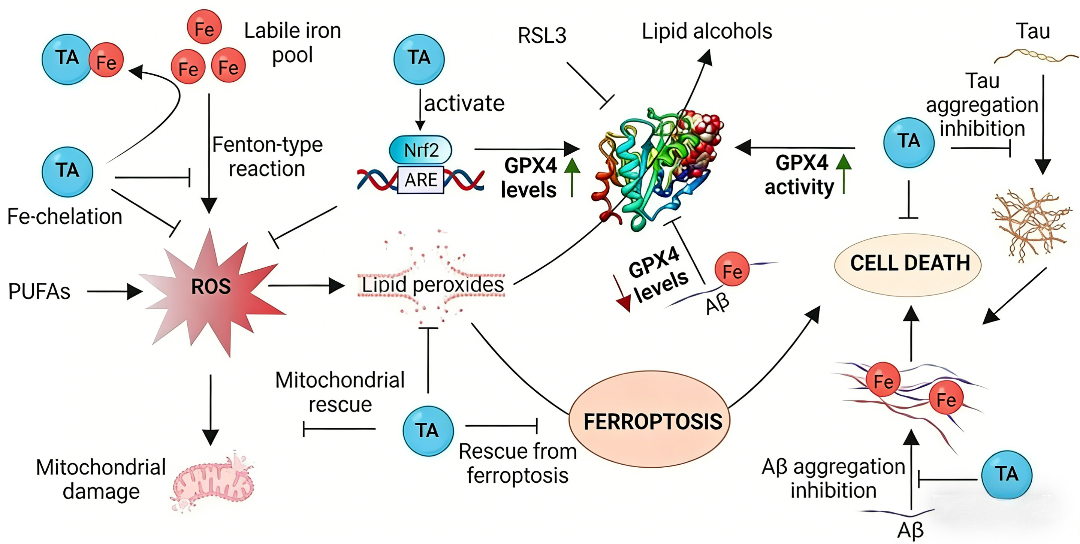
III. Key Findings: Multifunctional Neuroprotective Effects of Tannic Acid (TA)
This study systematically screened and evaluated the protective activities of a series of natural polyphenols in AD and ferroptosis-related models, revealing that TA exhibits the most comprehensive synergistic effects.
1. Potent iron chelation and antioxidant capacity: Owing to its multiple catechol/gallate groups, TA demonstrates the strongest iron-binding ability (binding constant KB = 6.64 × 10^5 M^-1), effectively stabilizing iron ions and inhibiting their participation in redox cycles, thereby reducing the generation of free radicals and reactive oxygen species (ROS) at the source. It also effectively suppresses iron-dependent lipid peroxidation and protein oxidation in vitro.
2. Inhibition of Aβ and Tau protein abnormal aggregation: TA significantly delays the aggregation process of Aβ42 (prolonging the lag phase and reducing the primary aggregation rate) and effectively inhibits Tau protein aggregation. Notably, even under conditions where Fe³⁺ promotes Aβ aggregation, TA maintains significant inhibitory activity, synergizing with its iron-chelating function to combat AD protein pathologies.
3. Direct targeting and activation of GPX4 enzyme activity: This is the key innovative discovery of the study. Molecular docking predicts that TA binds to the allosteric activation site of GPX4. In vitro enzymatic assays using the GPX4 Flag&His tag protein directly confirmed:
- Reversal of inhibition: TA effectively reverses the inhibitory effects of the GPX4-specific inhibitor RSL3 on enzyme activity, increasing RSL3's half-maximal inhibitory concentration (IC50) from 17.17 μM to 29.98 μM.
- Direct activation: TA itself enhances GPX4 enzyme activity in a concentration-dependent manner, achieving a 19% increase at 100 μM, demonstrating its role as a natural GPX4 activator.
4. Integrated synergistic mechanism: TA exerts protective effects through a multifaceted approach: ① iron chelation to reduce ferroptosis triggers; ② free radical scavenging to mitigate oxidative damage; ③ inhibition of Aβ and Tau pathological aggregation; ④ direct enhancement of GPX4, a key intracellular antioxidant defense enzyme. This "open-source and reduce expenditure" (reducing damage input and enhancing defense output) synergistic mechanism makes TA an ideal candidate molecule for combating the complex neurodegenerative pathologies and ferroptosis in AD.
IV. Summary and Future Perspectives
This study systematically reveals, for the first time, the natural polyphenol tannic acid (TA) as a multifunctional molecular drug candidate capable of simultaneously targeting Alzheimer's disease protein aggregation pathologies and ferroptosis pathways, particularly highlighting its novel and critical role as a GPX4 activator. Throughout the study, the GPX4 Flag&His tag protein served as a core research tool, providing an indispensable experimental platform for precisely analyzing the direct interaction between TA and GPX4 and validating its activating effects at the molecular level. This discovery not only offers a new candidate molecule and target (GPX4 activation) for AD treatment but also provides important design insights and lead compounds for developing synthetic multitarget drugs with antioxidant, iron-regulating, anti-protein aggregation, and enzyme-activating functions.
V. Which Manufacturers Provide GPX4 Flag&His Tag Protein?
Nanjing UA Protein independently developed the GPX4 Flag&His Tag Protein, Human (Catalog No.: UA085007), a high-purity, high-activity recombinant human glutathione peroxidase 4 (GPX4) protein. It is produced using a mammalian expression system and fused with Flag and His dual tags at the N- or C-terminus for easy purification, detection, and functional studies. GPX4 is a key enzyme regulating ferroptosis, playing a central role in antioxidant stress, lipid peroxidation inhibition, and programmed cell death. This product is suitable for ferroptosis mechanism research, enzyme activity analysis, drug screening, and cell protection function evaluation.
| Core Product Advantages |
|---|
| High purity and intact enzymatic activity: Expressed in a mammalian system to ensure proper folding and post-translational modifications, purified via affinity chromatography to achieve high purity (>95%) and low endotoxin levels, with validated glutathione peroxidase activity. |
| Dual-tag design enhances application flexibility: Fusion of Flag and His tags enables efficient purification via anti-Flag antibodies or nickel columns, immunoprecipitation (IP), Western Blot detection, and cellular localization studies, meeting diverse experimental needs. |
| Broad application compatibility: Suitable for enzyme activity assays, ferroptosis induction/inhibition experiments, antioxidant function studies, drug screening (e.g., GPX4 inhibitors/activators), antibody development, and as a standard for detection method development. |
| Excellent stability and batch consistency: Standardized production processes and strict quality control ensure long-term stability and high inter-batch consistency, guaranteeing reliable and reproducible experimental data. |
| Professional technical support: We provide detailed product manuals, recommended enzyme activity assay protocols, storage guidelines, and expert consultations for GPX4 research in ferroptosis, neurodegenerative diseases, cancer therapy, and oxidative stress. |
Nanjing UA Protein is dedicated to providing high-quality, high-performance recombinant protein tools for cell death mechanism research, disease model construction, and innovative drug development. For detailed technical parameters, enzyme activity validation data, or application guidance on GPX4 Flag&His Tag Protein, Human (Catalog No.: UA085007), please feel free to contact us.
This article is reviewed and published by the technical expert team of UA
Disclaimer: This article partially utilizes artificial intelligence assistance in its creation. If any content involves copyright or intellectual property issues, please let us know and we promise to verify and remove it as soon as possible.
Purchase recombinant protein, choose Nanjing UA-Bio
UA protein focuses on providing various protein reagents, raw materials, and services required for drug research and development, cell therapy, gene therapy, and basic scientific research, including drug target proteins, immune checkpoint proteins, cytokines, tool enzymes, customized protein expression, and full-length transmembrane protein development. Youai is committed to providing customers with high-quality products and professional services, and building a High-tech Biological Enterprise with International Competitiveness.







 Business license (three certificates in one)