




CD30/TNFRSF8: A Key Therapeutic Target in Lymphoma and Its Functional Research Tools


CD30, also known as TNFRSF8, is an important member of the tumor necrosis factor receptor superfamily. As a type I transmembrane protein, its expression is highly restricted in normal tissues, primarily occurring in some activated T and B lymphocytes.
- Recent Advances
- Product Information
I. Biological Characteristics and Clinical Relevance of CD30/TNFRSF8
CD30, also known as TNFRSF8, is an important member of the tumor necrosis factor receptor superfamily. As a type I transmembrane protein, its expression is highly restricted in normal tissues, primarily appearing in some activated T and B lymphocytes. However, in various lymphoid malignancies such as classical Hodgkin's lymphoma and systemic anaplastic large cell lymphoma, CD30 exhibits sustained, high-level expression. This significant expression difference makes it a highly valuable tumor-specific target that has been successfully translated into effective targeted therapeutic strategies.
II. Structure and Signal Transduction Mechanism of CD30 Protein
The CD30 protein consists of three parts: an extracellular domain, transmembrane region, and intracellular tail, which collectively determine its ligand binding and signal transduction functions.
1. Extracellular Domain: Contains multiple characteristic cysteine-rich domains (CRDs) responsible for specifically recognizing and binding its natural ligand CD30L (TNFSF8). This is the key region where antibody-based drugs (such as monoclonal antibodies and antibody-drug conjugates) bind.
2. Transmembrane Region: A single hydrophobic helix that anchors the receptor to the cell membrane.
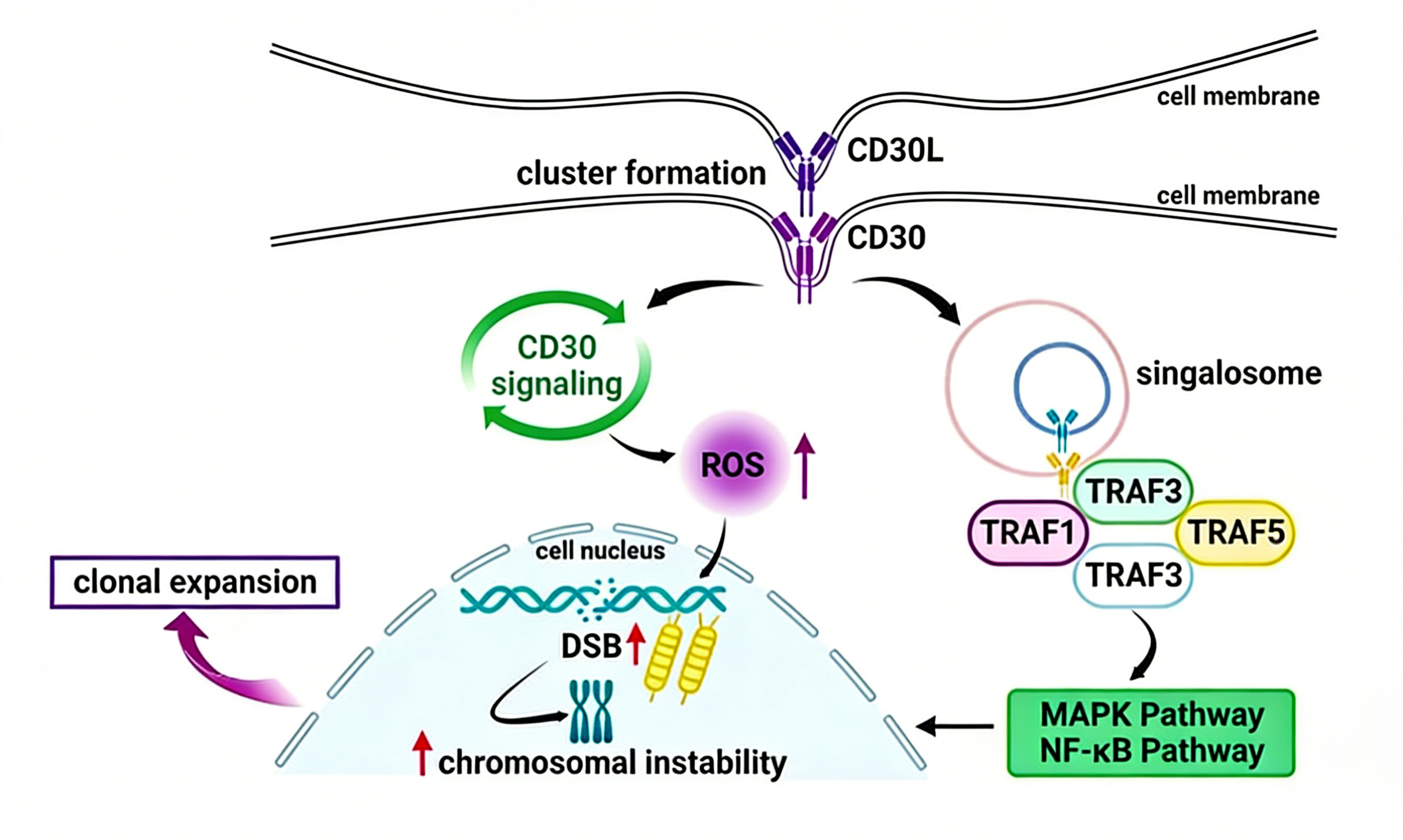
3. Intracellular Tail: Although lacking enzymatic activity, it contains signaling motifs that can recruit tumor necrosis factor receptor-associated factors (TRAFs, such as TRAF2 and TRAF5). After binding with its ligand, CD30 activates downstream key signaling pathways such as NF-κB and MAPK/ERK through TRAF proteins, thereby regulating cell survival, proliferation, cytokine secretion, and immune responses.
III. The Core Role of CD30 in the Development and Progression of Lymphoma
CD30 is not only a surface marker of tumor cells but also a key signaling node driving their malignant biological behavior.
1. Promoting Tumor Cell Survival and Proliferation: Sustained CD30 signaling activation can upregulate the expression of anti-apoptotic proteins in the BCL-2 family, enhancing tumor cell resistance to apoptotic signals and maintaining abnormal proliferation.
2. Reshaping the Immune Microenvironment: In Hodgkin's lymphoma, CD30-high-expressing tumor cells can secrete various factors such as IL-6, IL-13, and TGF-β, inducing and maintaining a local microenvironment characterized by chronic inflammation and immune suppression, thereby promoting immune escape.
3. Correlation with Disease Progression: The expression level of CD30 is closely related to the clinical stage, aggressiveness, and prognosis of lymphoma, making it an important prognostic biomarker and disease monitoring indicator.
IV. Application Value of FITC-Labeled CD30/TNFRSF8 His Tag Protein
In the study of CD30 mechanisms and drug development, high-quality, standardized recombinant protein tools are crucial. FITC-Labeled CD30/TNFRSF8 His Tag Protein combines multiple advantages, providing powerful technical support for related research:
1. High Purity and Ease of Use: The C-terminal or N-terminal His tag facilitates efficient purification via metal chelate chromatography, ensuring the homogeneity and high purity of the protein preparation.
2. Built-in Fluorescent Label: The pre-conjugated FITC (fluorescein isothiocyanate) label provides immediate, no-secondary-label fluorescence detection capability, greatly simplifying the process and improving result stability.
3. Core Application Scenarios:
- Flow Cytometry Analysis and Sorting: Can be directly used to label CD30-expressing cell lines or patient-derived primary cells for rapid, quantitative analysis of surface CD30 expression and enrichment of specific cell subsets.
- Receptor-Ligand/Antibody Binding Studies: Can be used to evaluate the binding affinity, competitive inhibition, and binding kinetics (e.g., via flow cytometry binding assays) of candidate therapeutic antibodies, aptamers, or CD30L with CD30.
- In Vivo and In Vitro Imaging and Tracing: The FITC label makes it suitable for live-cell imaging, tissue section staining, etc., enabling visualization of CD30 distribution and dynamic changes on cell surfaces.
V. Clinical Treatment Strategies and Prospects Targeting CD30
Based on an in-depth understanding of CD30's biological functions, significant clinical breakthroughs have been achieved in targeting this molecule.
1. Antibody-Drug Conjugates: Represented by Brentuximab vedotin, which delivers potent microtubule inhibitors precisely to tumor cells via anti-CD30 monoclonal antibodies, has become a standard treatment for relapsed/refractory classical Hodgkin's lymphoma and ALCL, and is gradually expanding to first-line therapy.
2. Novel Immunotherapies: Including CD30-targeted chimeric antigen receptor T cells (CAR-T) and bispecific antibodies, which are showing therapeutic potential for refractory patients in clinical studies.
3. Combination Therapy Strategies: Combining CD30-targeted drugs with chemotherapy, immune checkpoint inhibitors, or epigenetic drugs is an important direction for further improving efficacy and overcoming resistance.
VI. Summary
CD30 is a exemplary target connecting the molecular pathological mechanisms of lymphoma with precision therapy. From the analysis of basic signaling mechanisms to the successful application of antibody-drug conjugates and the exploration of novel immunotherapies, its research history fully demonstrates the path of translational medicine. In this process, FITC-Labeled CD30/TNFRSF8 His Tag Protein, as a key research tool, will continue to play an irreplaceable role in target validation, drug screening, cell function analysis, and preclinical research, facilitating the development and application of future more precise and effective CD30-targeted therapies.
VII. Which Manufacturers Provide FITC-Labeled CD30/TNFRSF8 His Tag Protein?
Nanjing U-Protein has independently developed FITC-Labeled CD30/TNFRSF8 His Tag Protein, Human (Catalog No.: UA011337), an innovative recombinant protein tool that combines high purity, high activity, and direct fluorescence detection functionality. This product fuses the extracellular domain of human CD30/TNFRSF8 (tumor necrosis factor receptor superfamily member 8) with a C-terminal His tag and is efficiently and stably labeled with fluorescein isothiocyanate (FITC). CD30 is a key biomarker and therapeutic target for specific lymphoma types such as Hodgkin's lymphoma and anaplastic large cell lymphoma. This product is suitable for flow cytometry, immunofluorescence, cell binding assays, and targeting studies, and can be used directly for detection without secondary antibody incubation, greatly simplifying experimental procedures.
| Core Advantages of the Product |
|---|
| Ready-to-Use Fluorescent Detection Probe: The protein is pre-labeled with FITC and can be directly used for flow cytometry to detect CD30 expression on cell surfaces, immunofluorescence staining, or microscopic imaging, eliminating the need for cumbersome secondary antibody incubation and washing steps. The operation is simple and fast, effectively reducing nonspecific background. |
| High Purity and Specific Binding: Expressed in mammalian expression systems to ensure the protein has the correct natural conformation. After multi-step purification, the purity is >95%. The product maintains high affinity and specific binding to CD30 ligand (CD30L) and therapeutic antibodies (e.g., Brentuximab). |
| Dual Tags and Flexible Applications: The C-terminal His tag facilitates protein purification or immobilization via nickel columns, while the pre-labeled FITC provides ready-to-use fluorescent signals. This design allows it to serve as both a direct detection reagent and a standard for method establishment or competitive inhibition assays. |
| Excellent Photostability and Batch-to-Batch Consistency: The FITC labeling process is mature and stable, with high and uniform labeling efficiency, ensuring strong fluorescent signals and minimal batch-to-batch variation. The product undergoes strict quality control to ensure reliable performance and reproducible results under various experimental conditions. |
| Broad and Direct Application Scenarios |
|---|
| Flow Cytometry: Direct staining for quantitative analysis of CD30 expression levels on lymphoma cell lines or primary cells. |
| Cell Binding and Competition Assays: Evaluate the competitive binding ability of antibodies or candidate drugs with CD30 receptors. |
| Immunofluorescence/Microscopic Imaging: Used for localization studies of CD30 in cells or tissue sections. |
| Diagnostic Reagent Development: Serves as a core raw material for the development of CD30 detection kits. |
Nanjing U-Protein is committed to providing innovative and efficient protein tools for tumor immunology research, hematologic malignancy diagnosis, and antibody drug development. For detailed technical parameters (such as F/P ratio, recommended usage concentration), experimental protocols, or application support regarding FITC-Labeled CD30/TNFRSF8 His Tag Protein, Human (Catalog No.: UA011337), please feel free to contact me.
Disclaimer: This article partially utilizes artificial intelligence assistance in its creation. If any content involves copyright or intellectual property issues, please let us know and we promise to verify and remove it as soon as possible.
Purchase recombinant protein, choose Nanjing UA-Bio
UA protein focuses on providing various protein reagents, raw materials, and services required for drug research and development, cell therapy, gene therapy, and basic scientific research, including drug target proteins, immune checkpoint proteins, cytokines, tool enzymes, customized protein expression, and full-length transmembrane protein development. Youai is committed to providing customers with high-quality products and professional services, and building a High-tech Biological Enterprise with International Competitiveness.







 Business license (three certificates in one)