




A "Signal-Enhanced" Fluorescent Nanoprobes Based on Bifunctional Nucleolin Protein for Single-Cell Imaging Research


Nucleolin (NCL) is a multifunctional nuclear protein distributed in the nucleolus, cytoplasm, and cell membrane, involved in regulating key biological processes such as rRNA synthesis, cell cycle progression, cell proliferation, and apoptosis.
- Recent Advances
- Product Information
1. Research Background: Challenges and Needs of Nucleolin as an Imaging Target
Nucleolin (NCL) is a multifunctional nuclear protein distributed in the nucleolus, cytoplasm, and cell membrane, participating in key biological processes such as rRNA synthesis, cell cycle progression, cell proliferation, and apoptosis. In various tumor cells, nucleolin is significantly overexpressed and often translocated to the cell membrane surface, making it an important potential marker for tumor-specific diagnosis and targeted therapy. However, traditional nucleolin detection methods (e.g., immunoblotting, immunofluorescence staining) typically rely on cell lysis or fixation, making it difficult to achieve in situ, real-time, and dynamic monitoring of nucleolin in living cells. Therefore, developing a live-cell imaging tool capable of high-sensitivity, high-specificity, and subcellular localization tracking of nucleolin at the single-cell level is crucial for understanding its role in physiological and pathological processes and advancing nucleolin-based precision diagnostics and therapeutics.
2. Core Tool: The Key Role of Biotinylated Nucleolin/NCL His&Avi Tag Protein in Probe Construction
In the development of novel targeted imaging probes, obtaining high-purity, structurally intact, and easily conjugated functional target proteins is the cornerstone for validating probe performance. Biotinylated Nucleolin/NCL His&Avi Tag Protein is an ideal research tool, designed with three critical tags/modifications:
1. Dual Affinity Tags: The His tag (polyhistidine) facilitates high-purity, high-recovery protein purification via metal chelate chromatography, while the Avi tag allows for site-specific biotinylation in vitro.
2. Efficient Biotinylation: Pre-biotinylated proteins can achieve rapid, stable, and orientation-controlled conjugation with various carriers (e.g., nanoparticles, fluorescent dyes, magnetic beads) through the ultra-strong non-covalent binding (picomolar affinity) between biotin and streptavidin.
3. Functional Validation: This recombinant protein retains key domains of nucleolin and can serve as a standard for validating the specificity and affinity (e.g., via SPR or ELISA) of nucleic acid aptamers (e.g., AS1411) or antibodies for nucleolin, as well as for competitive binding assays to evaluate probe specificity.
Thus, in the early stages of research, using Biotinylated Nucleolin/NCL His&Avi Tag Protein enables efficient and standardized evaluation and optimization of the conjugation efficiency and binding activity of targeting ligands (e.g., AS1411 aptamer), providing reliable preliminary validation for the subsequent construction of high-performance nanoprobes.
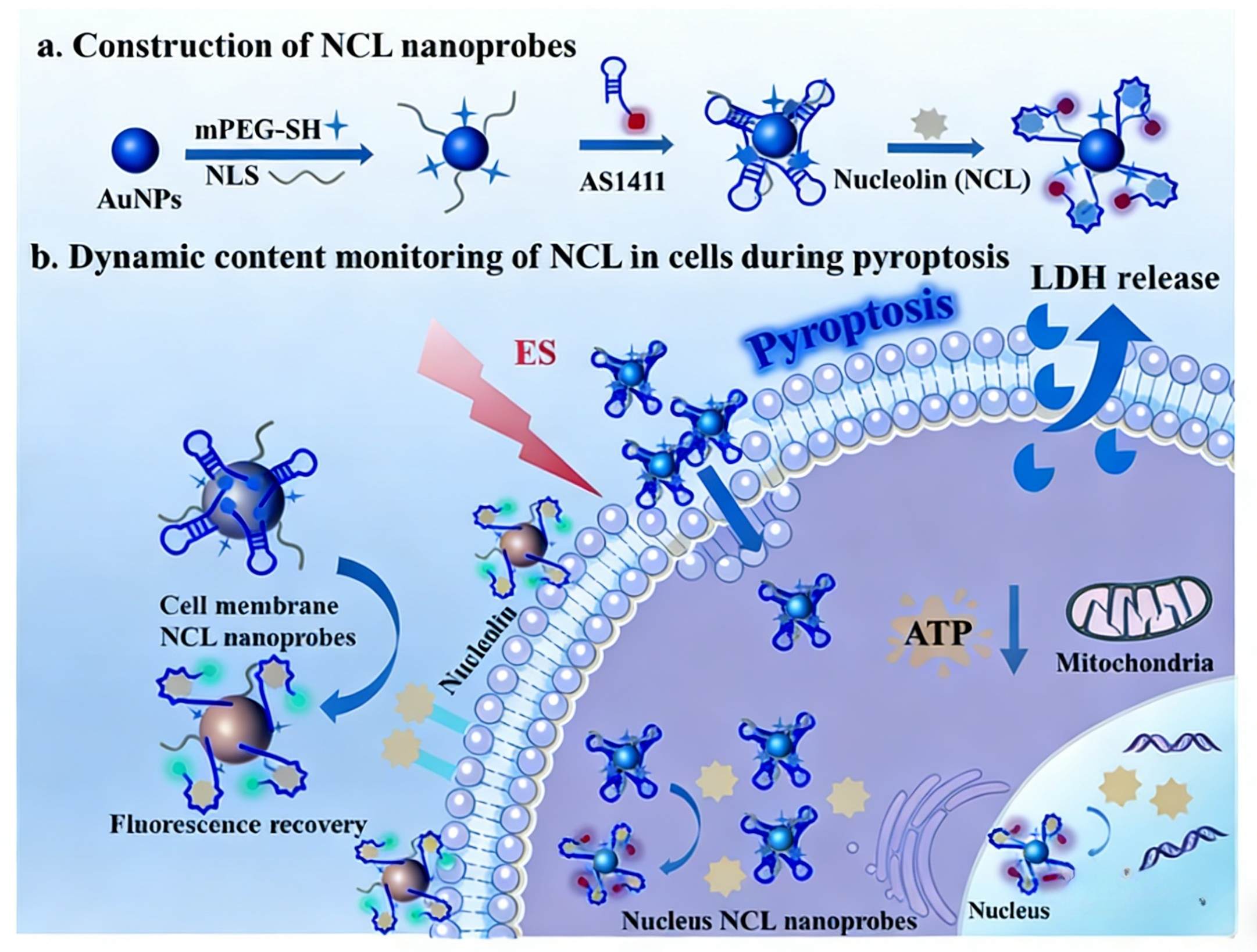
3. Design and Performance of an Intelligent "Signal-Enhanced" Fluorescent Nanoprobe
Based on the above tools and strategies, the research team successfully constructed an intelligent fluorescent nanoprobe for in situ monitoring of nucleolin.
1. Probe Design Principle: The probe uses gold nanoparticles (AuNPs) as carriers, modified with the nucleolin-specific nucleic acid aptamer AS1411 and linked to a fluorescent reporter molecule. Its core innovation lies in the "signal enhancement" mechanism: when the probe is unbound to the target, the fluorescent molecule is quenched ("off") due to energy transfer effects on the AuNP surface; once AS1411 binds to nucleolin on the cell surface or inside the cell, the probe conformation changes or the distance to the target protein increases, blocking energy transfer and significantly restoring fluorescence signal ("on"), thereby achieving high signal-to-noise ratio detection.
2. Excellent Analytical Performance: Studies confirmed that the probe exhibits good monodispersity, stability, and excellent targeting specificity. In vitro tests showed a linear relationship between fluorescence intensity and nucleolin concentration in the range of 4–21 nM, with effective discrimination between nucleolin and various common intracellular substances. By adjusting nanoparticle size, the probe can be designed to target either the cell membrane or nuclear region, enabling precise analysis of nucleolin's subcellular localization.
4. Application in a Pyroptosis Model: Dynamic Monitoring and Selective Recognition
To validate the probe's application value in complex biological processes, researchers applied it to an electrically induced cell pyroptosis model.
1. Dynamic Monitoring Capability: Using this fluorescent nanoprobe, the team performed real-time, in situ monitoring of dynamic changes in nucleolin expression levels and subcellular distribution in cancer cells (MCF-7) and normal cells (MCF-10A) before and after electrical stimulation at the single-cell level. Results clearly showed that nucleolin expression in cancer cells was significantly higher than in normal cells, and as the electrical stimulation voltage increased (inducing pyroptosis), nucleolin expression levels in cancer cells, particularly in the nucleus, showed a significant downward trend, while changes in normal cells were relatively minor.
2. Selective Recognition and Potential Applications: The study also found that specific voltages (e.g., 1.0 V) of electrical stimulation could selectively induce pyroptosis in cancer cells with minimal effects on normal cells. Combined with nucleolin probe imaging, this provides a potential molecular imaging method for selectively identifying and monitoring cancer cell-specific death processes.
5. Which Manufacturers Provide Biotinylated Nucleolin/NCL His&Avi Tag Protein?
Nanjing UniLove Protein independently developed Biotinylated Nucleolin/NCL His&Avi Tag Protein, Human (Catalog No.: UA011311), a highly pure, efficiently biotinylated recombinant fusion protein of human nucleolin (Nucleolin, NCL). This product is engineered by fusing human NCL protein with a C-terminal His tag and AviTag sequence, followed by site-specific, highly uniform biotinylation in vitro. Nucleolin is a multifunctional nucleolar protein widely involved in ribosome synthesis, cell proliferation, apoptosis regulation, and as a surface receptor for various viral and tumor-related molecules. This product combines excellent binding activity with detection flexibility, making it an important tool for studying RNA/DNA interactions, viral infection mechanisms, tumor-targeted therapy, and drug screening.
| Core Advantages of the Product |
|---|
| High Purity and Intact Biological Activity: Expressed in mammalian systems (e.g., HEK293) and purified via multi-step chromatography to achieve high purity (>95%) and low endotoxin levels. The protein retains NCL's natural multi-domain conformation, enabling binding to RNA, DNA, specific ligands (e.g., AS1411 aptamer), and various viral surface proteins. |
| Efficient, Uniform Biotinylation: Site-specific biotinylation via the AviTag ensures high labeling efficiency and batch consistency. The labeled product can directly bind to streptavidin or NeutrAvidin-coated detection platforms (e.g., ELISA plates, biosensor chips, magnetic beads), significantly improving detection sensitivity and experimental flexibility. |
| Dual-Tag Design Enhances Application Diversity: The C-terminal His tag and AviTag enable efficient capture and purification via nickel columns, while the biotin-avidin system allows high-sensitivity immobilization and signal amplification, meeting diverse experimental needs from molecular interaction studies to high-throughput screening. |
| Exceptional Stability and Batch Consistency: Rigorous production and quality control processes ensure product stability under long-term storage and repeated freeze-thaw cycles, with high consistency in purity, biotinylation efficiency, and binding activity across batches, guaranteeing experimental reproducibility. |
| Broad Application Scenarios: Suitable for biosensor analysis (e.g., SPR, BLI), affinity purification/immunoprecipitation (Pull-down), nucleic acid-protein interaction studies, viral invasion mechanism exploration, aptamer/antibody screening, and cell surface binding assays, among other cutting-edge research applications. |
Nanjing UniLove Protein is committed to providing high-performance, high-quality engineered protein tools for nucleic acid biology, virology, tumor-targeted therapy, and innovative drug development. For detailed technical parameters, binding validation data, or specific application protocols for Biotinylated Nucleolin/NCL His&Avi Tag Protein, Human (Catalog No.: UA011311), please feel free to contact us.
Disclaimer: This article partially utilizes artificial intelligence assistance in its creation. If any content involves copyright or intellectual property issues, please let us know and we promise to verify and remove it as soon as possible.
Purchase recombinant protein, choose Nanjing UA-Bio
UA protein focuses on providing various protein reagents, raw materials, and services required for drug research and development, cell therapy, gene therapy, and basic scientific research, including drug target proteins, immune checkpoint proteins, cytokines, tool enzymes, customized protein expression, and full-length transmembrane protein development. Youai is committed to providing customers with high-quality products and professional services, and building a High-tech Biological Enterprise with International Competitiveness.







 Business license (three certificates in one)