




New Mechanism of STAT6 Acetylation Modification in the Regulation of Tumor-Associated Macrophage Polarization


In the tumor immune microenvironment, tumor-associated macrophages (TAMs) play a complex and critical role.
- Recent Advances
- Product Information
I. Research Background: Tumor Microenvironment and Macrophage Polarization
In the tumor immune microenvironment, tumor-associated macrophages (TAMs) play a complex and critical role. Among them, TAMs with an M2 phenotype can suppress the body's anti-tumor immune response by secreting immunosuppressive cytokines, promoting angiogenesis, and tissue remodeling, thereby facilitating tumor growth, invasion, and metastasis. Therefore, a deeper understanding of the molecular mechanisms regulating the polarization of TAMs toward the M2 phenotype is crucial for developing new immunotherapy strategies. The transcription factor signal transducer and activator of transcription 6 (STAT6) is a core molecule mediating IL-4/IL-13 signaling and driving M2 polarization of macrophages. However, the fine post-transcriptional regulation of its activity, particularly how post-translational modifications affect its function, requires further elucidation.
II. The Tool Value of STAT6 His&Strep Tag Protein in Research
To explore the modifications and functions of the STAT6 protein in depth, obtaining high-purity recombinant protein that facilitates multidimensional manipulation is key. The STAT6 His&Strep Tag protein, as a well-designed research tool, integrates dual affinity purification tags and offers significant advantages:
1. High Purity and Efficient Purification: The His tag (polyhistidine sequence) allows for initial high-efficiency capture and purification via metal chelate chromatography; the Strep tag (based on the streptavidin-biotin system) enables secondary fine purification under nearly native, mild elution conditions, yielding extremely high-purity, conformationally intact STAT6 protein.
2. Compatibility with Multifunctional Applications: This protein is suitable for various downstream experiments. The His tag facilitates Western Blot detection and immobilization for protein-protein interaction screening; the Strep tag is particularly suitable for biophysical interaction analyses requiring high purity and non-denaturing conditions, such as surface plasmon resonance and microscale thermophoresis.
3. In Vitro Modification and Activity Studies: The purified STAT6 His&Strep Tag protein can be directly used for in vitro kinase/acetyltransferase reactions to study modifications at specific sites (e.g., the K383 site involved in this study), such as phosphorylation and acetylation, and to detect the impact of these modifications on its DNA-binding activity or transcriptional activation capacity.
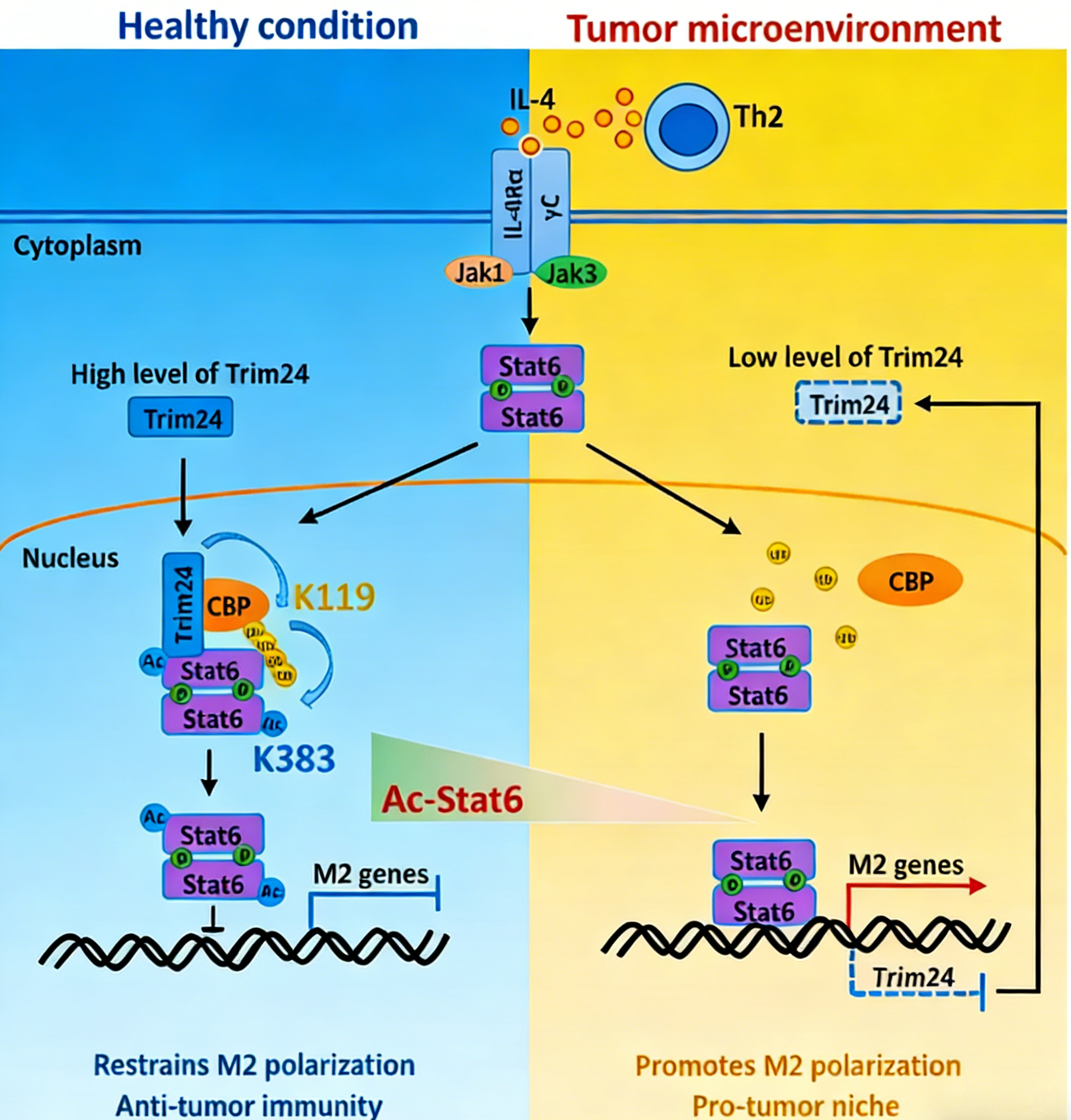
III. Key Findings: TRIM24-Mediated Acetylation of STAT6 Inhibits M2 Polarization
This study reveals a precise post-translational modification pathway regulating STAT6 activity and macrophage M2 polarization.
1. Discovery of STAT6 Acetylation: For the first time, the study found that during M2 polarization of macrophages, the key transcription factor STAT6 undergoes acetylation at the K383 site, mediated by CREB-binding protein. Functional experiments confirmed that this acetylation significantly inhibits STAT6's transcriptional activity and the expression of downstream M2-type signature genes.
2. Elucidation of Upstream Regulatory Mechanisms: Through omics analysis and biochemical validation, the study identified the E3 ubiquitin ligase TRIM24 as a key regulator of this process. TRIM24 can bind to CBP and mediate K63-linked ubiquitination at the K119 site of CBP. This ubiquitination enhances the interaction between CBP and STAT6, thereby promoting CBP-mediated acetylation of STAT6 at K383. Ultimately, this forms a "TRIM24-CBP-STAT6" regulatory axis that negatively regulates M2 polarization.
3. In Vivo Functional and Clinical Relevance Validation: In animal models, macrophage-specific deletion of the Trim24 gene resulted in reduced acetylation levels of STAT6 in TAMs within the tumor microenvironment, leading to enhanced M2 polarization and accelerated tumor growth. Analysis of clinical samples further supported this mechanism: compared to adjacent tissues, TAMs in breast cancer patients' tumor tissues expressed lower levels of TRIM24 and higher levels of M2-type gene markers. Additionally, conditioned medium from tumor cells could suppress TRIM24 expression in macrophages, suggesting that the tumor microenvironment may actively inhibit this negative regulatory pathway to maintain the pro-tumor M2-type TAM phenotype.
IV. Research Significance and Therapeutic Prospects
This study not only elucidates a new mechanism by which STAT6 activity is finely regulated by acetylation but also highlights the central bridging role of TRIM24 in this process. This "acetylation inhibition" pathway provides a new molecular perspective for understanding how the tumor microenvironment "educates" immune cells. The STAT6 His&Strep Tag protein, as an important tool in this mechanistic study, can be used in the future to screen small-molecule compounds that modulate STAT6 acetylation status or to validate therapeutic strategies targeting this interaction interface.
From a translational medicine perspective, the K383 acetylation site of STAT6 and the TRIM24-CBP interaction interface may serve as potential new targets for intervening in TAM polarization and reshaping the tumor immune microenvironment. By developing drugs that activate this pathway (e.g., promoting STAT6 acetylation) or mimic its effects, it may be possible to reverse pro-tumor M2-type TAMs into an anti-tumor phenotype, thereby providing new adjunctive strategies for tumor immunotherapy.
V. Which Manufacturers Provide STAT6 His&Strep Tag Protein?
Nanjing UniLove Protein independently developed the STAT6 His&Strep Tag Protein, Human (Catalog No.: UA085004), a high-purity, high-activity recombinant human signal transducer and activator of transcription 6 (STAT6) protein. It is produced using a mammalian expression system and fused with dual purification/detection tags: His tag and Strep tag. STAT6 is a key downstream transcription factor in the IL-4 and IL-13 signaling pathways, playing a central role in regulating B cell proliferation, Th2 cell differentiation, and allergic and anti-parasitic immunity. This product is suitable for protein-protein interaction studies, transcriptional regulation mechanisms, drug screening, and antibody development, providing a flexible and efficient research tool.
| Core Product Advantages |
|---|
| High Purity and Intact Functional Domains: Expressed in a mammalian expression system to ensure proper domain folding and functional integrity (including DNA-binding domains, etc.). Through tandem affinity purification (His-Strep), high-purity (>95%), low-endotoxin STAT6 protein is obtained, suitable for high-precision interaction studies. |
| Dual Tags Offer Exceptional Flexibility: Fused with His tag and Strep tag II, it enables highly efficient and specific two-step purification via nickel columns or Strep-Tactin resin to achieve extremely high purity. It also provides multiple immobilization and detection options for Pull-down, co-immunoprecipitation, biosensor (SPR/BLI) analysis, significantly expanding experimental design possibilities. |
| Suitable for Various Interaction Studies: This protein retains the potential to interact with phosphorylated tyrosine peptides (e.g., from IL-4 receptors), DNA response elements, and other signaling molecules (e.g., JAK kinases), making it an ideal tool for studying STAT6 phosphorylation activation, nuclear translocation, and transcriptional regulation mechanisms. |
| Excellent Stability and Batch-to-Batch Consistency: Standardized production processes and strict quality control systems ensure consistent purity, activity, and tag-binding capacity across different batches, guaranteeing experimental reproducibility and data reliability. |
| Broad Application Scenarios |
|---|
| Protein-DNA Interactions: Used for gel shift assays (EMSA) or bio-layer interferometry to analyze STAT6 binding to specific DNA sequences. |
| Protein-Protein Interactions: Serves as bait protein for screening or validating signaling molecules or inhibitors that interact with STAT6. |
| Antibody Development and Validation: Acts as a high-quality immunogen or detection antigen for developing specific antibodies against STAT6. |
| Drug Screening Platforms: Constructs in vitro screening models based on STAT6-DNA or STAT6-phosphopeptide interactions. |
Nanjing UniLove Protein is committed to providing high-performance, highly flexible recombinant protein tools for immune signal transduction, transcriptional regulation, and drug discovery. For detailed technical parameters, application protocols, or experimental design consultations regarding STAT6 His&Strep Tag Protein, Human (Catalog No.: UA085004), please feel free to contact us.
Disclaimer: This article partially utilizes artificial intelligence assistance in its creation. If any content involves copyright or intellectual property issues, please let us know and we promise to verify and remove it as soon as possible.
Purchase recombinant protein, choose Nanjing UA-Bio
UA protein focuses on providing various protein reagents, raw materials, and services required for drug research and development, cell therapy, gene therapy, and basic scientific research, including drug target proteins, immune checkpoint proteins, cytokines, tool enzymes, customized protein expression, and full-length transmembrane protein development. Youai is committed to providing customers with high-quality products and professional services, and building a High-tech Biological Enterprise with International Competitiveness.







 Business license (three certificates in one)