




Mechanism Study of Matrix Metalloproteinase-9 in Glymphatic System Dysfunction in Parkinson's Disease


Parkinson's disease is a common neurodegenerative disorder characterized by the progressive loss of dopaminergic neurons in the substantia nigra pars compacta and abnormal accumulation of α-synuclein.
- Recent Advances
I. Research Background: Parkinson's Disease and Glymphatic System Dysfunction
Parkinson's disease is a common neurodegenerative disorder characterized by the progressive loss of dopaminergic neurons in the substantia nigra pars compacta and the abnormal aggregation of α-synuclein. In recent years, the glymphatic system, as a key pathway for clearing metabolic waste and pathological proteins in the central nervous system, has garnered increasing attention for its role in neurodegenerative diseases like Parkinson's. Studies indicate that glymphatic system function is impaired in Parkinson's patients and animal models, potentially exacerbating pathological protein deposition and neuronal damage. However, the specific molecular mechanisms driving glymphatic dysfunction in Parkinson's remain unclear.
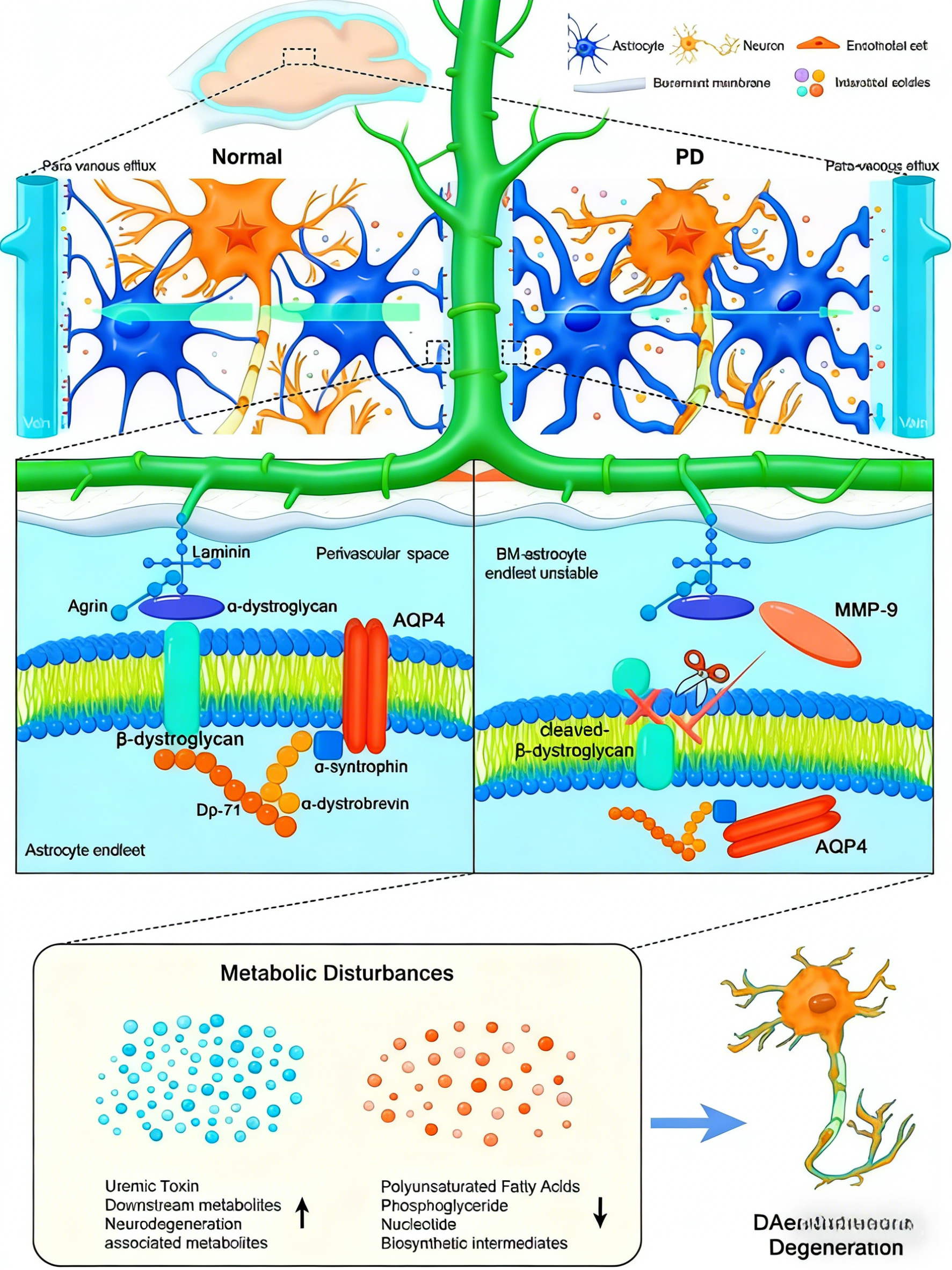
The effective operation of the glymphatic system heavily relies on the polarized localization of aquaporin-4 (AQP4) on astrocyte endfeet. AQP4 regulates water and solute exchange in the paravascular pathway, playing a critical role in cerebrospinal fluid-interstitial fluid circulation. The polarized state of AQP4 is regulated by the integrity of its anchoring protein complex—the dystrophin-glycoprotein complex—where β-dystroglycan serves as a key linker between the extracellular matrix and the cytoskeleton.
II. Core Hypothesis: MMP-9-Mediated β-DG Cleavage Leads to AQP4 Depolarization and Dysfunction
Based on this background, researchers propose a key hypothesis: during Parkinson's progression, the expression and activity of matrix metalloproteinase-9 (MMP-9) from astrocytes or neurons are upregulated. Activated MMP-9 specifically cleaves the extracellular domain of β-dystroglycan, disrupting its structural integrity and destabilizing the connection between astrocyte endfeet and the basement membrane. This disruption causes AQP4 to shift away from the endfoot membrane (depolarization), ultimately impairing glymphatic inflow and outflow functions and exacerbating neuropathological changes.
III. Research Tool: Application of MMP-9(20-707) His Tag Protein in Mechanism Validation
To validate this hypothesis and investigate the interaction between MMP-9 and β-DG, high-purity, functionally intact recombinant MMP-9 protease is an essential research tool. MMP-9(20-707) His Tag Protein offers the following advantages for mechanistic studies:
1. Full-Length Catalytic Domain: This recombinant protein includes the complete propeptide and catalytic domains of MMP-9, mimicking its active form in vivo for studying enzymatic properties.
2. High Purity and Ease of Use: The C-terminal His tag enables efficient purification via immobilized metal ion affinity chromatography, ensuring high-purity protein for precise biochemical and cellular experiments.
3. Substrate Cleavage Validation: The protein can be used directly in in vitro cleavage assays to verify its ability to cleave recombinant or immunoprecipitated β-DG protein or specific peptide fragments, identify cleavage sites, and provide a platform for evaluating the efficacy of specific inhibitors.
IV. Experimental Validation: Functional and Mechanistic Exploration in Animal Models
The research team conducted a series of experiments using Parkinson's mouse models (e.g., MPTP-induced or A53T transgenic models).
1. Characterization of Glymphatic Dysfunction: By injecting fluorescent tracers of varying molecular weights into the cerebellomedullary cistern or striatum, the study confirmed significant glymphatic inflow and outflow dysfunction in Parkinson's model mice, manifested by reduced tracer clearance in brain parenchyma (particularly the striatum and substantia nigra).
2. Role of MMP-9 Inhibitors: Intervention with broad-spectrum MMP inhibitors revealed that suppressing MMP-9 activity significantly alleviated glymphatic dysfunction in model mice, accompanied by improved AQP4 polarization, restored structural connections of astrocyte endfeet, and reduced dopaminergic neuron degeneration.
3. Molecular Mechanism Link: Further immunohistochemical and biochemical analyses showed increased MMP-9 expression and activity in the brains of Parkinson's model mice, particularly in perivascular regions, alongside elevated β-DG cleavage and loss of AQP4 polarity. This provided direct experimental evidence for the hypothesis that "MMP-9 cleavage of β-DG causes AQP4 depolarization."
V. Summary and Future Directions
This study identifies MMP-9 as a key molecular node linking Parkinson's neuropathology to glymphatic system dysfunction. By cleaving β-dystroglycan, MMP-9 disrupts the anchoring structure of astrocyte endfeet, leading to AQP4 depolarization and impaired glymphatic clearance, potentially creating a vicious cycle that exacerbates disease progression. MMP-9(20-707) His Tag Protein, as a core research tool, played a pivotal role in validating this mechanism in vitro. These findings not only deepen our understanding of Parkinson's pathophysiology but also offer potential therapeutic targets: targeting MMP-9 inhibition may emerge as a promising adjunctive strategy to restore glymphatic function and slow disease progression. Future research should further clarify MMP-9's role at different disease stages and explore the potential of more selective MMP-9 inhibitors in preclinical and clinical applications.
VI. Which Manufacturers Provide MMP-9(20-707) His Tag Protein?
Nanjing YouAi Protein independently developed MMP-9(20-707) His Tag Protein, Human (Catalog No.: UA011314), a high-purity, high-activity recombinant human matrix metalloproteinase-9 (MMP-9) protein encompassing the full-length catalytic and hinge domains. This product is produced using a mammalian expression system and includes the complete sequence of MMP-9 from the propeptide to the hinge region (amino acids 20-707), with a C-terminal His tag for easy purification. This form closely resembles the structure of natural MMP-9 zymogen, making it an ideal tool for studying zymogen activation, protein interactions, and developing highly specific inhibitors.
| Core Advantages of the Product |
|---|
| More Complete Domains and Function: Compared to shorter variants containing only the catalytic domain, this product additionally includes the hinge region, which is critical for MMP-9's proper folding, stability, and interactions with natural substrates or inhibitors (e.g., TIMP-1), offering higher physiological relevance for research. |
| Provided as Zymogen for Safety and Control: The product is supplied as inactive pro-MMP-9, which can be controllably activated in vitro (e.g., via APMA or proteolytic cleavage) to generate active enzyme, suitable for studies simulating in vivo activation processes. |
| Excellent Platform for Drug Development and Mechanistic Research: - Inhibitor Screening and Characterization: As a target closer to the natural state, it is used to screen and evaluate novel inhibitors that can interfere with catalytic activity and/or protein interactions. - Protein Interaction Studies: The intact hinge region enables research on MMP-9 binding with tissue inhibitors of metalloproteinases (e.g., TIMP-1) or cell surface receptors (e.g., CD44), revealing its complex regulatory networks in the tumor microenvironment. - Antibody Development and Epitope Mapping: As a high-quality antigen, it can be used to develop domain-specific antibodies (targeting catalytic or hinge regions) for diagnostic or therapeutic purposes. |
| High Purity and Rigorous Quality Control: The mammalian expression system ensures proper glycosylation, and multi-step chromatography yields high-purity (>95%) product. Each batch is validated for purity, concentration, and zymogen form to ensure consistent performance. |
Professional Technical Support: We provide detailed product information, including recommended activation protocols, enzyme activity assays, and application guidance for specific research goals (e.g., protein interactions or inhibitor discovery).
Nanjing YouAi Protein is committed to providing structurally intact, functionally defined high-quality tool proteins for research on tumor invasion, tissue remodeling, and inflammatory diseases. For detailed technical parameters, domain schematics, or application advice regarding MMP-9(20-707) His Tag Protein, Human (Catalog No.: UA011314), please feel free to contact us.
Disclaimer: This article partially utilizes artificial intelligence assistance in its creation. If any content involves copyright or intellectual property issues, please let us know and we promise to verify and remove it as soon as possible.
Purchase recombinant protein, choose Nanjing UA-Bio
UA protein focuses on providing various protein reagents, raw materials, and services required for drug research and development, cell therapy, gene therapy, and basic scientific research, including drug target proteins, immune checkpoint proteins, cytokines, tool enzymes, customized protein expression, and full-length transmembrane protein development. Youai is committed to providing customers with high-quality products and professional services, and building a High-tech Biological Enterprise with International Competitiveness.







 Business license (three certificates in one)