




Controlled immobilization of SCF His Tag protein in hydrogels and its functional regulation on hematopoietic stem cells


Hematopoietic stem cells are a critical cell population responsible for maintaining lifelong hematopoietic function, and their fate decisions between self-renewal and differentiation are precisely regulated by various cytokines and extracellular matrices within the bone marrow niche (niche).
- Recent Advances
I. Research Background: Biomimetic Design of Biomaterials for Stem Cell Microenvironments
Hematopoietic stem cells (HSCs) are a critical cell population responsible for maintaining lifelong hematopoiesis. Their fate decisions between self-renewal and differentiation are precisely regulated by various cytokines and extracellular matrices within the bone marrow niche. To replicate this complex microenvironment in vitro for supporting HSC expansion and phenotype maintenance, integrating key cytokines (such as stem cell factor) into three-dimensional biomaterial scaffolds in a controlled and sustained manner is an important strategy in tissue engineering and regenerative medicine. Among these, methacrylated gelatin (GelMA) hydrogels, with their excellent biocompatibility, tunable mechanical properties, and ease of photo-crosslinking, have become an ideal material for constructing in vitro hematopoietic microenvironments. However, the technical challenge lies in how to efficiently and stably immobilize cytokines within the GelMA network while preserving their bioactivity to precisely regulate HSC behavior.
II. Advantages of SCF His Tag Protein as a Research Tool
In studies on cytokine immobilization strategies, high-purity, easily traceable, and manipulable recombinant proteins are essential. The SCF His Tag protein offers unique advantages for such research:
1. High Purity Assurance: The His tag facilitates efficient purification via metal-chelating chromatography, yielding high-purity SCF protein, ensuring a clear starting point for immobilization studies and minimizing interference from impurities.
2. Functional Validation Basis: It can be directly used to verify whether modifications or immobilization treatments affect its binding ability to the c-Kit receptor and downstream signaling activation, providing a foundation for subsequent biomaterial construction.
3. Versatility in Immobilization Strategies: The N- or C-terminal His tag provides additional chemical handles for potential site-specific conjugation strategies (e.g., via metal coordination or His tag-specific chemical reactions), enhancing the flexibility of immobilization methods.
III. Chemical Immobilization Strategy for SCF: Acrylated PEG-NHS Crosslinking Method
To achieve long-term, controlled loading of SCF in GelMA hydrogels, a two-step chemical conjugation strategy was employed:
1. Protein Functionalization: Acrylated polyethylene glycol N-hydroxysuccinimide ester (AC-PEG-NHS) was reacted with primary amines (lysine residues) on the surface of the SCF His Tag protein under mild conditions (pH 8.0 PBS buffer). This step covalently attaches a PEG chain with an acrylate double bond to the SCF molecule, resulting in a "double-bond-functionalized" PEG-SCF conjugate. Successful modification can be confirmed by molecular weight shifts in gel electrophoresis (e.g., SDS-PAGE).
2. Covalent Immobilization in Hydrogel: The modified PEG-SCF conjugate was mixed with GelMA prepolymer solution and subjected to UV irradiation in the presence of a photoinitiator. During this process, the methacrylate double bonds on GelMA and the acrylate double bonds on PEG-SCF undergo radical copolymerization, forming a covalent network that permanently anchors SCF within the three-dimensional gel matrix.
IV. Impact of Different Loading Modes on SCF Release Kinetics and Bioactivity
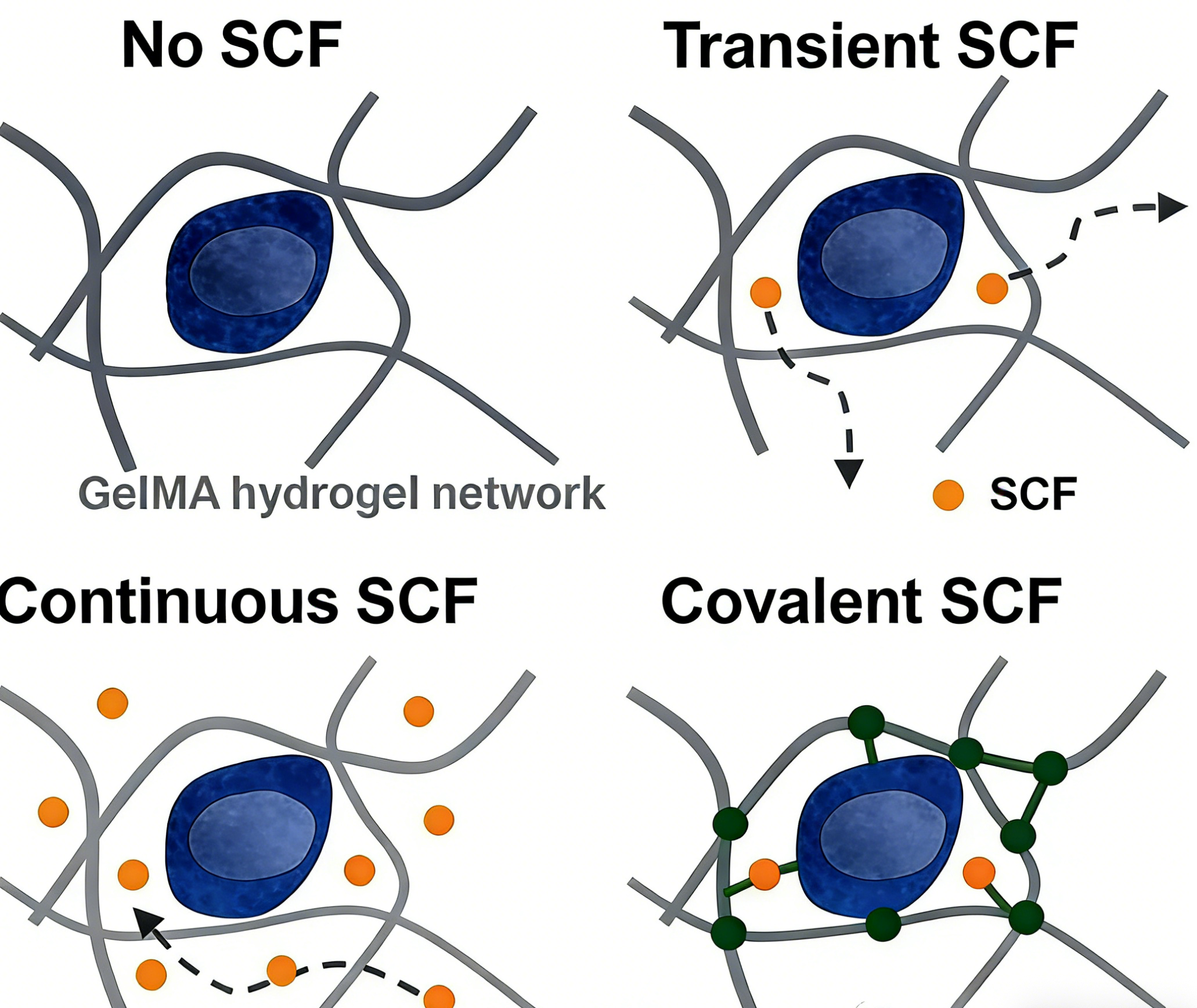
To evaluate the advantages of the chemical immobilization strategy, the study systematically compared the effects of four different SCF loading models on HSC function:
1. No SCF Loading Group: Served as a negative control.
2. Physical Mixing Group: The SCF His Tag protein was simply mixed into the GelMA precursor solution for physical encapsulation.
3. Continuous Supplementation Group: In addition to physical mixing, soluble SCF was continuously added to the culture medium.
4. Covalent Immobilization Group: The AC-PEG-NHS strategy was used to covalently immobilize SCF within the GelMA network.
The results showed:
- Release Kinetics: Physically mixed SCF exhibited rapid release (approximately 60% within 12 hours), while covalently immobilized SCF retained over 80% after 7 days, achieving long-term, stable local signal presentation.
- Bioactivity Retention: Cell proliferation assays confirmed that the bioactivity of SCF in promoting HSC proliferation was effectively preserved after AC-PEG-NHS modification and covalent immobilization.
V. Selective Regulation of HSC Function by Covalently Immobilized SCF
In the three-dimensional GelMA culture system, covalently immobilized SCF demonstrated unique biological effects:
1. Proliferation and Phenotype Regulation: Unlike soluble SCF, which induced rapid HSC expansion, HSCs cultured in hydrogels with covalently immobilized SCF exhibited slower overall proliferation.
2. Primitive State Maintenance: More importantly, the covalently immobilized SCF environment significantly increased the proportion of HSC subpopulations maintaining a primitive phenotype (e.g., Lin⁻Sca-1⁺c-Kit⁺). This suggests that locally and persistently presented SCF signals from the hydrogel matrix better mimic the niche function of the in vivo microenvironment, promoting HSC self-renewal rather than rapid differentiation, thereby selectively regulating HSC fate.
VI. Summary and Future Perspectives
This study successfully immobilized the SCF His Tag protein in a long-term and bioactive manner within GelMA hydrogels using the AC-PEG-NHS crosslinking strategy, constructing a biomimetic three-dimensional microenvironment that replicates key signaling features of the bone marrow niche. This strategy not only addresses the issue of rapid cytokine loss in materials but, more importantly, reveals the profound impact of signal presentation modes (soluble diffusion vs. matrix immobilization) on HSC fate. It provides essential design principles and methodological references for developing next-generation smart biomaterials for in vitro HSC expansion, maintenance, or differentiation. In the future, combining the co-immobilization of other cytokines or adhesion ligands may enable the construction of more functionally comprehensive and finely regulated composite artificial hematopoietic microenvironments.
Disclaimer: This article partially utilizes artificial intelligence assistance in its creation. If any content involves copyright or intellectual property issues, please let us know and we promise to verify and remove it as soon as possible.
Purchase recombinant protein, choose Nanjing UA-Bio
UA protein focuses on providing various protein reagents, raw materials, and services required for drug research and development, cell therapy, gene therapy, and basic scientific research, including drug target proteins, immune checkpoint proteins, cytokines, tool enzymes, customized protein expression, and full-length transmembrane protein development. Youai is committed to providing customers with high-quality products and professional services, and building a High-tech Biological Enterprise with International Competitiveness.







 Business license (three certificates in one)