




IL-6 signaling pathway: molecular mechanisms, biological functions, and disease associations


Interleukin-6 is a pleiotropic cytokine secreted by various cells (such as macrophages, T cells, fibroblasts, etc.)
- Recent Advances
- Product Information
I. Molecular Basis of IL-6 and Its Signaling Pathway
Interleukin-6 (IL-6) is a pleiotropic cytokine secreted by various cells (such as macrophages, T cells, fibroblasts, etc.), playing a central role in immune regulation, inflammatory responses, hematopoietic regulation, and neuroendocrine processes, among other physiological and pathological processes. Its biological effects are achieved by binding to specific receptor complexes on target cell surfaces, activating downstream signal transduction networks. The core components of this signaling system include:
1. IL-6 Receptor: Divided into membrane-bound IL-6R (primarily expressed on hepatocytes and certain immune cells) and soluble IL-6R (produced through proteolytic cleavage or alternative splicing).
2. Signal Transducing Subunit gp130: Widely expressed on cell surfaces, it serves as the common subunit for signal transduction.
3. Downstream Signaling Molecules: Mainly include the Janus kinase family (JAKs) and the signal transducer and activator of transcription family (particularly STAT3), while also activating the Ras-MAPK and PI3K-Akt pathways.
II. Two Major Modes of IL-6 Signal Transduction
IL-6 signaling primarily occurs through two mechanisms, expanding its cellular range and functional complexity.
1. Classic Signaling: IL-6 binds to target cells expressing membrane-bound IL-6R, subsequently recruiting gp130 to form a functional receptor complex, which activates the associated JAK kinases.
2. Trans-Signaling: IL-6 forms a complex with soluble IL-6R in the extracellular space, which can bind to and activate cells expressing only gp130. This mechanism allows IL-6 to act on a broader range of cell types that do not express IL-6R, playing a critical role in amplifying inflammation and tissue damage.
Regardless of the mode, both ultimately lead to the activation of JAK kinases, which phosphorylate and activate STAT3. Activated STAT3 forms dimers and translocates to the nucleus, regulating the transcription of downstream target genes. This pathway is finely regulated by negative feedback mechanisms, such as suppressor of cytokine signaling proteins, to ensure timely signal termination.
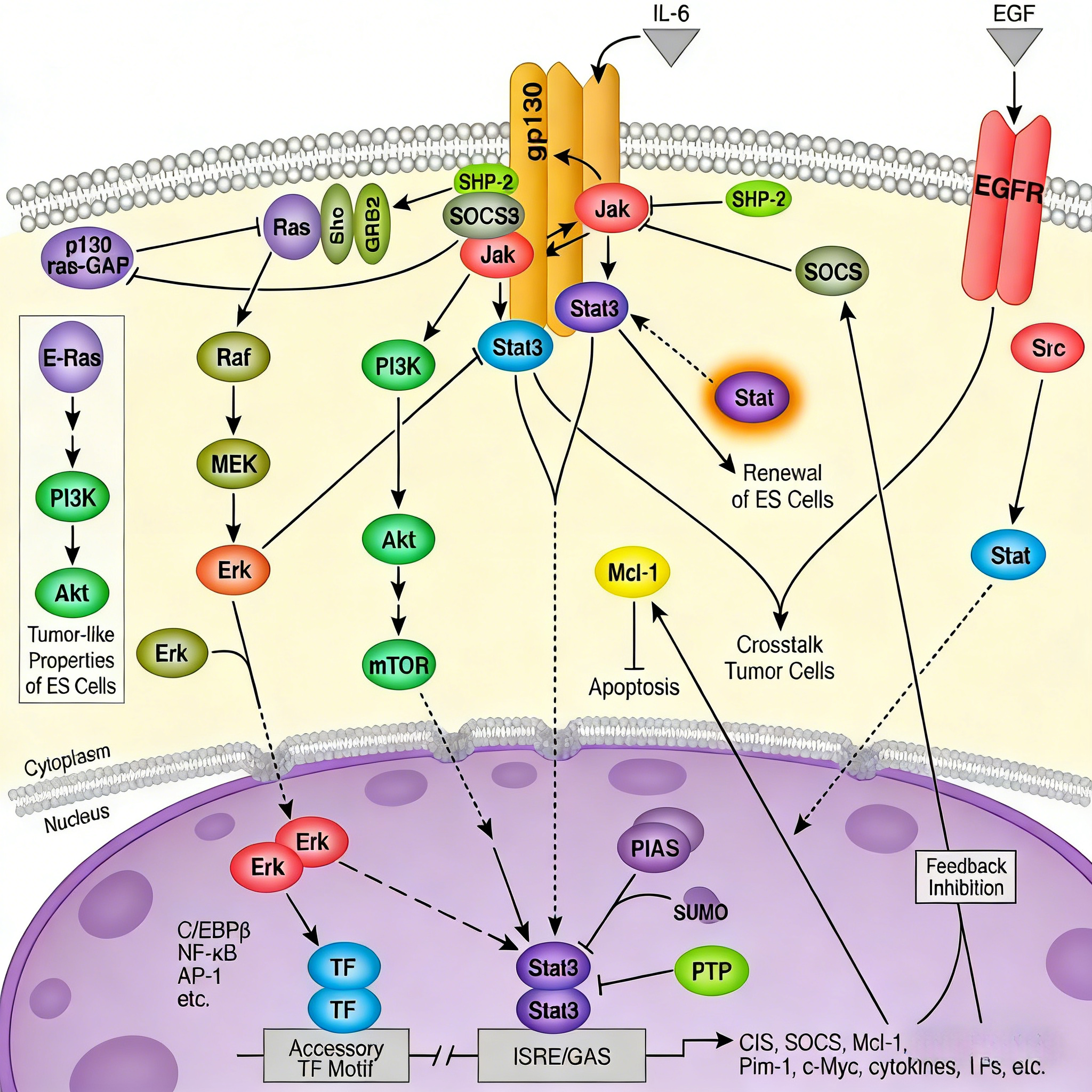
III. Core Biological Functions of IL-6 Signaling
The widespread activation of IL-6 signaling affects multiple systems in the body:
1. Immune Regulation:
- B Cells: Promotes B cell proliferation and differentiation into plasma cells, driving antibody production.
- T Cells: A key factor in the differentiation of Th17 cells while suppressing regulatory T cell function, playing a dual role in balancing infection defense and autoimmunity.
2. Inflammatory Responses: As a key pro-inflammatory cytokine, IL-6 is the primary signal inducing the liver to produce acute-phase proteins like C-reactive protein and recruits leukocytes to inflammatory sites.
3. Hematopoietic Regulation: Collaborates with other growth factors to regulate the proliferation and differentiation of hematopoietic stem/progenitor cells, influencing megakaryocyte production.
4. Other Physiological and Pathological Processes: Involved in bone metabolism (promoting osteoclast activity), neural function regulation, and closely linked to cardiovascular diseases and metabolic syndrome.
IV. Dysregulation of IL-6 Signaling and Human Diseases
Excessive or sustained activation of the IL-6 signaling pathway is a core pathological feature of several major diseases:
1. Autoimmune and Inflammatory Diseases: In conditions like rheumatoid arthritis and systemic lupus erythematosus, elevated IL-6 levels drive local and systemic inflammation, leading to tissue damage. In inflammatory bowel disease, it promotes persistent intestinal mucosal inflammation.
2. Cancer: IL-6 activates pathways like STAT3 in various tumor microenvironments, promoting tumor cell proliferation, survival, invasion, and angiogenesis while suppressing anti-tumor immune responses, making it a key driver of immune evasion.
3. Cardiovascular Diseases: Contributes to the development of atherosclerosis by promoting vascular inflammation; its levels correlate with poor prognosis after myocardial infarction.
4. Cytokine Storm: In severe infections (e.g., sepsis) or certain immunotherapies, excessive IL-6 release is a key mediator of life-threatening systemic hyperinflammatory responses (cytokine storm).
V. IL-6 Protein as a Research and Therapeutic Target
Given the central role of the IL-6 pathway in physiology and pathology, IL-6 protein itself is not only a key effector molecule but also an important research tool and drug development target.
1. Basic Research Tool: High-purity recombinant IL-6 protein is essential for in vitro studies of this signaling pathway, used to stimulate cells, activate pathways, and investigate downstream gene expression and functional changes.
2. Drug Mechanism Research and Screening: As a standard ligand, it is used to evaluate and screen the neutralizing activity of therapeutic antibodies targeting IL-6, IL-6R, or downstream signaling molecules (e.g., JAK kinase inhibitors) or the blocking efficacy of small-molecule inhibitors.
3. Disease Model Construction: In animal models, exogenous administration of IL-6 protein can simulate or amplify inflammatory states to study specific disease pathologies.
Currently, targeting the IL-6 pathway (e.g., using IL-6R monoclonal antibodies) has become an effective strategy for treating autoimmune diseases like rheumatoid arthritis and is being explored for broader applications in inflammatory diseases and certain cancers.
VI. Which Manufacturers Provide IL-6 Protein?
Nanjing YouAi Protein independently developed IL-6 Protein, Human (Catalog No.: UA040052), a high-purity, high-activity recombinant human interleukin-6 (IL-6) protein produced using a mammalian expression system, fully retaining its natural biological function and conformation. This product has undergone rigorous validation for purity, activity, and stability, making it suitable for various applications, including inflammation mechanism research, immune regulation experiments, cell culture additives, antibody drug screening, and target validation.
| Core Product Advantages |
|---|
| High Purity and Natural Conformation: Expressed in a mammalian system to ensure proper folding and glycosylation, purified through multiple chromatography steps with >95% purity and low endotoxin levels, accurately mimicking native IL-6 bioactivity. |
| Exceptional Biological Activity: Validated via IL-6-dependent cell (e.g., 7TD1 or TF-1 cells) proliferation assays, exhibiting high specific activity to effectively activate IL-6 signaling, suitable for cell function studies and in vitro efficacy evaluation. |
| Broad Application Compatibility: Compatible with various experimental systems, including cell stimulation and signal transduction research, antibody/inhibitor screening (ELISA/SPR/BLI), as a standard for quantitative detection, and as an immunogen for antibody development. |
| Excellent Stability and Batch Consistency: Standardized production and strict quality control ensure consistent purity, activity, and stability across batches, guaranteeing experimental reproducibility and reliability. |
| Professional Technical Support: We provide detailed product manuals, recommended protocols, storage guidelines, and expert technical consultation for IL-6 research in inflammation, tumor immunology, and cell therapy. |
Nanjing YouAi Protein is committed to providing high-quality core protein tools for immunology research, inflammatory disease model construction, and innovative drug development. For detailed technical information, activity validation data, or application inquiries regarding IL-6 Protein, Human (Catalog No.: UA040052), please feel free to contact us.
Disclaimer: This article partially utilizes artificial intelligence assistance in its creation. If any content involves copyright or intellectual property issues, please let us know and we promise to verify and remove it as soon as possible.
Purchase recombinant protein, choose Nanjing UA-Bio
UA protein focuses on providing various protein reagents, raw materials, and services required for drug research and development, cell therapy, gene therapy, and basic scientific research, including drug target proteins, immune checkpoint proteins, cytokines, tool enzymes, customized protein expression, and full-length transmembrane protein development. Youai is committed to providing customers with high-quality products and professional services, and building a High-tech Biological Enterprise with International Competitiveness.







 Business license (three certificates in one)