




IL-17A: The Dual Role of a Pleiotropic Cytokine in Homeostasis Maintenance and Inflammatory Diseases


IL-17A is the most characteristic member of the IL-17 cytokine family, and its core function lies in mediating the host's early innate immune defense.
- Recent Advances
- Product Information
I. Core Biological Functions of IL-17A
IL-17A is the most characterized member of the IL-17 cytokine family, with its core function being the mediation of early innate immune defense, particularly against extracellular fungi (e.g., Candida albicans) and bacteria (e.g., Staphylococcus aureus). IL-17A primarily activates stromal cells such as epithelial cells and fibroblasts, inducing the production of a series of effector molecules, including:
1. Chemokines: Such as CXCL1, CXCL2, and CXCL8 (IL-8), which recruit myeloid cells like neutrophils to sites of infection or injury.
2. Pro-inflammatory cytokines: Such as IL-6 and granulocyte colony-stimulating factor, further amplifying the inflammatory response.
3. Antimicrobial peptides: Such as defensins and lipocalin 2, which directly kill or inhibit pathogenic microorganisms.
Thus, the IL-17A signaling pathway is crucial for maintaining local immune surveillance and antimicrobial defense in barrier tissues like the skin and mucosa. Genetic or acquired defects in this pathway can lead to severe opportunistic infections such as chronic mucocutaneous candidiasis.
II. Regulatory Role of IL-17A in Tissue Homeostasis and Repair
Under steady-state conditions, IL-17A is not always pro-inflammatory; it plays finely tuned, non-inflammatory physiological regulatory roles in multiple tissues:
1. Skin and gut homeostasis: In healthy skin and gut, localized IL-17A produced by specific immune cells (e.g., non-classical T cells) in response to commensal microbes promotes epithelial production of antimicrobial peptides, enhancing barrier defense without triggering significant tissue inflammation. This "homeostatic" IL-17A signaling is key to maintaining tissue-microbe symbiosis.
2. Tissue repair and fibrosis regulation: IL-17A participates in wound healing, such as accelerating skin wound repair by promoting keratinocyte proliferation. In kidney injury models, IL-17A can induce matrix metalloproteinase production through specific mechanisms (e.g., the kallikrein-kinin system), reducing fibrotic scar formation and demonstrating organ-protective effects.
3. Metabolic regulation: In adipose tissue, IL-17A is involved in regulating glucose homeostasis, lipogenesis, and thermogenesis, suggesting its role in metabolic balance.
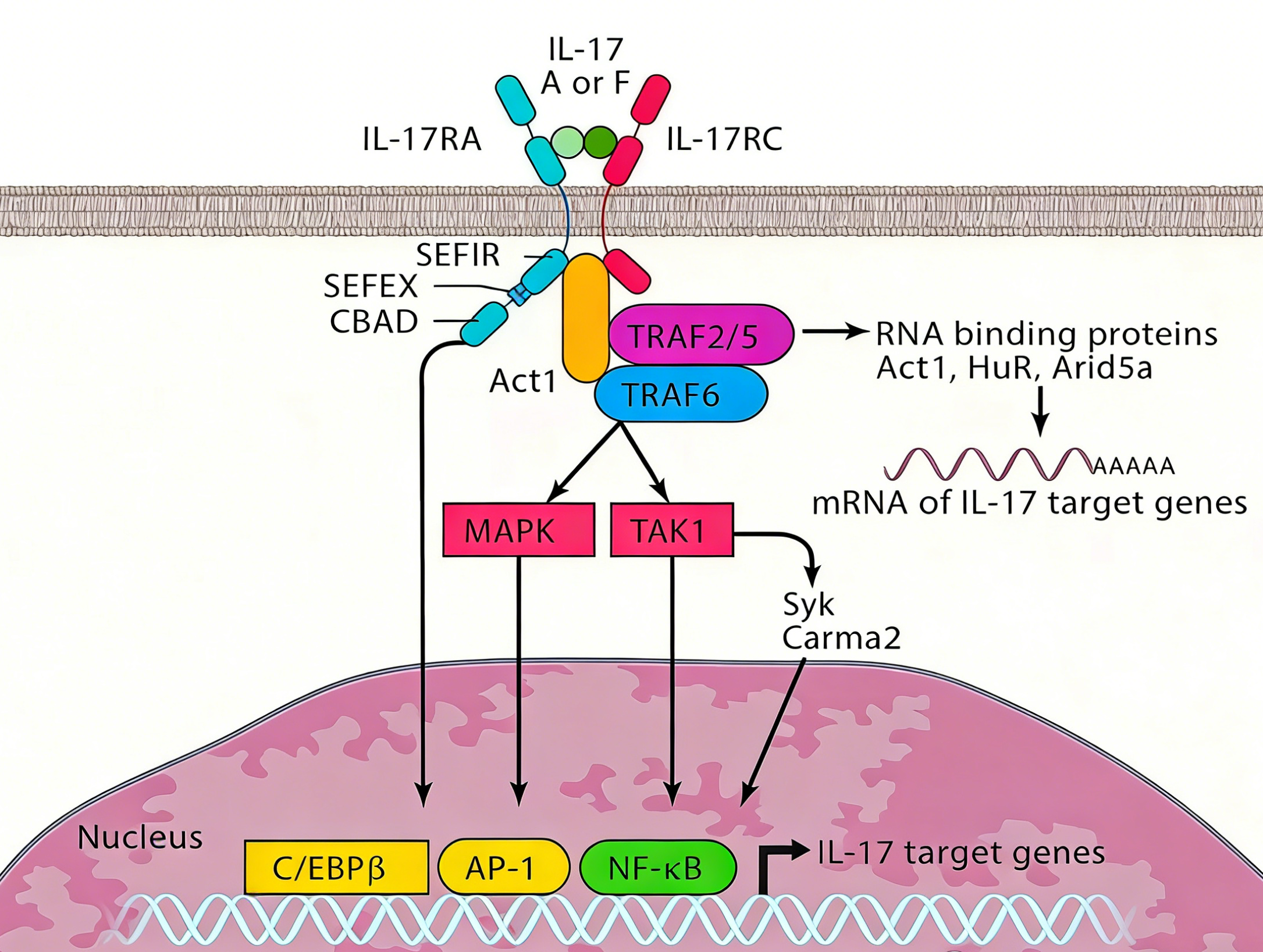
III. Dysregulation of IL-17A Signaling and Disease Associations
When IL-17A production becomes uncontrolled or its targets are inappropriate, its potent pro-inflammatory and tissue-remodeling capabilities drive various chronic inflammatory and autoimmune diseases.
1. Psoriasis and psoriatic arthritis: IL-17A is a central cytokine driving the formation of psoriatic lesions and joint inflammation. Biologics targeting IL-17A or its receptors have become effective treatments for these conditions.
2. Ankylosing spondylitis: Similar to psoriatic arthritis, IL-17A plays a key role in the pathology of this disease, and blocking its signaling shows significant therapeutic efficacy.
3. Neuroinflammation and injury: In models of central nervous system diseases such as multiple sclerosis and stroke, IL-17A can promote neuroinflammation, exacerbate oligodendrocyte damage, and hinder functional recovery. Recent studies also suggest its potential association with epilepsy, cognitive dysfunction, and certain behavioral abnormalities.
4. Other diseases: IL-17A participates in immune complex deposition in lupus nephritis and is elevated in obesity-related metabolic inflammation. Its effects exhibit a complex "double-edged sword" nature, depending on the tissue microenvironment and disease stage.
IV. Research Tools: Application Value of IL-17A / CTLA-8(24-155) His Tag Protein
To elucidate the specific mechanisms of IL-17A in these complex biological processes and facilitate drug development, high-purity, functionally defined recombinant proteins are essential. The IL-17A / CTLA-8(24-155) His Tag Protein provides a standardized solution:
1. Structural design and advantages: This protein contains the mature active portion of IL-17A (also known as CTLA-8, amino acids 24-155) and is expressed with a polyhistidine tag. This design ensures the protein retains native biological activity while enabling efficient purification via metal chelate chromatography.
2. Key applications:
- In vitro functional studies: As a standardized cytokine, it directly stimulates target cells (e.g., epithelial cells, fibroblasts, synovial cells) to study its induction of downstream gene expression (e.g., chemokines, antimicrobial peptides) and mechanisms of activating signaling pathways like MAPK and NF-κB.
- Receptor interaction analysis: Used to study its binding properties with receptor complexes (IL-17RA/IL-17RC) or evaluate the competitive blocking ability of candidate neutralizing antibodies or soluble receptors.
- Drug screening and evaluation: Serves as a positive control or stimulant in cell-based reporter gene systems or functional assays to screen and evaluate the efficacy of small-molecule inhibitors or biologics targeting the IL-17A pathway.
- Animal model studies: In some studies, it can be administered locally or systemically as an exogenous stimulant to mimic or investigate its role in specific pathological models.
V. Which Manufacturers Provide IL-17A / CTLA-8(24-155) His Tag Protein?
Nanjing U-AIR Biotech independently developed the IL-17A / CTLA-8(24-155) His Tag Protein, Human (Catalog No.: UA040508), a high-purity, high-activity recombinant human interleukin-17A (IL-17A, also known as CTLA-8). This product is produced using a mammalian expression system, with the expression sequence corresponding to the mature protein's amino acids 24-155 and a C-terminal His tag for purification and detection. IL-17A is a key pro-inflammatory cytokine secreted by Th17 cells, playing a central role in host defense, autoimmune diseases (e.g., psoriasis, rheumatoid arthritis), and chronic inflammation. This product is suitable for cell function studies, antibody screening, and signaling pathway analysis.
| Core Product Advantages |
|---|
| High purity and native homodimeric conformation: Expressed in a mammalian system, ensuring the protein forms the correct, biologically active homodimer structure. Purified via affinity chromatography, with >95% purity and low endotoxin levels, it faithfully mimics native IL-17A's biological functions. |
| Exceptional bioactivity: Validated in inflammation factor (e.g., IL-6, CXCL1) induction assays using cells expressing IL-17RA/RC receptors (e.g., HEK293 reporter cells or mouse embryonic fibroblasts), demonstrating high specific activity and effective activation of downstream NF-κB and MAPK pathways. |
| His tag for convenience: The C-terminal His tag enables rapid purification via nickel columns and can be used for His-tag-based detection or immobilization, enhancing experimental flexibility. |
| Excellent stability and batch consistency: Standardized production and strict quality control ensure consistent purity, activity, and dimer stability across batches, guaranteeing experimental reproducibility and data reliability. |
Nanjing U-AIR Biotech is committed to providing high-quality core cytokine tools for autoimmune disease, inflammation research, and antibody drug development. For detailed technical parameters, activity validation data, or application inquiries regarding the IL-17A / CTLA-8(24-155) His Tag Protein, Human (Catalog No.: UA040508), please feel free to contact us.
Disclaimer: This article partially utilizes artificial intelligence assistance in its creation. If any content involves copyright or intellectual property issues, please let us know and we promise to verify and remove it as soon as possible.
Purchase recombinant protein, choose Nanjing UA-Bio
UA protein focuses on providing various protein reagents, raw materials, and services required for drug research and development, cell therapy, gene therapy, and basic scientific research, including drug target proteins, immune checkpoint proteins, cytokines, tool enzymes, customized protein expression, and full-length transmembrane protein development. Youai is committed to providing customers with high-quality products and professional services, and building a High-tech Biological Enterprise with International Competitiveness.







 Business license (three certificates in one)