




Mechanistic study on how intestinal epithelial IL-17RA signaling influences distal tumor progression by modulating microbiota and immune balance


The intestine is not only an organ for digestion and absorption but also a crucial immune barrier in the human body. Intestinal epithelial cells express various pattern recognition receptors and cytokine receptors on their surfaces.
- Recent Advances
- Product Information
I. Research Background and Scientific Questions
The gut is not only an organ for digestion and absorption but also a critical immune barrier in the human body. Intestinal epithelial cells, through their surface-expressed pattern recognition receptors and cytokine receptors, play a central role in sensing luminal contents (including commensal microbes) and regulating local and systemic immune homeostasis. Interleukin-17 receptor A (IL-17RA) is the primary receptor mediating the signaling of key pro-inflammatory cytokines IL-17A and IL-17F. Although the role of IL-17 signaling in the tumor microenvironment has been extensively studied, the specific mechanisms by which intestinal epithelial cell-derived IL-17RA signaling remotely regulates the growth of distal organ tumors (e.g., pancreas, brain) via the "gut-axis" remain unclear. Investigating how local gut immune signals influence tumor progression through systemic effects is crucial for understanding the complexity of tumor immune evasion and developing novel therapies.
II. Key Finding: Loss of Intestinal Epithelial IL-17RA Promotes Distal Tumor Growth
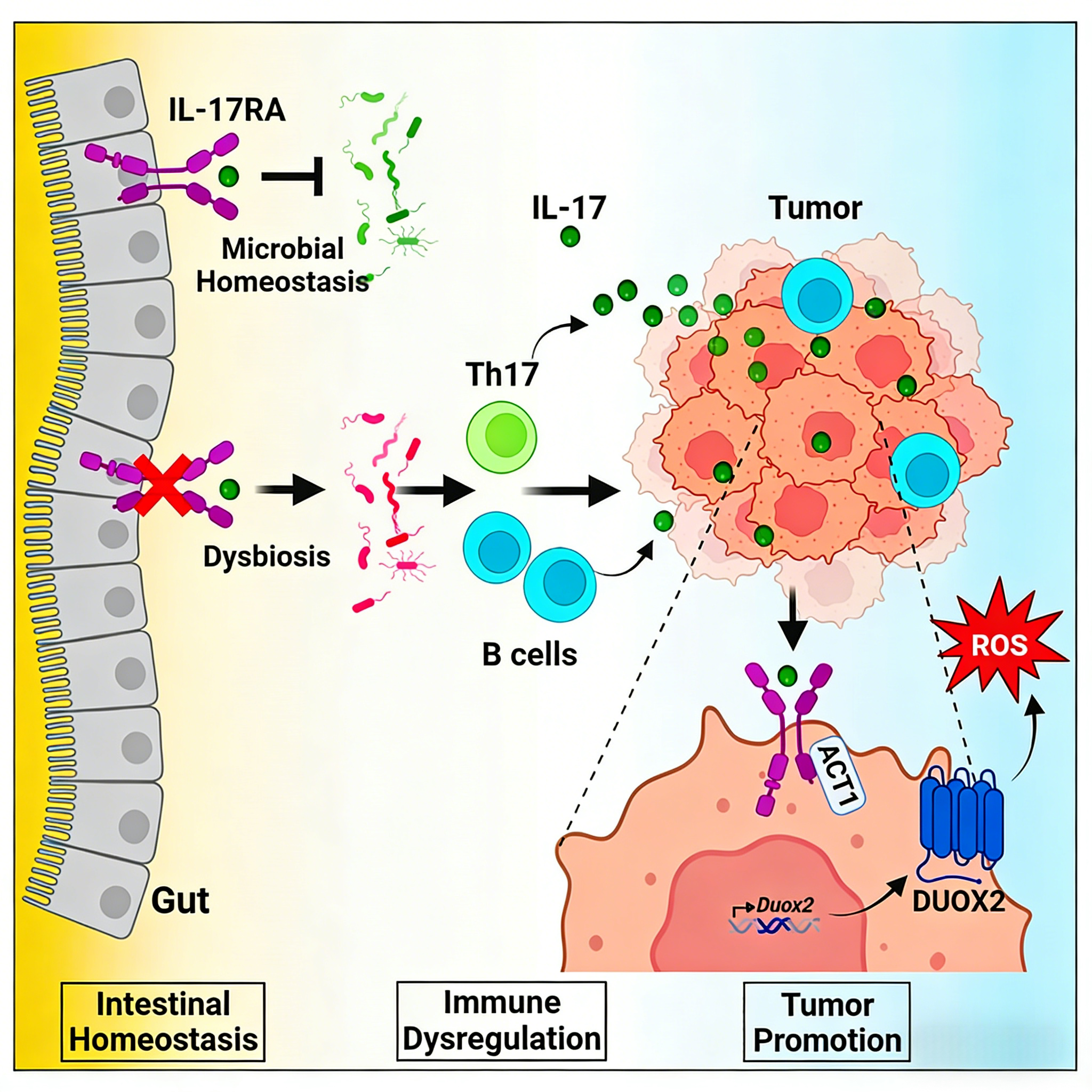
A recent study, using a mouse model with intestinal epithelial cell-specific knockout of IL-17RA, explored the role of this signaling pathway in tumorigenesis. The study found that compared to wild-type controls, mice lacking IL-17RA in intestinal epithelial cells exhibited significantly accelerated growth of transplanted tumors in distal sites such as the pancreas and brain. Mechanistic studies revealed that the loss of local IL-17RA signaling disrupted gut immune homeostasis, leading to systemic immune remodeling. Specifically, compensatory increases in gut-derived IL-17 promoted the expansion of Th17 cells and altered circulating B-cell subsets, collectively creating a pro-tumor systemic immune microenvironment.
III. Mechanism: Microbial-Dependent Signaling Axis and DUOX2 Pathway Activation
Further research identified key molecular bridges linking local gut signal dysregulation to distal tumor progression.
1. Critical Role of Microbiota: The integrity of intestinal epithelial IL-17RA signaling is essential for maintaining gut microbiota balance. Its loss led to significant alterations in microbiota composition, which was necessary for driving subsequent systemic immune changes and promoting tumor growth.
2. DUOX2 Pathway Activation in Distal Tumor Cells: The study found that microbiota-driven systemic IL-17 elevation remotely activated the dual oxidase 2 (DUOX2) pathway in distal tumor cells. DUOX2, a key enzyme generating reactive oxygen species, may accelerate tumor progression by inducing oxidative stress, promoting tumor cell proliferation, or inhibiting apoptosis.
3. Clinical Relevance: Analysis of pancreatic ductal adenocarcinoma patient samples revealed a positive correlation between IL-17 expression in tumor-infiltrating lymphocytes/peripheral blood and DUOX2 expression in tumor tissue, supporting the potential relevance of this mechanism in human disease.
IV. Research Tool: Application of IL-17RA/CD217(33-320) Fc Chimera Protein
High-quality recombinant protein tools are indispensable for validating molecular mechanisms, particularly IL-17-receptor interactions and downstream signaling. The IL-17RA/CD217(33-320) Fc Chimera Protein provides robust support:
1. Structure and Functional Design: The protein contains the IL-17RA extracellular ligand-binding domain (aa 33-320) fused to an IgG Fc segment, enhancing stability, half-life, and facilitating purification/immobilization via Protein A/G.
2. Mechanistic Research Applications:
- Ligand Binding and Competition Analysis: Serves as a standard receptor for assessing IL-17A/F binding affinity or testing neutralizing antibodies/decoy receptors.
- Signaling Pathway Studies: Investigates IL-17RA signaling alone or in combination with other subunits (e.g., IL-17RC).
- Cell Functional Assays: Acts as an exogenous stimulator/blocker to study IL-17RA's impact on gut epithelial cells, immune cells, or tumor cells.
V. Therapeutic Implications and Future Directions
This study reveals a novel "gut epithelial IL-17RA-microbiota-systemic immunity-distal tumor" axis and offers insights for cancer therapy:
1. Complexity of Targeted Therapy: Pharmacological IL-17RA inhibition alone showed limited efficacy, likely due to compensatory microbial-IL-17 feedback loops post-signal loss.
2. Combined Intervention Strategies: Simultaneously targeting microbiota (e.g., probiotics, prebiotics, or selective antibiotics) and IL-17 signaling may be more effective.
3. Future Prospects: Identifying specific gut bacteria/metabolites driving this axis and validating its universality in human cancers will lay the groundwork for microbiota-immune combo therapies.
VI. Suppliers of IL-17RA/CD217(33-320) Fc Chimera Protein
Nanjing U-IP Biological's IL-17RA/CD217(33-320) Fc Chimera Protein, Human (Cat#: UA011361) is a high-purity, bioactive recombinant fusion protein. It features the IL-17RA extracellular domain (aa 33-320) fused to an IgG1 Fc, expressed in mammalian cells as stable homodimers. This product is a key tool for studying IL-17 signaling, inflammatory/autoimmune diseases, and drug screening.
| Core Advantages |
|---|
| High Purity & Native Conformation: Mammalian expression ensures proper folding, glycosylation, and dimer stability. Multi-step purification (e.g., Protein A) yields >95% purity with low endotoxins, preserving native function. |
| Stable Dimer Enhances Functionality: Fc-mediated homodimers mimic native multivalent receptors, boosting avidity for IL-17A/F ligands in binding, neutralization, or blocking assays. |
| Precise Extracellular Domain: Contains the core functional region (33-320) mediating interactions with IL-17 ligands and co-receptors (e.g., IL-17RC). |
| Excellent Stability & Batch Consistency: Rigorous QC ensures consistent purity, molecular weight, and bioactivity across batches. |
Nanjing U-IP Biological specializes in high-performance molecular tools for inflammation/autoimmunity research, cytokine signaling, and drug development. For detailed specifications, binding data, or application support for IL-17RA/CD217(33-320) Fc Chimera Protein, Human (Cat#: UA011361), please contact us.
Disclaimer: This article partially utilizes artificial intelligence assistance in its creation. If any content involves copyright or intellectual property issues, please let us know and we promise to verify and remove it as soon as possible.
Purchase recombinant protein, choose Nanjing UA-Bio
UA protein focuses on providing various protein reagents, raw materials, and services required for drug research and development, cell therapy, gene therapy, and basic scientific research, including drug target proteins, immune checkpoint proteins, cytokines, tool enzymes, customized protein expression, and full-length transmembrane protein development. Youai is committed to providing customers with high-quality products and professional services, and building a High-tech Biological Enterprise with International Competitiveness.







 Business license (three certificates in one)