




Precision treatment strategy for patients with growth hormone receptor inactivation mutations: Exploration of high-dose growth hormone intervention


The growth hormone signaling pathway is a critical endocrine axis that regulates linear body growth, metabolic homeostasis, and tissue repair. The proper functioning of this pathway relies on the precise binding of growth hormone to its cell surface receptor and subsequent signal transduction.
- Recent Advances
- Product Information
I. Growth Hormone Signaling Pathway and Receptor Function Inactivating Mutations
The growth hormone signaling pathway is a key endocrine axis that regulates linear growth, metabolic homeostasis, and tissue repair. The normal functioning of this pathway depends on the precise binding and signal transduction between growth hormone and its cell surface receptor. When dominant negative mutations occur in the growth hormone receptor gene, even in the presence of sufficient or excessive circulating growth hormone, the signal cannot be effectively transmitted, leading to cellular resistance to growth hormone. Clinically, this manifests as severe growth retardation, short stature, and ineffectiveness of conventional growth hormone therapy. Therefore, exploring precise intervention strategies targeting such specific pathological mechanisms has become an important topic in endocrinology.
II. Clinical Exploration of High-Dose Growth Hormone Therapy for GHR Dominant Negative Mutations
For growth hormone resistance caused by GHR dominant negative mutations, a study proposed and validated a treatment approach that breaks through conventional dosage: using ultra-high doses of exogenous growth hormone to partially overcome receptor functional defects through "dose advantage" and forcibly drive downstream signals.
In a clinical study aimed at evaluating the efficacy and safety of this method, researchers administered high-dose growth hormone intervention for 12 months to patients meeting diagnostic criteria. The treatment regimen adopted a dose-escalation strategy, starting at a dose significantly higher than conventional levels and ultimately maintaining a supraphysiological dose for sustained treatment.
The study results showed positive preliminary outcomes from this intervention strategy:
1. Growth Promotion Effect: During treatment, patients showed a significant improvement in annualized growth velocity compared to baseline levels, with effective improvement in height standard deviation scores, indicating partial reversal of linear growth obstruction.
2. Biochemical Marker Response: As a key downstream effector molecule of growth hormone, insulin-like growth factor-1 levels were restored to the target range under the action of ultra-high-dose growth hormone, biochemically confirming the activation of the GH-IGF-1 axis.
3. Safety Observations: No treatment-related serious adverse events occurred during the entire treatment cycle. Monitoring of key safety indicators such as blood glucose, thyroid function, and bone age showed that the treatment did not induce expected metabolic disorders or abnormal acceleration of skeletal maturation, preliminarily proving the feasibility of this regimen under controllable risks.
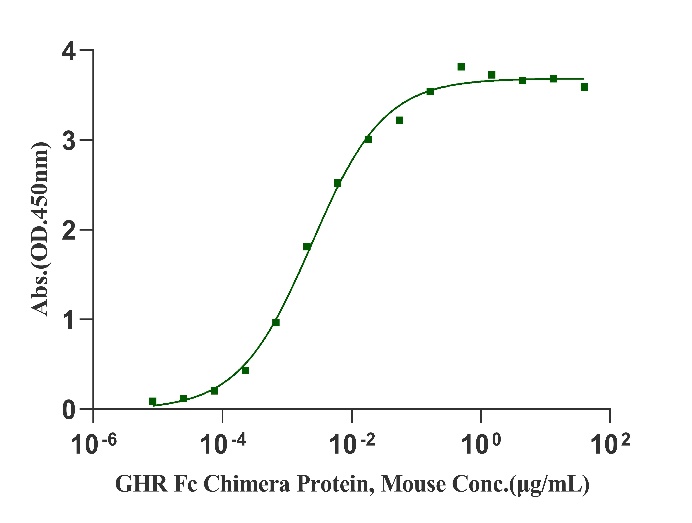
III. Application Value of GHR Fc Chimera Protein in Related Research
In-depth understanding of the molecular mechanisms of growth hormone resistance, optimization of treatment strategies, and screening of potential new therapies all depend on detailed analysis of GH-GHR interactions and their downstream events. In this process, high-quality recombinant receptor proteins, as key research tools, play an irreplaceable role. The GHR Fc Chimera Protein is one such important tool designed for such research.
1. Receptor-Ligand Interaction Studies: This chimeric protein consists of the extracellular domain of the growth hormone receptor fused to the Fc fragment of immunoglobulin G. It can be used in vitro to quantitatively evaluate the affinity and kinetic characteristics of growth hormone or its analogs binding to the receptor. Through techniques such as surface plasmon resonance or enzyme-linked immunosorbent assays, the binding differences between wild-type and mutant GHR and growth hormone can be precisely measured, providing direct evidence for elucidating the molecular mechanisms of dominant negative mutations.
2. Mutant Functional Analysis and New Therapy Exploration: Using this recombinant protein, the effects of different GHR mutations (including dominant negative mutations) on receptor dimerization, conformational changes, and binding to growth hormone can be systematically studied. This helps to understand resistance mechanisms from a structure-function perspective. The protein can also serve as a screening platform for discovering small molecules, peptides, or engineered antibodies that can stabilize or restore mutant receptor function, laying the foundation for developing new treatment modalities beyond simple high-dose replacement.
3. Detection Methods and Biomarker Development: In preclinical and clinical research, this protein can serve as a reliable standard or capture reagent for establishing assays to measure serum levels of growth hormone or growth hormone-binding proteins, ensuring the accuracy and comparability of test results. It may also be used to develop detection methods for specific GHR mutations or abnormal activation states, aiding in precise patient stratification and efficacy prediction.
IV. Summary and Outlook
The exploration of ultra-high-dose growth hormone therapy for patients with growth hormone receptor dominant negative mutations is an important practice of precision medicine in the field of growth disorders. It preliminarily validates the feasibility of partially overcoming specific molecular defects through "pharmacological doses," offering new hope for patients who are unresponsive to conventional treatments. However, long-term efficacy, optimal dosing, and safety in broader populations still require larger-scale, longer-term studies.
In the future, with a deeper understanding of the GHR signaling network and the widespread application of advanced research tools such as the GHR Fc Chimera Protein, it is expected not only to optimize existing high-dose strategies but also to promote the development of new targeted therapies for mutant receptors themselves, ultimately providing safer, more effective, and more personalized treatment options for patients with growth hormone resistance.
V. Which Manufacturers Provide GHR Fc Chimera Protein?
Nanjing UniLove Protein independently developed the GHR Fc Chimera Protein, Mouse (Catalog No.: UA011366), a high-purity, high-activity recombinant fusion protein of the mouse growth hormone receptor (GHR) extracellular domain that exists as a stable dimer. This product is produced by genetically fusing the extracellular domain of mouse GHR with human or mouse immunoglobulin Fc fragments and expressing it in a mammalian cell system. Growth hormone (GH) plays a central role in individual growth, metabolic regulation, and cell proliferation through its binding to the growth hormone receptor (GHR). This product is a key molecular tool for studying mouse growth, metabolism, and related disease models.
| Core Product Advantages |
|---|
| Species Specificity and High Purity: This product is of mouse (Mouse) origin, making it an ideal choice for mouse model research, ensuring species-matched interactions with mouse growth hormone (GH). It is produced in a mammalian expression system to ensure proper protein folding and glycosylation, purified by Protein A affinity chromatography to achieve high purity (>95%) and low endotoxin levels. |
| Stable Dimer Enhances Functionality: The homodimer formed by the Fc fragment mimics the receptor dimerization activation state induced by growth hormone, effectively binding its ligand mouse GH. This structure significantly enhances binding avidity, offering higher efficiency and sensitivity when used as a ligand capture, neutralization assay, or detection tool. |
Excellent Application Flexibility and Convenience:
|
| Superior Stability and Batch Consistency: Strict production processes and quality control ensure consistent purity, molecular weight, and biological activity across batches, guaranteeing reliable and reproducible experimental results. |
Nanjing UniLove Protein is committed to providing high-performance, highly flexible recombinant protein tools for endocrinology, metabolic research, and mouse disease models. For detailed technical parameters, binding activity data, or application consultation regarding GHR Fc Chimera Protein, Mouse (Catalog No.: UA011366), please feel free to contact us.
This article is reviewed and published by the technical expert team of UA
Disclaimer: This article partially utilizes artificial intelligence assistance in its creation. If any content involves copyright or intellectual property issues, please let us know and we promise to verify and remove it as soon as possible.
Purchase recombinant protein, choose Nanjing UA-Bio
UA protein focuses on providing various protein reagents, raw materials, and services required for drug research and development, cell therapy, gene therapy, and basic scientific research, including drug target proteins, immune checkpoint proteins, cytokines, tool enzymes, customized protein expression, and full-length transmembrane protein development. Youai is committed to providing customers with high-quality products and professional services, and building a High-tech Biological Enterprise with International Competitiveness.







 Business license (three certificates in one)