




Dual regulatory mechanisms and engineering strategies of the IL-2/IL-2R signaling pathway


Interleukin-2 is a pivotal cytokine in adaptive immune responses, playing a decisive role in the proliferation, differentiation, and function of T cells.
- Recent Advances
- Product Information
I. The Dual Role of IL-2 in Immunotherapy and Clinical Application Challenges
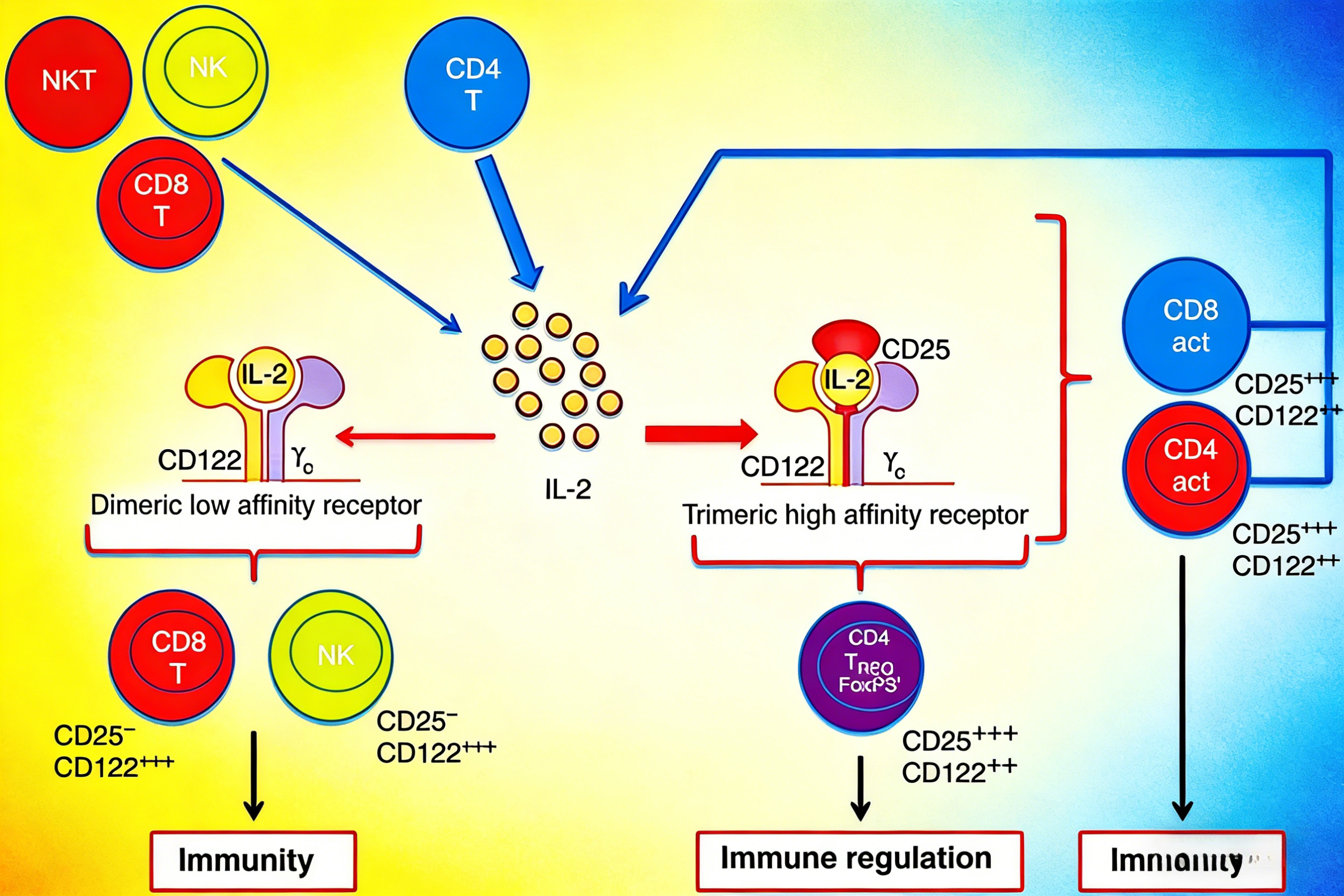
Interleukin-2 is a central cytokine in adaptive immune responses, playing a decisive role in the proliferation, differentiation, and function of T cells. Its biological effects primarily stem from interactions with the interleukin-2 receptor, where differential expression of receptor complexes on immune cells determines the dual functionality of IL-2.
1. Effector T Cell Activation: Effector cells such as CD8+ T cells and natural killer cells predominantly express intermediate-affinity dimeric receptors composed of the IL-2Rβ chain (CD122) and the common γ chain (CD132/γc). High-dose IL-2 can strongly drive the expansion and cytotoxic function of effector cells through this pathway, exerting anti-tumor effects.
2. Regulatory T Cell Activation: Regulatory T cells (Tregs) highly express high-affinity trimeric receptors containing the α chain (CD25), β chain, and γ chain. Due to their significantly higher affinity for IL-2 compared to dimeric receptors, low-dose IL-2 can selectively activate and expand Tregs, thereby suppressing excessive immune responses. This property holds potential for treating autoimmune diseases.
The differences in receptor distribution and affinity also pose significant challenges for the clinical application of native IL-2. Approved IL-2 drugs have extremely short half-lives, and the high doses required for anti-tumor effects often cause severe dose-limiting toxicities, most notably vascular leak syndrome, which greatly limits their clinical applicability and efficacy.
II. Structure-Based Engineering Strategies for IL-2
To overcome the limitations of native IL-2—achieving long-lasting, safe, and cell-selective therapy—researchers have developed various protein engineering strategies based on a deep understanding of the three-dimensional structure of IL-2 and its receptor complexes. The core objective is to alter IL-2's binding preference for different receptor subunits (particularly the CD25 α chain) through molecular modifications.
1. Reducing α Chain Binding Affinity (Effector T Cell Bias): Site-specific mutations can weaken the interaction between IL-2 and the CD25 α chain, thereby reducing its binding capacity to high-affinity trimeric receptors. Such modifications aim to make IL-2 more inclined to activate effector T cells and NK cells expressing βγ dimeric receptors, minimizing Treg activation. This approach seeks to achieve anti-tumor effects at lower doses while reducing toxicity.
2. Increasing α Chain Binding Affinity (Treg Bias): Conversely, mutations that enhance IL-2's binding to CD25 can design IL-2 variants with higher selectivity for Tregs, aiming to more efficiently expand Tregs for treating autoimmune diseases or graft-versus-host disease.
3. Other Optimization Strategies: Beyond affinity engineering, strategies such as PEGylation or fusion with antibody Fc fragments are often employed to significantly extend IL-2's circulating half-life in vivo, improving its pharmacokinetic properties.
III. The Application Value of IL-2 Rγ/CD132 His Tag Protein in Research
In IL-2 engineering and related drug development, precise evaluation of candidate molecules' interactions with different receptor subunits is critical. The common γ chain is an indispensable component of IL-2 signaling and serves as a shared signal-transducing subunit for multiple cytokines, including IL-2, IL-4, IL-7, IL-9, IL-15, and IL-21. Thus, research tools targeting the γ chain hold foundational significance.
IL-2 Rγ/CD132 His Tag Protein, as a recombinant protein carrying a histidine tag, plays a pivotal role in such research:
1. Receptor Complex Assembly and Interaction Studies: This recombinant protein can be used to reconstitute different IL-2 receptor complexes (e.g., βγ dimers or αβγ trimers) in vitro. Techniques such as surface plasmon resonance, bio-layer interferometry, or ELISA can quantitatively analyze the binding affinity and kinetics of IL-2 or its engineered variants with specific receptor complexes, providing direct molecular-level evidence for "biased" design.
2. Signal Transduction Mechanism Analysis: As the common signaling partner for all γ chain-dependent cytokines, this protein is a key component in studying the upstream activation events of the JAK-STAT pathway (particularly the JAK3-STAT5 axis). Using this protein helps elucidate how IL-2 effectively recruits and activates γ chain-associated downstream kinases.
3. Drug Screening and Specificity Validation: In screening small-molecule inhibitors or antagonistic antibodies targeting the IL-2/IL-2R pathway, this protein serves as a critical target. By assessing whether candidate drugs interfere with IL-2's binding to γ chain-containing receptor complexes, molecules with potential therapeutic value can be identified.
4. Tool Reagent Preparation: The histidine tag facilitates high-purity, high-efficiency affinity purification via metal chelate chromatography, ensuring protein quality and batch-to-batch consistency. The purified protein can serve as a reliable material for generating detection antibodies, establishing standardized assays, or as an additive in cell-based functional experiments.
IV. Which Manufacturers Provide IL-2 Rγ/CD132 His Tag Protein?
Nanjing U-AIR Biotech independently developed IL-2 Rγ/CD132 His Tag Protein, Human (Catalog No.: UA011350), a high-purity, high-activity recombinant human interleukin-2 receptor γ chain (IL-2Rγ, also known as CD132). This product is expressed in a mammalian system with a C-terminal His tag and serves as a core tool for studying cytokine signaling, immunodeficiency diseases, and cell therapies.
| Core Product Advantages |
|---|
| Core Functional Subunit: As the γc chain, it is the shared signal-transducing subunit for receptors of key cytokines such as IL-2, IL-4, IL-7, IL-9, IL-15, and IL-21, playing a vital role in lymphocyte development and function. |
| High Purity and Native Conformation: Expressed in a mammalian system, it ensures proper folding and glycosylation, with a purity >95% after purification, making it a reliable component for receptor complex assembly. |
| Flexible His Tag: Facilitates rapid purification, immobilization, or detection via nickel columns, suitable for interaction studies and functional analyses. |
Key Applications:
|
| Exceptional Stability and Consistency: Standardized production and rigorous quality control ensure batch-to-batch performance stability, guaranteeing experimental reproducibility. |
Nanjing U-AIR Biotech is committed to providing high-quality core protein tools for immunology and cell therapy research. For detailed technical specifications or application inquiries regarding IL-2 Rγ/CD132 His Tag Protein, Human (Catalog No.: UA011350), please feel free to contact us.
This article is reviewed and published by the technical expert team of UA
Disclaimer: This article partially utilizes artificial intelligence assistance in its creation. If any content involves copyright or intellectual property issues, please let us know and we promise to verify and remove it as soon as possible.
Purchase recombinant protein, choose Nanjing UA-Bio
UA protein focuses on providing various protein reagents, raw materials, and services required for drug research and development, cell therapy, gene therapy, and basic scientific research, including drug target proteins, immune checkpoint proteins, cytokines, tool enzymes, customized protein expression, and full-length transmembrane protein development. Youai is committed to providing customers with high-quality products and professional services, and building a High-tech Biological Enterprise with International Competitiveness.







 Business license (three certificates in one)