




Research progress of FGFR3-targeting antibody-drug conjugates in the treatment of bladder cancer


Bladder cancer is a common malignant tumor of the urinary system, and its clinical treatment faces core challenges such as high recurrence rates, significant pathological heterogeneity, and limited treatment options.
- Recent Advances
- Product Information
I. Current Status of Bladder Cancer Treatment and the Need for ADC Drug Development
Bladder cancer is a common malignant tumor of the urinary system, and its clinical treatment faces core challenges such as high recurrence rates, significant pathological heterogeneity, and limited therapeutic options. The current standard chemotherapy regimen, primarily consisting of gemcitabine combined with cisplatin, is widely used but suffers from efficacy bottlenecks, significant systemic toxicity, and poor patient tolerance. Therefore, developing novel therapeutic strategies with high efficacy and low toxicity is an urgent need to improve the prognosis of bladder cancer patients.
Antibody-drug conjugates (ADCs), as an advanced targeted therapy modality, achieve precise recognition and potent killing of tumor cells by linking specific antibodies with highly cytotoxic drugs. However, in the field of bladder cancer, the number of approved or clinically studied ADC drugs is limited, and their target coverage is insufficient to meet the needs of a broad patient population with diverse molecular characteristics. Consequently, exploring new membrane protein targets highly expressed in bladder cancer and designing novel ADC drugs based on these targets has become an important research direction in this field.
II. Biological Basis of FGFR3 as an Ideal Target for Bladder Cancer ADC
Fibroblast growth factor receptor 3 (FGFR3) is a member of the receptor tyrosine kinase family and plays a key role in regulating cell proliferation, differentiation, and survival. Studies have shown that abnormal activation of the FGFR3 gene (e.g., mutations, overexpression, or fusions) is closely associated with the development and progression of various tumors. In bladder cancer, the high expression rate of FGFR3 protein can reach 28% to 40%, and its expression is significantly correlated with tumor malignancy and poor prognosis.
FGFR3 protein exhibits clear cell membrane localization and can be effectively internalized after binding to ligands or antibodies, making it an ideal carrier target for ADC drug design. The targeted delivery of ADCs can minimize the damage of cytotoxic drugs to normal tissues, thereby expanding the therapeutic window.
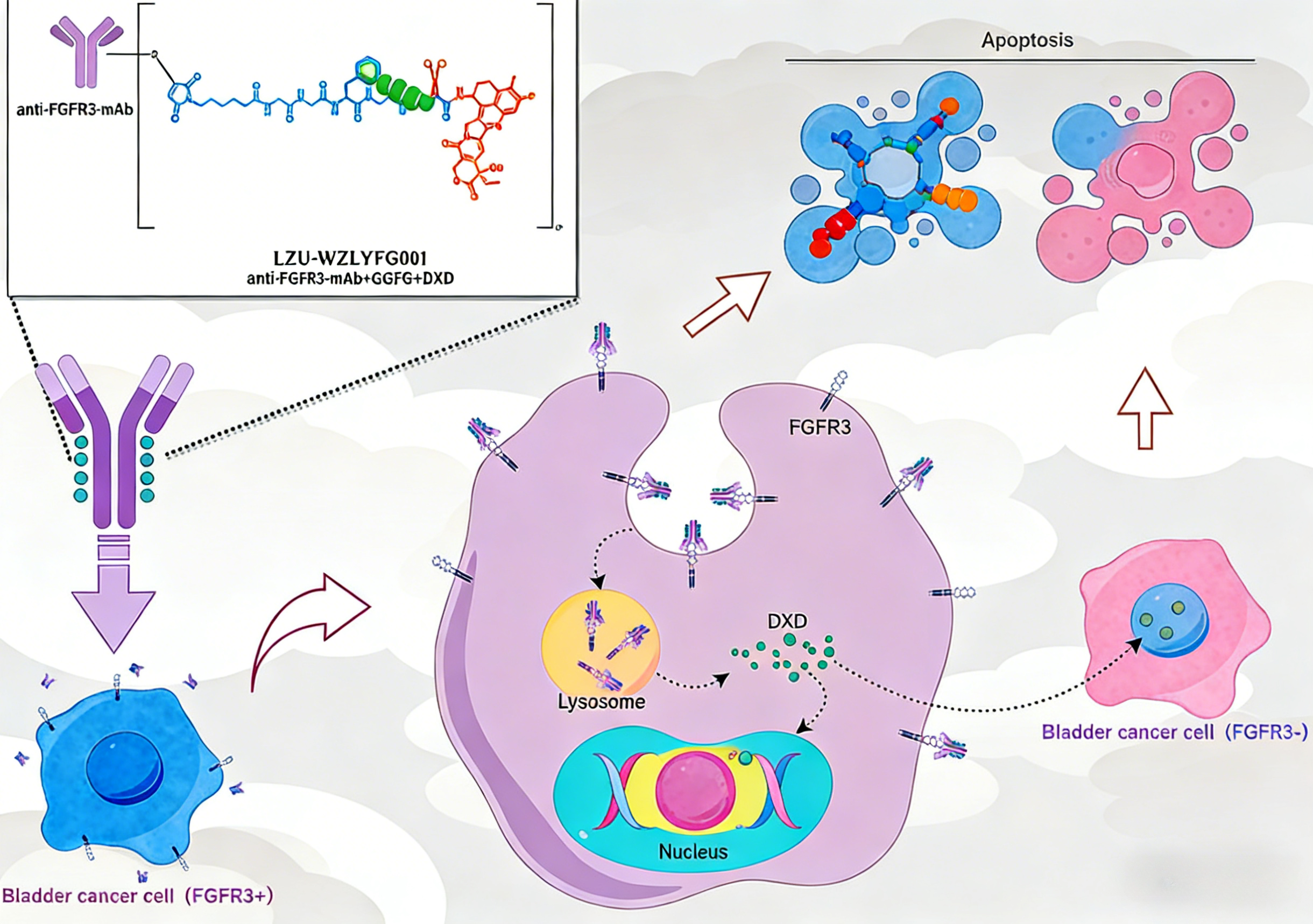
III. Design, Mechanism, and Preclinical Studies of FGFR3-Targeted ADC Drugs
Based on the above biological foundation, researchers have designed and developed a novel FGFR3-targeted ADC drug.
1. Drug Design and Construction: This ADC drug employs a humanized anti-FGFR3 IgG1 antibody as the targeting carrier, linked via a cleavable tetrapeptide linker to a highly potent topoisomerase I inhibitor (DXD). Through precise conjugation chemistry, a highly homogeneous product with a drug-to-antibody ratio of 8 was obtained, ensuring that each antibody molecule carries an adequate payload of cytotoxic agents.
2. In Vitro Anti-Tumor Activity and Mechanism of Action: In vitro experiments demonstrated that this ADC drug exhibits potent and specific anti-tumor activity. Its ability to inhibit the proliferation, migration, and invasion of bladder cancer cells is positively correlated with the expression level of FGFR3 on the cell surface. Mechanistic studies revealed that the drug specifically binds to the FGFR3 receptor, enters cells via receptor-mediated endocytosis, and releases the cytotoxic payload DXD in lysosomes, thereby inducing tumor cell death. Notably, the released DXD, due to its lipophilicity, can diffuse into neighboring tumor cells, producing a "bystander effect" that further enhances the overall clearance of tumor tissue.
3. In Vivo Efficacy and Safety Validation: In both cell-derived and patient-derived bladder cancer xenograft models, this FGFR3-targeted ADC demonstrated significant tumor growth inhibition, outperforming the traditional gemcitabine-cisplatin regimen and remaining effective in some chemotherapy-resistant models. In three-dimensional organoid models, the drug also showed good tissue penetration and sustained efficacy. In terms of safety, preclinical toxicology assessments yielded favorable results. Compared to the chemotherapy group, which exhibited significant weight loss and hematological toxicity, the ADC-treated animals maintained stable body weight and blood parameters, with no significant pathological damage to major organs. This indicates that targeted antibody delivery effectively limits the systemic exposure of highly cytotoxic drugs, achieving potent anti-tumor effects while significantly reducing off-target toxicity.
IV. Application Value of FGF R3 (IIIc) Fc Chimera Protein in Research
In the development and evaluation of FGFR3-targeted drugs (including ADCs, monoclonal antibodies, or small-molecule inhibitors), high-quality recombinant target proteins are essential research tools. The FGF R3 (IIIc) Fc Chimera Protein, as an engineered recombinant protein, has multiple applications in such research:
1. Drug Binding Activity Screening and Validation: This chimeric protein contains the extracellular domain of FGFR3 (IIIc isoform) and can be used for high-throughput screening based on ELISA, surface plasmon resonance, or bio-layer interferometry to evaluate the binding affinity, specificity, and kinetic parameters of candidate antibodies or ADCs with FGFR3 antigen.
2. Receptor-Ligand Interaction Studies: It can be used to study the interactions between FGFR3 and its natural ligands or other regulatory molecules, elucidating the molecular basis of signaling pathways.
3. Antibody Preparation and Detection Standards: It can serve as an immunogen for preparing FGFR3-specific antibodies or as a positive control and quantitative standard in assay development, ensuring the reliability and comparability of analytical methods.
V. Which Manufacturers Provide FGF R3 (IIIc) Fc Chimera Protein?
Nanjing UniLove Protein has independently developed the FGF R3 (IIIc) Fc Chimera Protein, Human (Product No.: UA011374), a high-purity, high-activity recombinant fusion protein of the human fibroblast growth factor receptor 3 (FGFR3) IIIc isoform extracellular domain. This product fuses the FGFR3 IIIc extracellular domain with the human immunoglobulin Fc fragment, expressed in a mammalian system to form a stable dimer. It accurately represents the major splice variant form of FGFR3 in specific tissues (e.g., cartilage and neural tissue) and is a key molecular tool for studying skeletal development, endochondral ossification, and diseases with FGFR3 gene activating mutations (e.g., achondroplasia, multiple myeloma, bladder cancer).
| Core Advantages of the Product |
|---|
| Precise IIIc Isoform: This product specifically expresses the IIIc splice acceptor of FGFR3, not the IIIb isoform. These two isoforms exhibit significant differences in ligand (FGF) binding specificity. The IIIc isoform is the core target form for studying the aforementioned diseases, ensuring physiological and pathological relevance. |
| Stable Dimer Structure and High Affinity: The homodimer formed by the Fc fragment mimics the pre-aggregated state of the receptor on the membrane or ligand-induced dimerization, enabling more effective capture and binding of its specific ligands (e.g., FGF1, FGF9). This provides stronger signals and higher sensitivity in ligand-binding experiments and functional studies. |
Exceptional Application Specificity:
|
| High Purity and Strict Quality Control: The mammalian expression system ensures proper glycosylation, and multi-step purification (e.g., Protein A) yields a high-purity product (>95%). Rigorous quality control ensures its reliability as a research and screening tool. |
Nanjing UniLove Protein is committed to providing high-quality receptor tools with precise isoforms and well-defined functions for developmental biology, skeletal diseases, and tumor-targeted therapy. For detailed technical parameters, ligand specificity data, or specific application protocols of the FGF R3 (IIIc) Fc Chimera Protein, Human (Product No.: UA011374), please feel free to contact us.
This article is reviewed and published by the technical expert team of UA
Disclaimer: This article partially utilizes artificial intelligence assistance in its creation. If any content involves copyright or intellectual property issues, please let us know and we promise to verify and remove it as soon as possible.
Purchase recombinant protein, choose Nanjing UA-Bio
UA protein focuses on providing various protein reagents, raw materials, and services required for drug research and development, cell therapy, gene therapy, and basic scientific research, including drug target proteins, immune checkpoint proteins, cytokines, tool enzymes, customized protein expression, and full-length transmembrane protein development. Youai is committed to providing customers with high-quality products and professional services, and building a High-tech Biological Enterprise with International Competitiveness.







 Business license (three certificates in one)