




Molecular characteristics of interleukin-8 and its role in inflammation-related diseases


Interleukin-8 (IL-8) is a multifunctional cytokine belonging to the CXC chemokine family, playing a central regulatory role in acute inflammatory responses.
- Recent Advances
- Product Information
I. Introduction
Interleukin-8 (IL-8) is a multifunctional cytokine belonging to the CXC chemokine family that plays a central regulatory role in acute inflammatory responses. IL-8 is primarily induced by various cells including monocytes, lymphocytes, granulocytes, fibroblasts, endothelial cells, and epithelial cells under inflammatory stimuli. Platelets can also store IL-8 in their granules and rapidly release it upon activation. This chemokine plays a critical role in host defense mechanisms by specifically recruiting and activating neutrophils, while its abnormal expression is closely associated with the development of various inflammatory diseases. Based on a systematic understanding of IL-8's molecular structure and biological functions, the Human IL-8 Kit (HICA) has become an essential tool for inflammation-related disease research and clinical sample detection.
II. Gene Localization and Protein Structural Characteristics of IL-8
Gene Localization and Structure: The human IL-8 gene is located on chromosome 4q12-21, spanning approximately 1.6 kb, and consists of 4 exons and 3 introns. This gene encodes a 99-amino acid IL-8 precursor protein, with an N-terminal signal peptide sequence of 20 amino acids.
Protein Processing and Isoforms: The IL-8 precursor protein undergoes signal peptide cleavage during secretion and can be further processed by various proteolytic enzymes to generate mature protein isoforms of different lengths. The 72-amino acid form (residues 28-99) and the 77-amino acid form (residues 23-99), catalyzed by serine proteases (including plasmin, thrombin, matrix metalloproteinases, and cathepsins), are the primary biologically active conformations, with the former being expressed at levels several to ten times higher than the latter under stable conditions. Additionally, isoforms of 79, 76, 75, 70, and 69 amino acids in length have been reported, reflecting the diversity of IL-8 post-translational processing.
Three-Dimensional Structural Features: Nuclear magnetic resonance and X-ray crystallography studies reveal that IL-8 functions as a homodimer. In its three-dimensional structure, two symmetry-related antiparallel α-helices, approximately 24 Å in length and spaced 14 Å apart, lie atop a six-stranded antiparallel β-sheet platform. This dimeric conformation provides the structural basis for high-affinity binding to its specific receptors, with both monomeric and dimeric forms exhibiting biological activity.
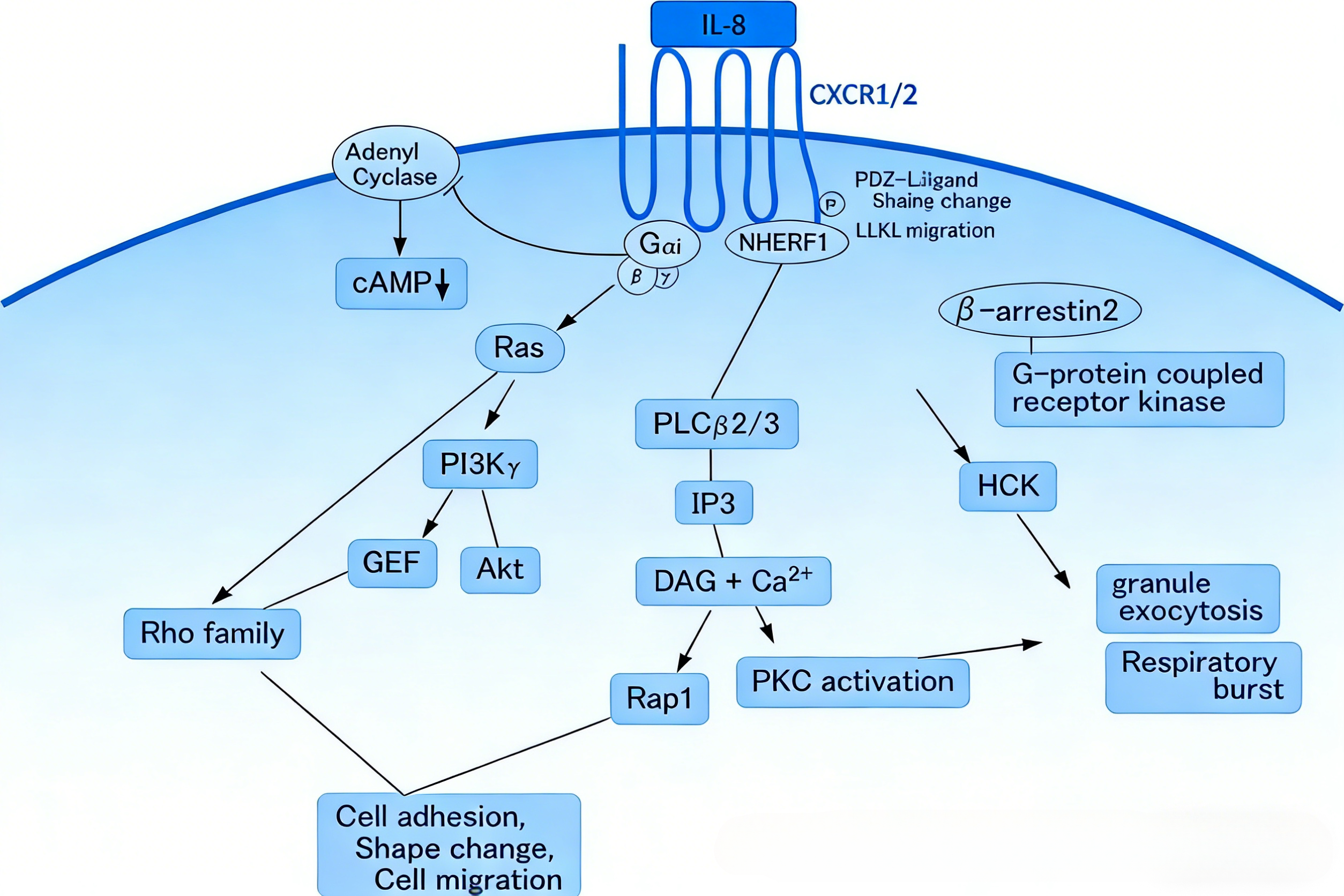
III. IL-8 Receptor System and Signal Transduction Pathways
Receptor Subtypes and Ligand Specificity: Human IL-8 exerts its biological effects through two G protein-coupled receptors, CXCR1 and CXCR2. CXCR1 is relatively specific for IL-8, with low affinity for other CXC chemokines except CXCL5 and CXCL6, while CXCR2 can bind multiple CXC chemokine ligands, including CXCL1, CXCL2, CXCL3, CXCL5, CXCL6, CXCL7, and IL-8. Both monomeric and dimeric forms of IL-8 can bind to these receptors and initiate signal transduction.
Signal Transduction Mechanism: IL-8 binding to CXCR1/CXCR2 induces conformational changes in the receptors, activating heterotrimeric G proteins. In neutrophils, Gαi2-subtype G proteins dissociate into Gα and Gβγ subunits, with the latter further activating downstream effector molecules. Phosphatidylinositol-3-kinase γ (PI3Kγ) and phospholipase Cβ2/β3 (PLCβ2/β3) are key nodes in this signaling pathway. PLCβ activation catalyzes the hydrolysis of phosphatidylinositol-4,5-bisphosphate, generating inositol trisphosphate (IP3) and diacylglycerol (DAG). IP3 induces intracellular calcium release, while DAG activates protein kinase C (PKC), ultimately triggering lysosomal enzyme exocytosis. Simultaneously, small GTPases act as downstream effectors of Gβγ subunits, regulating cell adhesion, actin polymerization, membrane protrusion formation, and directional migration.
IV. Biological Functions and Pathological Significance of IL-8
Neutrophil Recruitment and Activation: IL-8 is one of the most potent chemokines for neutrophils. In acute inflammatory responses, locally produced IL-8 guides neutrophils through vascular endothelium and directs their migration to inflammatory sites via concentration gradients. Compared to other members of the CXC chemokine family, IL-8 exhibits significantly higher expression levels in inflammatory microenvironments and stronger receptor binding affinity, indicating its dominant role in neutrophil recruitment.
Abnormal Expression in Inflammatory Diseases: IL-8 levels are markedly elevated in both local lesions and circulating systems of patients with various inflammatory diseases characterized by neutrophil infiltration. In rheumatoid arthritis, elevated IL-8 concentrations in synovial tissue and fluid correlate positively with joint cavity neutrophil recruitment and cartilage erosion. Psoriatic keratinocytes highly express IL-8, driving epidermal neutrophil microabscess formation. Chronic obstructive pulmonary disease patients show increased IL-8 levels in airway secretions and bronchoalveolar lavage fluid, closely associated with airway neutrophil inflammation and lung function decline. Additionally, conditions such as renal ischemia-reperfusion injury, post-islet cell transplant inflammatory rejection, and endometriosis are accompanied by upregulated IL-8 expression.
V. Which Manufacturers Provide Human IL-8 Kits (HICA)?
Nanjing UA-Bio Technology Co., Ltd. (UA-Bio) has independently developed the "Human IL-8 Kit (HICA)", a high-performance in vitro detection platform specifically designed for studying neutrophil chemotaxis and key pathways in inflammatory microenvironments. This kit enables precise and efficient quantitative detection of human interleukin-8 (IL-8/CXCL8) protein immunobinding activity, providing stable and reliable standardized solutions for efficacy evaluation, mechanism research, and biomarker analysis in fields such as acute/chronic inflammation, tumor microenvironments, infection immunity, and anti-inflammatory drug development.
| Core Product Advantages |
|---|
| High Purity and Complete Biological Activity: The kit's core components utilize high-purity, high-biological-activity human IL-8 protein validated through multidimensional quality control. This protein maintains correct native conformation and full chemokine receptor (CXCR1/CXCR2) binding capacity, accurately simulating IL-8-mediated immune chemotaxis signals under physiological conditions, ensuring binding experiment data accuracy, reproducibility, and functional relevance. |
| Exceptional Batch-to-Batch Consistency and Stability: Leveraging an internationally leading recombinant protein expression platform and highly standardized purification processes, combined with a stringent release quality control system, ensures outstanding long-term stability and excellent batch-to-batch consistency. Provides solid reliability for long-term, continuous critical experiments and high-throughput screening. |
| Ready-to-Use Flexible Detection Platform: Based on optimized enzyme-linked immunosorbent assay (ELISA) principles, this kit provides pre-coated strips, highly specific detection antibodies, standards, and a complete optimized buffer system. Simple, fast operation with high sensitivity and strong specificity, widely applicable for various research needs including anti-IL-8 antibody/receptor antagonist screening, neutralization activity determination, competitive binding assays, affinity analysis, and immunogenicity evaluation. |
| Complete Solutions and Professional Support: We provide fully validated standard protocols, typical dose-response curves, and detailed result interpretation guides to help quickly establish stable, reproducible detection workflows. Nanjing UA-Bio's professional technical team offers comprehensive technical consultation and support for research design, experimental optimization, and data analysis. |
Nanjing UA-Bio Technology Co., Ltd. remains committed to providing cutting-edge, high-quality core reagents and tools for immunology, cell therapy, and innovative drug development. For detailed technical parameters, validation data, or specific application inquiries regarding the "Human IL-8 Kit (HICA)" (Catalog No.: UA086039), please feel free to contact us.
This article is reviewed and published by the technical expert team of UA
Disclaimer: This article partially utilizes artificial intelligence assistance in its creation. If any content involves copyright or intellectual property issues, please let us know and we promise to verify and remove it as soon as possible.
Purchase recombinant protein, choose Nanjing UA-Bio
UA protein focuses on providing various protein reagents, raw materials, and services required for drug research and development, cell therapy, gene therapy, and basic scientific research, including drug target proteins, immune checkpoint proteins, cytokines, tool enzymes, customized protein expression, and full-length transmembrane protein development. Youai is committed to providing customers with high-quality products and professional services, and building a High-tech Biological Enterprise with International Competitiveness.







 Business license (three certificates in one)