




Molecular Mechanisms and Biological Functions of the Interleukin-6 Signaling Pathway


Interleukin-6 (IL-6) is a pleiotropic cytokine that plays a central role in immune responses, inflammatory regulation, hematopoietic differentiation, and neuroendocrine processes in both physiological and pathological contexts.
- Recent Advances
- Product Information
I. Introduction
Interleukin-6 (IL-6) is a pleiotropic cytokine that plays a central role in physiological and pathological processes such as immune response, inflammation regulation, hematopoietic differentiation, and neuroendocrine functions. By binding to its specific receptor system, IL-6 activates a complex signaling network centered on the JAK-STAT axis, thereby regulating cell proliferation, differentiation, apoptosis, and functional gene expression. Based on in-depth analysis of the IL-6 signaling pathway, the Human IL-6 Assay Kit (HICA) has become a widely used detection tool in both basic research and clinical evaluation.
II. Molecular Components of the IL-6 Signaling Pathway
IL-6 Molecule: IL-6 is a glycoprotein with a molecular weight of approximately 26 kDa, secreted by various cells including lymphocytes, mononuclear macrophages, fibroblasts, and endothelial cells. Its expression is precisely regulated by bacterial endotoxins, viruses, and other inflammatory factors. IL-6 exhibits dual roles in immune regulation: moderate levels contribute to host defense, while sustained high expression is closely associated with various autoimmune diseases and chronic inflammation.
IL-6 Receptor System: The membrane-bound IL-6R (IL-6R) is primarily expressed on the surface of hepatocytes and some immune cells. Soluble IL-6R (sIL-6R) can be generated through proteolysis or alternative splicing and, when bound to IL-6, can activate cells that lack membrane-bound IL-6R but express gp130, a process known as trans-signaling. gp130 is a common signal-transducing chain shared by the IL-6 family of cytokines and is widely expressed in various tissues and cells throughout the body. Upon binding of IL-6 to IL-6R, gp130 is recruited to form an IL-6/IL-6R/gp130 heterohexameric complex, initiating intracellular signal transduction.
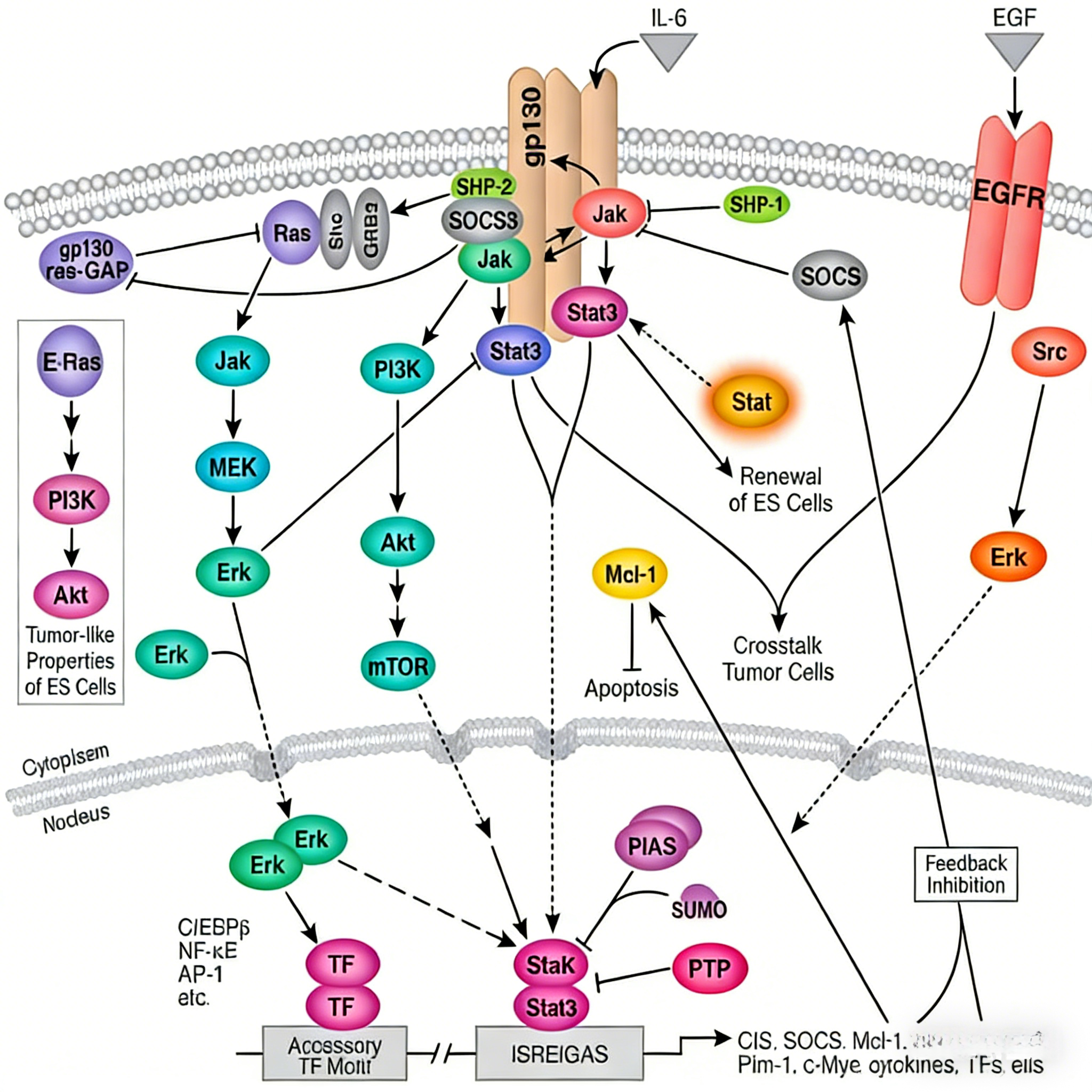
Downstream Signaling Molecules: The JAK family kinases (JAK1, JAK2, TYK2) are constitutively associated with the intracellular domain of gp130; receptor complex aggregation induces JAK phosphorylation and activation, which in turn catalyzes the phosphorylation of tyrosine residues in the intracellular region of gp130. STAT3 is the most critical effector molecule in the IL-6 signaling pathway. Its SH2 domain binds to phosphorylated gp130 and is subsequently phosphorylated by JAK, forming dimers that translocate to the nucleus to regulate the transcription of acute-phase proteins, cytokines, and anti-apoptotic genes. Additionally, IL-6 can activate the Ras-MAPK and PI3K-AKT pathways, participating in cell proliferation and metabolic regulation.
III. Signal Transduction Modes and Regulatory Mechanisms
Classical Signaling: Depends on the co-expression of IL-6R and gp130 on the target cell membrane, primarily occurring in hepatocytes and some immune cells. This is the main mechanism by which IL-6 induces acute-phase protein synthesis and terminal differentiation of B cells.
Trans-Signaling: Mediated by sIL-6R, it activates cell types that do not express or have low expression of membrane-bound IL-6R, such as endothelial cells, fibroblasts, and tumor cells. This mode significantly expands the spectrum of IL-6 target cells and is the primary mechanism underlying the pathogenic effects of IL-6 in chronic inflammation, autoimmune damage, and tumor microenvironment remodeling. Combined detection of IL-6 and sIL-6R complex levels in serum and tissue fluids using the Human IL-6 Assay Kit (HICA) can provide an assessment of trans-signaling activation status.
Negative Regulation: SOCS3 is the most important negative regulator of IL-6 signaling. Induced by STAT3, it feedback inhibits JAK activity. Protein tyrosine phosphatases dephosphorylate JAK and STAT to terminate signaling, while receptor internalization also limits signal intensity. Changes in the expression of these regulatory nodes can be quantitatively assessed using the Human IL-6 Assay Kit (HICA) combined with phosphorylated protein detection.
IV. Biological Functions
Immune Regulation: IL-6 is a key auxiliary signal for the differentiation of B cells into plasma cells, driving immunoglobulin synthesis. Simultaneously, IL-6, in conjunction with TGF-β, induces the differentiation of naive CD4⁺ T cells into Th17 cells while inhibiting regulatory T cell differentiation, breaking immune tolerance and promoting the establishment of effector immune responses.
Inflammatory Response: IL-6 is a core inducer of the acute-phase reaction. Through the bloodstream, it acts on hepatocytes to activate STAT3 and C/EBP family transcription factors, inducing the synthesis of C-reactive protein, serum amyloid A, and others. IL-6 upregulates the expression of vascular endothelial adhesion molecules and chemokines, promoting leukocyte recruitment to inflammatory sites. Monitoring IL-6 levels has become an important indicator for assessing the activity of inflammatory diseases, with the Human IL-6 Assay Kit (HICA) providing a stable and sensitive quantitative tool for this purpose.
Hematopoietic Regulation and Other Functions: IL-6, in synergy with various hematopoietic factors, regulates megakaryocyte differentiation and platelet production. Additionally, IL-6 is involved in neural development, bone metabolism, and cardiovascular function regulation, with upregulated expression and pathological roles in corresponding systemic diseases.
V. Disease Associations
Autoimmune Diseases: Patients with rheumatoid arthritis exhibit significantly elevated IL-6 levels in serum and synovial fluid, positively correlating with disease activity. Activated IL-6/STAT3 signaling promotes synovial cell proliferation and osteoclast activation. Abnormal IL-6 signaling activation is also observed in systemic lupus erythematosus and Castleman disease. Dynamic changes in IL-6 in these diseases can be continuously monitored using the Human IL-6 Assay Kit (HICA), providing quantitative indicators for efficacy evaluation.
Chronic Inflammatory Diseases: Patients with inflammatory bowel disease show elevated IL-6 and sIL-6R concentrations in intestinal mucosa and serum, with the trans-signaling pathway playing a pathogenic role in maintaining Th17 responses and disrupting the intestinal epithelial barrier. In sepsis, IL-6 is a core component of the cytokine storm, and its rapid quantitative detection is crucial for assessing the intensity of the inflammatory storm.
Cancer: IL-6 is upregulated in various solid tumors and hematologic malignancies. STAT3 promotes tumor cell survival by upregulating anti-apoptotic genes, induces VEGF to promote angiogenesis, and remodels the tumor microenvironment to mediate immune escape. Accurate quantification of IL-6 concentration in the tumor microenvironment has prognostic significance, and the Human IL-6 Assay Kit (HICA) is widely used in tumor immunology research.
Cardiovascular and Metabolic Diseases: Elevated IL-6 levels in atherosclerotic plaques contribute to endothelial activation and monocyte recruitment. Serum IL-6 levels independently correlate with the risk of cardiovascular events. IL-6 signaling is also mechanistically linked to insulin resistance and obesity-related metabolic inflammation.
VI. Which Manufacturers Provide the Human IL-6 Assay Kit (HICA)?
Nanjing UA-Bio Technology Co., Ltd. (UA-Bio) has independently developed the "Human IL-6 Kit (HICA)", a high-performance in vitro detection platform specifically designed for studying key pathways in inflammatory signal transduction and immune regulation. This kit is engineered to accurately and efficiently quantify the immunobinding activity of human interleukin-6 (IL-6) protein, providing a stable and reliable standardized solution for efficacy evaluation, mechanism research, and biosimilar analysis in fields such as autoimmune diseases, chronic inflammation, cytokine storm monitoring, and antibody drug development.
| Core Product Advantages |
|---|
| High Purity and Complete Biological Activity: The core components of the kit utilize high-purity, high-biological-activity human IL-6 protein validated through multidimensional quality control. This protein maintains the correct native conformation and full receptor-binding capacity, accurately simulating the specific interactions between IL-6 and its receptor complexes under physiological conditions, ensuring the accuracy, reproducibility, and physiological relevance of binding assay data. |
| Exceptional Batch-to-Batch Consistency and Stability: Leveraging an internationally leading recombinant protein expression platform and highly standardized purification processes, combined with a stringent release quality control system, the product exhibits outstanding long-term stability and excellent batch-to-batch consistency. This provides solid and reliable quality assurance for your long-term, continuous critical experiments and high-throughput screening work. |
| Ready-to-Use Flexible Detection Platform: Based on an optimized enzyme-linked immunosorbent assay (ELISA) principle, the kit provides pre-coated strips, highly specific detection antibodies, standards, and a complete set of optimized buffer systems. It is simple and quick to operate, with high sensitivity and strong specificity, making it widely suitable for various research applications such as anti-IL-6 antibody/receptor antagonist screening, neutralizing activity determination, competitive binding assays, affinity analysis, and immunogenicity evaluation. |
| Comprehensive Solutions and Professional Support: We provide thoroughly validated standard experimental protocols, typical dose-response curves, and detailed result interpretation guidelines to help you quickly establish stable and reproducible detection workflows. Nanjing UA-Bio's professional technical team offers full-process, expert technical consultation and support for your research design, experimental optimization, and data analysis. |
Nanjing UA-Bio Technology Co., Ltd. is committed to providing cutting-edge, high-quality core reagents and tools for immunology, cell therapy, and innovative drug development. For detailed technical parameters, validation data, or specific application inquiries regarding the "Human IL-6 Kit (HICA)" (Catalog No.: UA086038), please feel free to contact us at any time.
This article is reviewed and published by the technical expert team of UA
Disclaimer: This article partially utilizes artificial intelligence assistance in its creation. If any content involves copyright or intellectual property issues, please let us know and we promise to verify and remove it as soon as possible.
Purchase recombinant protein, choose Nanjing UA-Bio
UA protein focuses on providing various protein reagents, raw materials, and services required for drug research and development, cell therapy, gene therapy, and basic scientific research, including drug target proteins, immune checkpoint proteins, cytokines, tool enzymes, customized protein expression, and full-length transmembrane protein development. Youai is committed to providing customers with high-quality products and professional services, and building a High-tech Biological Enterprise with International Competitiveness.







 Business license (three certificates in one)