




Molecular Characteristics and Immunoregulatory Functions of Interleukin-5 (IL-5)


Interleukin-5 (IL-5) is a pleiotropic cytokine primarily secreted by Th2-type T cells and mast cells, playing a pivotal role in regulating the development and function of specific leukocyte lineages.
- Recent Advances
- Product Information
I. Introduction
Interleukin-5 (IL-5) is a pleiotropic cytokine primarily secreted by Th2-type T cells and mast cells, playing a pivotal role in regulating the development and function of specific leukocyte lineages. Through its specific regulation of eosinophil production, activation, and chemotaxis, IL-5 participates in anti-parasitic immunity and allergic responses, while also promoting IgA synthesis by modulating B cell function in mucosal immunity, thereby serving as a crucial regulatory node in immune homeostasis maintenance. The deepening understanding of IL-5 molecular mechanisms has driven the development of corresponding immunoassay tools, among which the Human IL-5 Kit (HICA) represents a core application.
II. Molecular Structure and Genetic Localization of IL-5
IL-5 is a weakly acidic glycoprotein with a molecular weight ranging between 40-50 kD, typically existing as a disulfide-linked homodimer, though its monomer retains certain biological activity. Human IL-5 precursor consists of 134 amino acid residues, including a 22-amino acid signal peptide sequence and two N-glycosylation sites. Glycosylation modifications are critical for its conformational stability and receptor recognition, serving as important structural bases for antibody recognition in immunoassays using the Human IL-5 Kit (HICA). Mouse IL-5 precursor contains 133 amino acid residues with a 21-amino acid signal peptide, and the mature protein comprises 112 amino acids with three glycosylation sites, exhibiting a dimer molecular weight of approximately 45 kD.
The human IL-5 gene is located on the long arm of chromosome 5, closely linked with hematopoietic-related cytokine genes such as IL-3, IL-4, and granulocyte-macrophage colony-stimulating factor (GM-CSF). The mouse IL-5 gene is situated on chromosome 11. Human and mouse IL-5 share approximately 70% amino acid sequence homology and exhibit cross-species biological activity, indicating high functional conservation during evolution. This characteristic provides a feasibility basis for the cross-application of the Human IL-5 Kit (HICA) in both basic research and clinical testing.
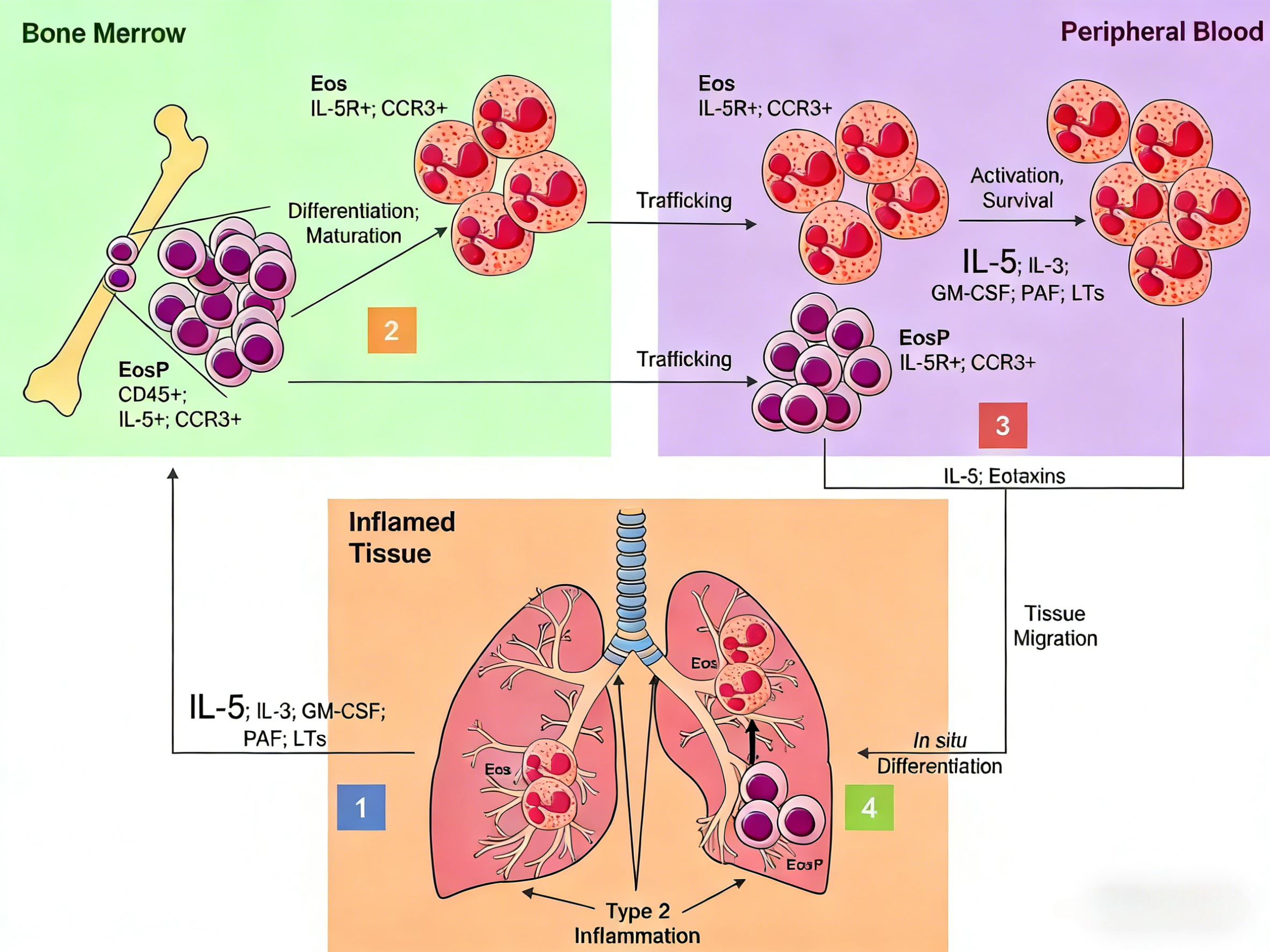
III. Immunobiological Functions of IL-5
(1) Lineage-Specific Regulation of Eosinophils
IL-5 is the most specific cytokine for eosinophil differentiation, expansion, and functional activation, with mechanisms including:
1. Promoting Bone Marrow Differentiation: IL-5 drives hematopoietic stem cells toward eosinophil lineage differentiation, significantly enhancing production efficiency;
2. Extending Survival: By inhibiting apoptotic signals, IL-5 markedly prolongs the lifespan of mature eosinophils;
3. Activating Effector Functions: Induces eosinophil release of granule contents such as major basic protein and eosinophil cationic protein, while promoting synthesis and secretion of leukotrienes, platelet-activating factor, and inflammatory mediators like IL-4 and IL-13;
4. Chemotactic Recruitment: IL-5 directly induces eosinophil migration to inflammatory sites, playing a central role in respiratory eosinophil infiltration during allergic diseases such as allergic rhinitis and bronchial asthma. Dynamic changes in IL-5 levels during these pathological processes can be quantitatively monitored using the Human IL-5 Kit (HICA), providing critical references for disease activity assessment.
(2) Regulation of B Cell Differentiation and IgA Class Switching
IL-5 serves as an important auxiliary signal for B cell terminal differentiation, particularly in mucosal immunity:
1. Promoting IgA Synthesis: IL-5 induces class switching from surface IgM-positive (mIgM⁺) B cells to surface IgA-positive (mIgA⁺) B cells and further promotes their differentiation into IgA-secreting plasma cells;
2. Synergistic Regulation: IL-5 cooperates with cytokines like IL-4 and IL-6 to enhance B cell immunoglobulin synthesis, especially IgA antibody production, thereby maintaining mucosal immune barrier function. In mucosal immunity research, the Human IL-5 Kit (HICA) has been widely applied for precise quantitative analysis of IL-5 expression levels in various experimental models.
(3) Effects on Other Immune Cells
1. Basophil Activation: Human IL-5 induces basophil release of pro-inflammatory mediators like histamine and leukotrienes, enhancing their effector functions;
2. Cytotoxic T Cell Differentiation Assistance: IL-5 assists thymic microenvironment in differentiating cytotoxic T cell precursors into functional CTLs, contributing to adaptive cellular immune responses.
IV. Conclusion
As a functionally specialized yet broadly acting cytokine, IL-5 occupies a central position in eosinophil-mediated inflammatory responses and mucosal humoral immunity. In-depth understanding of its molecular structure and signaling pathways not only helps elucidate related immunopathological mechanisms but also provides theoretical foundations for IL-5-targeted intervention strategies and the development/application of corresponding Human IL-5 Kits (HICA). With advancing detection technologies, the Human IL-5 Kit (HICA) will find broader applications in clinical diagnosis, pharmacodynamic evaluation, and basic research.
V. Which Manufacturers Provide Human IL-5 Kits (HICA)?
Nanjing UA-Biotech Co., Ltd. (UA-Bio) has independently developed the "Human IL-5 Kit (HICA)", a high-performance in vitro detection platform specifically designed for studying eosinophil-mediated immune responses and type 2 inflammation key pathways. This kit aims to accurately and efficiently quantify the immunobinding activity of human interleukin-5 (IL-5) protein, providing stable and reliable standardized solutions for efficacy assessment, mechanism research, and quality control in fields such as allergic diseases, asthma, eosinophilia, and antibody drug development.
| Core Product Advantages |
|---|
| High Purity and Full Bioactivity: The kit's core components utilize high-purity, high-bioactivity human IL-5 protein validated through comprehensive quality control. This protein maintains native conformation and complete receptor-binding capacity, accurately simulating physiological IL-5-receptor interactions to ensure data accuracy and physiological relevance. |
| Exceptional Batch Consistency and Stability: Leveraging advanced recombinant protein expression platforms and highly standardized purification processes, combined with multi-level release quality control, ensures superior long-term stability and outstanding batch consistency, providing solid quality assurance for continuous pharmacological screening and evaluation. |
| Ready-to-Use Flexible Detection Platform: Based on optimized enzyme-linked immunosorbent assay (ELISA) principles, the kit provides pre-coated strips, highly specific detection antibodies, standards, and a complete optimized buffer system. With simple operation, high sensitivity, and strong specificity, it is widely applicable to anti-IL-5 antibody/antagonist screening, neutralization activity determination, competitive binding assays, and immunogenicity evaluation. |
| Comprehensive Solutions and Professional Support: We provide thoroughly validated standard protocols, typical dose-response curves, and detailed result interpretation guidelines to help establish stable, reproducible detection workflows. Nanjing UA-Bio's professional team offers full-process technical consultation and support for research design, experimental optimization, and data analysis. |
Nanjing UA-Biotech Co., Ltd. remains committed to providing cutting-edge, high-quality core reagents and tools for immunology, cell therapy, and innovative drug development. For detailed technical parameters, validation data, or specific application inquiries regarding the "Human IL-5 Kit (HICA)" (Catalog No.: UA086037), please feel free to contact us.
This article is reviewed and published by the technical expert team of UA
Disclaimer: This article partially utilizes artificial intelligence assistance in its creation. If any content involves copyright or intellectual property issues, please let us know and we promise to verify and remove it as soon as possible.
Purchase recombinant protein, choose Nanjing UA-Bio
UA protein focuses on providing various protein reagents, raw materials, and services required for drug research and development, cell therapy, gene therapy, and basic scientific research, including drug target proteins, immune checkpoint proteins, cytokines, tool enzymes, customized protein expression, and full-length transmembrane protein development. Youai is committed to providing customers with high-quality products and professional services, and building a High-tech Biological Enterprise with International Competitiveness.







 Business license (three certificates in one)