




Study on the mechanism of IFN-β regulating IL-12p70 secretion downstream of the TLR4 pathway


The interleukin-12 (IL-12) family, as a class of heterodimeric cytokines composed of different subunits, plays a central regulatory role in anti-infection immune responses.
- Recent Advances
- Product Information
I. Research Background and Scientific Questions
The interleukin-12 (IL-12) family, as a class of heterodimeric cytokines composed of different subunits, plays a central regulatory role in anti-infection immune responses. Among them, IL-12p70, consisting of p35 and p40 subunits, is a key effector molecule that induces Th1 cell differentiation and proliferation. Previous studies have confirmed that the expression of IL-12p70 is regulated by multiple signaling pathways, but its upstream determinants and variation mechanisms in human populations remain incompletely elucidated. This study systematically investigates the regulatory role of IFN-β in the individual differences of IL-12p70 secretion after TLR4 pathway activation, providing new theoretical insights into the regulatory mechanisms of innate immune responses. During the research, the Human IL-12p70 Kit (HICA) was used for quantitative detection of cytokine levels to ensure data accuracy and reproducibility.
II. Individual Differences in IL-12p70 Secretion
(1) Analysis of Cytokine Secretion Profiles Under Various Stimulation Conditions
The study first collected whole blood samples from healthy subjects and activated them in vitro with 27 different stimulants to systematically detect the expression levels of 32 secreted proteins. The results showed that in the Escherichia coli and lipopolysaccharide (LPS) stimulation groups, IL-12p70 secretion exhibited significant inter-individual differences. This phenomenon suggests that the activation effects of the TLR4 pathway may involve intrinsic regulatory variations.
(2) Specific Validation of the TLR4 Pathway
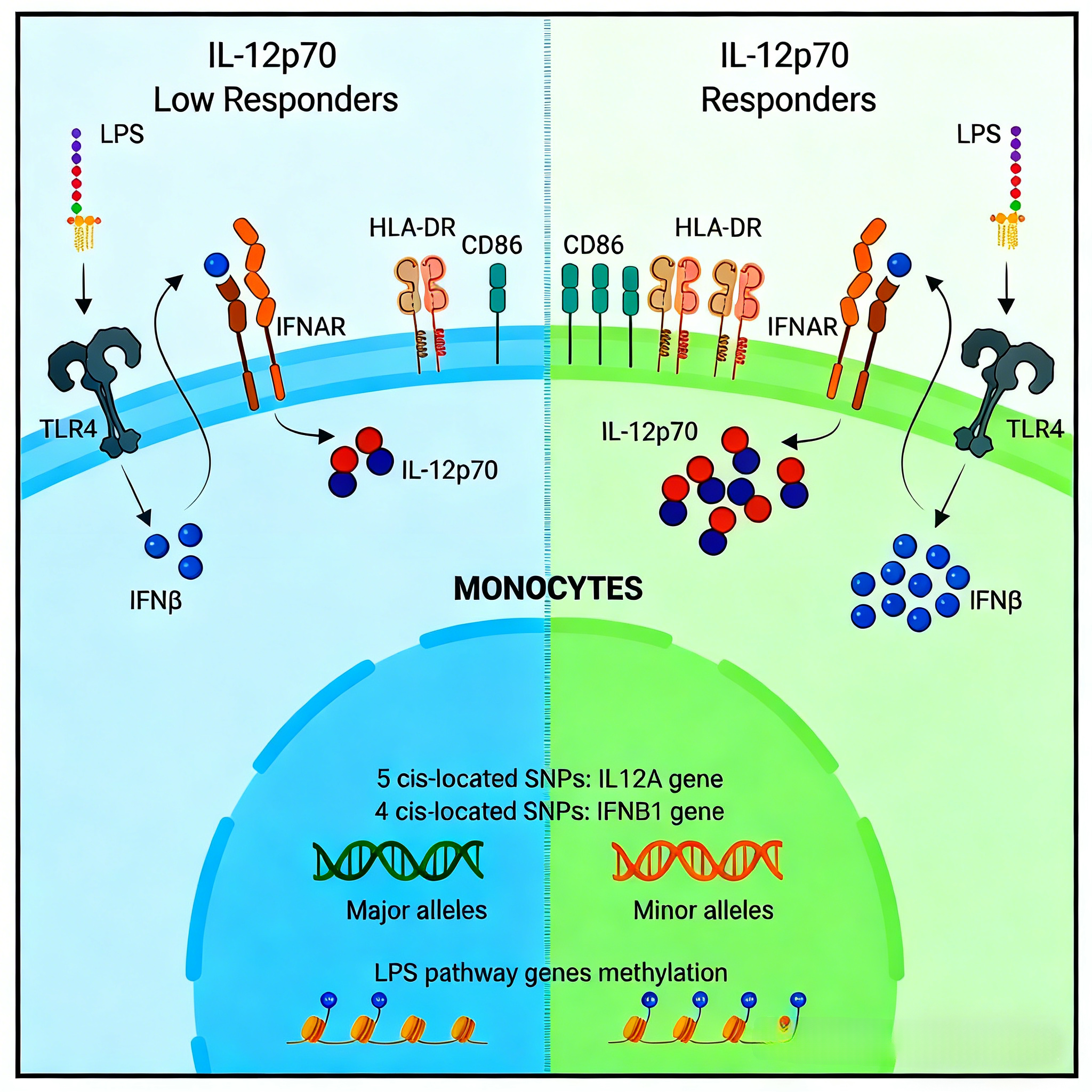
To further clarify the source of differences, the study expanded the sample size to 1,000 healthy subjects and stimulated whole blood with TLR3 and TLR4 agonists for 22 hours. The results confirmed that significant individual differences in IL-12p70 secretion were maintained only in the TLR4 agonist stimulation group, while the TLR3 pathway did not show a similar phenomenon. This finding focused the research on the TLR4-IL-12p70 signaling axis.
III. Analysis of Cellular Sources and Activation States
(1) Major IL-12p70-Producing Cells
To investigate whether the differences in IL-12p70 secretion stem from variations in immune cell composition, the study performed fine classification of cell populations after LPS stimulation. Flow cytometry analysis revealed that CD14+ monocytes and dendritic cells are the primary sources of IL-12p70 and IL-23. Among them, over 30% of CD14+ monocytes simultaneously secreted IL-12p70 and IL-23, while approximately 7% of CD14+ monocytes specifically secreted IL-12p70.
(2) Dissociation of Cell Numbers and Activation States
Comparison between the high- and low-responder groups for IL-12p70 showed no significant differences in the numbers of key immune cell subsets such as CD14+ monocytes, cDC2, and plasmacytoid dendritic cells. However, immunophenotyping revealed that the expression levels of HLA-DR and CD86 on CD14+ monocytes were significantly lower in the low-responder group. This indicates that the differences in IL-12p70 secretion capacity are not determined by cell numbers but are closely related to the activation state of monocytes and dendritic cells.
IV. Identification of IFN-β as an Upstream Regulatory Factor
(1) Transcriptomic Differential Analysis
To further dissect the molecular basis of IL-12p70 secretion differences, the study performed whole-genome expression profiling of control and LPS-stimulated groups. The most significantly differentially expressed genes were concentrated in the HLA family, highly consistent with the flow cytometry immunophenotyping results. Additionally, IFN-γ signaling pathway-related genes such as CIITA, MX1, and IDO1 also showed significant differential expression. While previous studies have reported a positive feedback loop between IFN-γ and IL-12p70, the current data suggest the existence of a more upstream regulatory factor.
(2) Key Role of Type I Interferons
Notably, type I interferons (IFN-α/β) can also induce the expression of the IL12A gene, which encodes the p35 subunit of IL-12p70 and is directly regulated by the TLR pathway. To distinguish the contributions of type I and type II interferons to IL-12p70 secretion after LPS stimulation, the study constructed a dynamic response model based on multiple healthy subject samples. Model analysis showed that the early production of IFN-β was highly correlated with subsequent IL-12p70 secretion, suggesting that IFN-β is an upstream regulatory factor determining the response intensity of IL-12p70 downstream of the TLR4 pathway. The repeated application of the Human IL-12p70 Kit (HICA) in the study provided critical quantitative data support for establishing this association.
V. Pathway Validation in Clinical Disease Models
(1) Changes in the IFN-β-IL-12p70 Axis in COVID-19 Patients
To test the applicability of the above mechanism in clinical infectious diseases, the study included mild, severe, and convalescent COVID-19 patients and measured serum levels of IFN-β and IL-12p70. The results showed that IL-12p70 secretion was significantly positively correlated with IFN-β levels in all patient groups. During hospitalization, the activation level of the IFN-β-IL-12p70 axis after TLR4 pathway activation decreased; after recovery, the pathway activation level returned to the normal range.
(2) Pathway Alterations in HCV Infection
The study further validated the above association in HCV-infected individuals. Whole blood from patients was collected and stimulated with LPS for 22 hours, revealing that the IL-12p70 secretion in the HCV-infected group was significantly lower than in healthy controls, accompanied by changes in Th1 response characteristics. This result was consistent with observations in the COVID-19 cohort, suggesting that acute and chronic viral infections can impair the function of the IFN-β-IL-12p70 pathway.
(3) Functional Recovery After Infection Clearance
Notably, in both COVID-19 convalescents and individuals who cleared HCV infection, the activation capacity of the IFN-β-IL-12p70 axis could recover to levels comparable to healthy populations. This finding provides a new observational dimension for understanding post-infection immune reconstruction and further confirms the central role of IFN-β in IL-12p70 regulation.
VI. Which Manufacturers Provide the Human IL-12p70 Kit (HICA)?
Nanjing UA-Bio Technology Co., Ltd. (UA-Bio) independently developed the "Human IL-12p70 Kit (HICA)", a high-performance in vitro detection platform specifically designed for studying Th1-type immune responses and key pathways of cellular immunity. This kit is intended to accurately and efficiently quantify the immunobinding activity of human IL-12p70 heterodimeric protein, providing stable and reliable standardized solutions for your research in anti-tumor immunity, infection immunity, autoimmune diseases, and immunomodulator development, including efficacy evaluation, mechanism investigation, and biomarker analysis.
| Core Product Advantages |
|---|
| High Purity and Complete Biological Activity: The core components of the kit utilize high-purity, high-biological-activity human IL-12p70 heterodimeric protein validated through multidimensional quality control. This protein maintains the correct native conformation and full receptor (IL-12Rβ1/IL-12Rβ2) binding capacity, faithfully simulating the IFN-γ induction and Th1 differentiation signals mediated by IL-12p70 under physiological conditions, ensuring the accuracy, reproducibility, and functional relevance of binding assay data. |
| Excellent Batch-to-Batch Consistency and Stability: Relying on an internationally leading recombinant protein expression platform and highly standardized purification processes, combined with a stringent release quality control system, the product exhibits outstanding long-term stability and excellent batch-to-batch consistency. This provides solid and reliable quality assurance for your long-term, continuous critical experiments and high-throughput screening work. |
| Ready-to-Use Flexible Detection Platform: Based on an optimized enzyme-linked immunosorbent assay (ELISA) principle, this kit provides pre-coated strips, highly specific detection antibodies, standards, and a complete set of optimized buffer systems. The operation is simple and fast, with high sensitivity and strong specificity, widely applicable to various research needs such as anti-IL-12p70 antibody/receptor antagonist screening, neutralizing activity determination, competitive binding assays, affinity analysis, and immunogenicity evaluation. |
| Complete Solutions and Professional Support: We provide fully validated standard experimental protocols, typical dose-response curves, and detailed result interpretation guidelines to help you quickly establish stable and reproducible detection processes. The Nanjing UA-Bio professional technical team can offer comprehensive and professional technical consultation and support for your research design, experimental optimization, and data analysis. |
Nanjing UA-Bio Technology Co., Ltd. is committed to providing cutting-edge, high-quality core reagents and tools for immunology, cell therapy, and innovative drug development. For detailed technical parameters, validation data, or specific application inquiries regarding the "Human IL-12p70 Kit (HICA)" (Catalog No.: UA086042), please feel free to contact us.
This article is reviewed and published by the technical expert team of UA
Disclaimer: This article partially utilizes artificial intelligence assistance in its creation. If any content involves copyright or intellectual property issues, please let us know and we promise to verify and remove it as soon as possible.
Purchase recombinant protein, choose Nanjing UA-Bio
UA protein focuses on providing various protein reagents, raw materials, and services required for drug research and development, cell therapy, gene therapy, and basic scientific research, including drug target proteins, immune checkpoint proteins, cytokines, tool enzymes, customized protein expression, and full-length transmembrane protein development. Youai is committed to providing customers with high-quality products and professional services, and building a High-tech Biological Enterprise with International Competitiveness.







 Business license (three certificates in one)