




Mechanism study of IL-22 improving renal injury through PFKFB3-mediated renal metabolic reprogramming


Acute kidney injury (AKI), as a clinically common critical condition, is closely associated with high mortality and poor prognosis, and its incidence is increasing year by year.
- Recent Advances
- Product Information
I. Research Background and Scientific Questions
Acute kidney injury (AKI), as a clinically common critical condition, is closely associated with high mortality and poor prognosis, and its incidence has been increasing annually. Renal tubular epithelial cells (TECs) exhibit metabolic dysfunction under injury conditions, serving as a core driver in the progression of end-stage renal disease. Interleukin-22 (IL-22), a key member of the IL-10 family, has been previously confirmed to promote epithelial cell proliferation and tissue repair by activating the STAT3 signaling pathway. However, whether IL-22 exerts renal protective effects by regulating cellular metabolism and its underlying molecular mechanisms remain unclear. This study systematically explores the role and mechanisms of IL-22-mediated metabolic reprogramming in renal injury treatment. During the research, the Human IL-22 Kit (HICA) was used to quantitatively detect IL-22 expression levels, providing technical support for mechanistic validation.
II. Regulatory Effects of IL-22 on Renal Tubular Epithelial Cell Metabolism
(1) IL-22 Maintains Energy Metabolic Homeostasis in TECs
Assessment using the Seahorse energy metabolism analysis system revealed that under renal injury factor stimulation, TECs exhibited significant impairments in mitochondrial basal oxygen consumption rate (OCR), maximal respiratory capacity (MRC), and glycolytic function. IL-22 intervention effectively prevented these metabolic abnormalities. Knockout of IL-22 receptor 1 (IL-22R1) demonstrated complete disappearance of STAT3 phosphorylation levels and IL-22's metabolic reprogramming effects, confirming that IL-22 directly acts on IL-22R1 to restore TECs' metabolic state and enhance oxidative phosphorylation (OXPHOS) and glycolytic capacity under injury conditions.
(2) IL-22 Promotes Mitophagy to Clear Dysfunctional Mitochondria
Under injury conditions, TECs showed decreased mitochondrial membrane potential, abnormal mitochondrial mass, accumulated reactive oxygen species (ROS), and aggravated mitochondrial dysfunction. IL-22 treatment significantly alleviated these mitochondrial damage indicators. Silencing the autophagy-related gene ATG5 with siRNA revealed that the loss of mitophagy function markedly weakened IL-22's protective effects in maintaining mitochondrial integrity, suggesting that IL-22 activates the mitophagy pathway to clear dysfunctional mitochondria, thereby maintaining cellular metabolic homeostasis.
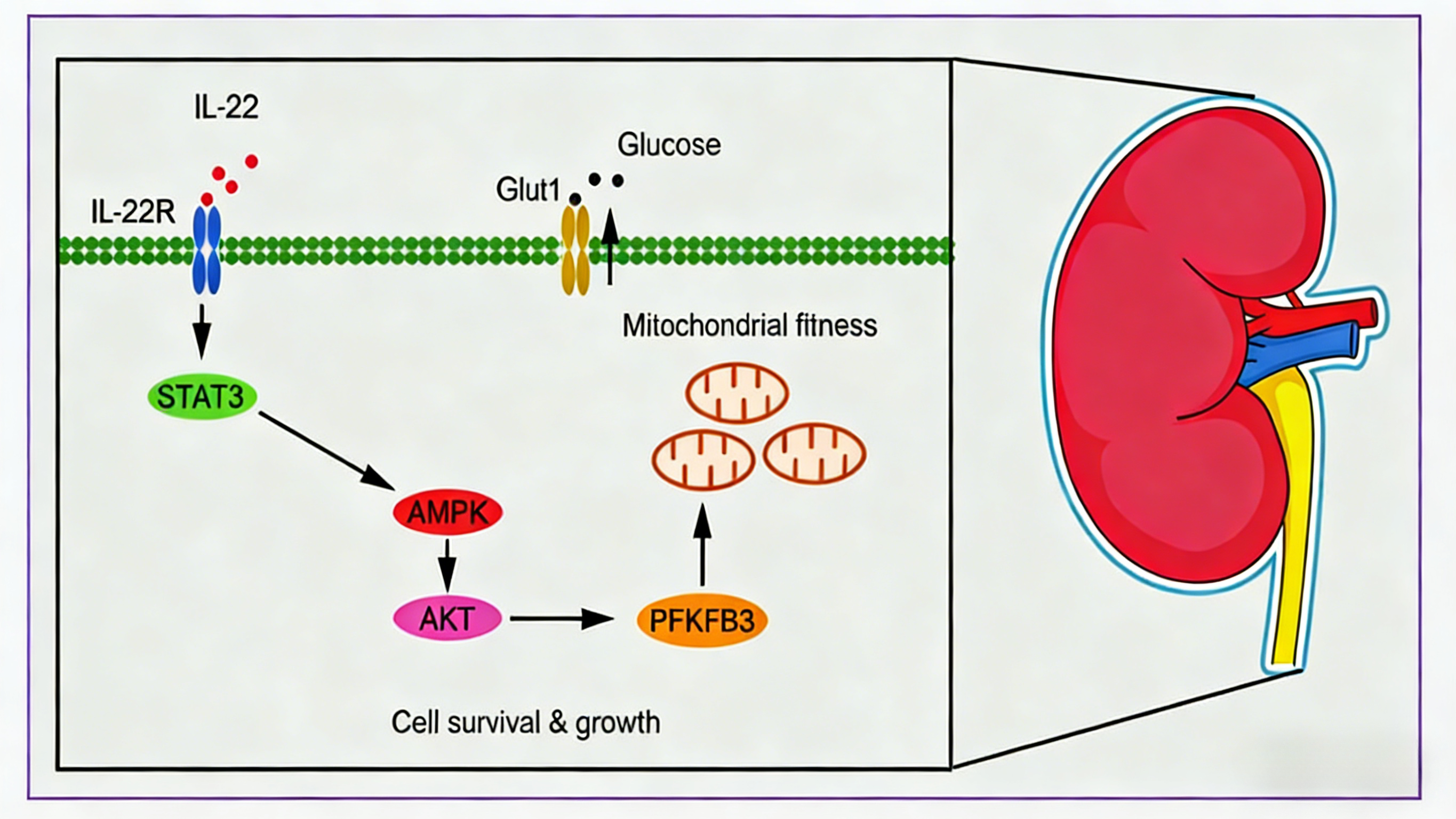
III. Molecular Mechanisms of IL-22 in Regulating TECs Metabolism
(1) Mediating Role of the AMPK/AKT Signaling Pathway
IL-22 treatment significantly enhanced the phosphorylation levels of STAT3, AMPK, and AKT in injured TECs, while this effect was blocked in STAT3-deficient tubular cells. Further inhibition of the AMPK/AKT signaling pathway showed that IL-22-induced enhancements in OXPHOS and glycolysis disappeared, confirming that IL-22 regulates TECs' energy metabolism by activating the AMPK/AKT signaling pathway.
(2) PFKFB3 as a Key Downstream Effector Molecule
Transcriptome sequencing analysis revealed that IL-22 treatment significantly altered the expression of multiple genes, with PFKFB3 being the most prominently upregulated. This result was validated through confocal imaging, quantitative PCR, and immunoblotting. PFKFB3 is a key regulatory enzyme in the glycolytic pathway and plays an important role in epithelial regeneration and repair post-injury. Studies showed that inhibiting AMPK/AKT signaling reduced PFKFB3 expression, while silencing PFKFB3 significantly weakened IL-22's restorative effects on OCR and extracellular acidification rate (ECAR). Notably, the loss of IL-22's metabolic regulation due to STAT3 deficiency could be partially rescued by PFKFB3 overexpression, confirming that IL-22 achieves metabolic reprogramming through the STAT3-AMPK/AKT-PFKFB3 signaling axis.
IV. Protective Effects of IL-22 in Renal Injury Animal Models
(1) Cisplatin-Induced Acute Kidney Injury Model
In a cisplatin-induced AKI mouse model, IL-22 treatment significantly alleviated renal tubular cell injury, hemorrhage, and renal dysfunction. Mitochondria-specific ROS staining and JC-1 detection showed that IL-22 treatment markedly reduced ROS accumulation and improved mitochondrial membrane potential abnormalities in injured kidneys, confirming its in vivo effects in mitigating mitochondrial dysfunction.
(2) Diabetic Nephropathy Model
In a high-fat diet-fed db/db diabetic nephropathy mouse model, after 8 weeks of continuous IL-22 treatment, renal fibrosis, histopathological changes, and renal function indicators (serum creatinine, urea nitrogen, 24-hour urinary albumin excretion) were significantly improved. IL-22 treatment effectively reduced mitochondrial ROS levels and decreased the accumulation of dysfunctional mitochondria. Adenovirus-mediated PFKFB3 knockdown experiments confirmed that reduced PFKFB3 expression partially offset IL-22's renal protective effects, further validating PFKFB3's central role in this pathway. The Human IL-22 Kit (HICA) was used in these animal model studies to detect IL-22 levels in circulation and renal tissues, providing quantitative data for dose-effect relationships and pharmacodynamic evaluations.
V. Summary
This study systematically reveals IL-22's renal protective mechanisms through the STAT3-AMPK/AKT-PFKFB3 signaling axis, regulating TECs' metabolic reprogramming, maintaining mitochondrial function, and alleviating oxidative damage. These effects were validated in both acute kidney injury and diabetic nephropathy animal models. The research not only deepens the understanding of IL-22's biological functions but also provides new theoretical foundations and potential targets for interventions in renal injury diseases. The Human IL-22 Kit (HICA), as a key detection tool, played a crucial supporting role in this mechanistic analysis.
VI. Which Manufacturers Provide the Human IL-22 Kit (HICA)?
Nanjing UA-Bio Technology Co., Ltd. (UA-Bio) independently developed the "Human IL-22 Kit (HICA)", a high-performance in vitro detection platform specifically designed for studying tissue repair and mucosal immune key pathways. This kit aims to accurately and efficiently quantify the immunobinding activity of human interleukin-22 (IL-22) protein, providing stable and reliable standardized solutions for efficacy evaluation, mechanism research, and biomarker analysis in fields such as inflammatory bowel disease, psoriasis, tissue injury repair, and antibody drug development.
| Core Product Advantages |
|---|
| High Purity and Intact Biological Activity: The kit's core components utilize high-purity, high-biological-activity human IL-22 protein verified through multidimensional quality control. This protein maintains correct native conformation and full receptor complex (IL-22R1/IL-10R2) binding capacity, authentically simulating IL-22-mediated tissue protection and regeneration signals under physiological conditions, ensuring accurate, reproducible, and functionally relevant binding experimental data. |
| Exceptional Batch-to-Batch Consistency and Stability: Leveraging an internationally leading recombinant protein expression platform and highly standardized purification processes, combined with a stringent release quality control system, the product exhibits outstanding long-term stability and excellent batch-to-batch consistency. This provides solid and reliable quality assurance for your long-term, continuous critical experiments and high-throughput screening work. |
| Ready-to-Use Flexible Detection Platform: Based on optimized enzyme-linked immunosorbent assay (ELISA) principles, the kit provides pre-coated strips, highly specific detection antibodies, standards, and a complete set of optimized buffer systems. It features simple and fast operation, high sensitivity, and strong specificity, widely applicable to various research needs such as anti-IL-22 antibody/receptor antagonist screening, neutralizing activity determination, competitive binding assays, affinity analysis, and immunogenicity evaluation. |
| Comprehensive Solutions and Professional Support: We provide fully validated standard experimental protocols, typical dose-response curves, and detailed result interpretation guides to help you quickly establish stable and reproducible detection processes. Nanjing UA-Bio's professional technical team offers全程, professional technical consultation and support for your research design, experimental optimization, and data analysis. |
Nanjing UA-Bio Technology Co., Ltd. is committed to providing cutting-edge, high-quality core reagents and tools for immunology, cell therapy, and innovative drug development. For detailed technical parameters, validation data, or specific application inquiries regarding the "Human IL-22 Kit (HICA)" (Catalog No.: UA086044), please feel free to contact us.
This article is reviewed and published by the technical expert team of UA
Disclaimer: This article partially utilizes artificial intelligence assistance in its creation. If any content involves copyright or intellectual property issues, please let us know and we promise to verify and remove it as soon as possible.
Purchase recombinant protein, choose Nanjing UA-Bio
UA protein focuses on providing various protein reagents, raw materials, and services required for drug research and development, cell therapy, gene therapy, and basic scientific research, including drug target proteins, immune checkpoint proteins, cytokines, tool enzymes, customized protein expression, and full-length transmembrane protein development. Youai is committed to providing customers with high-quality products and professional services, and building a High-tech Biological Enterprise with International Competitiveness.







 Business license (three certificates in one)