




Mechanism study of low-dose interferon-γ inducing stemness in non-small cell lung cancer cells


Interferon-gamma (IFN-γ), as a crucial inflammatory cytokine, plays a central role in anti-tumor immunity and is clinically applied in the treatment of various malignant tumors.
- Recent Advances
- Product Information
I. Research Background and Scientific Questions
Interferon-gamma (IFN-γ), as a crucial inflammatory cytokine, plays a central role in anti-tumor immunity and is clinically applied in the treatment of various malignancies. However, recent studies have revealed the complex nature of IFN-γ's role in the tumor microenvironment: on one hand, high levels of IFN-γ can induce tumor cell apoptosis; on the other hand, low levels of IFN-γ may promote tumor progression and increase metastasis risks during immunotherapy. This paradoxical phenomenon suggests that IFN-γ may regulate different biological behaviors of tumor cells in a dose-dependent manner, but the underlying molecular mechanisms remain unclear. This study systematically investigates the mechanisms by which IFN-γ regulates tumor cell stemness in the non-small cell lung cancer (NSCLC) tumor microenvironment, focusing on its dose-effect relationship. The Human IFN-γ Kit (HICA) was employed to quantitatively measure IFN-γ expression levels, providing technical support for analyzing the differential effects under various dose conditions.
II. Dose-Dependent Bidirectional Effects of IFN-γ
(1) High levels of IFN-γ induce tumor cell apoptosis
IFN-γ is primarily secreted by activated T cells, NK cells, and NKT cells. Upon binding to the heterodimeric surface receptors IFNGR1/IFNGR2, it activates the classical JAK-STAT signaling pathway, initiating the transcription of a series of interferon-stimulated genes, thereby mediating cell cycle arrest and apoptosis in tumor cells. High levels of IFN-γ exert anti-tumor effects through the JAK1-STAT1-caspase pathway, which forms the theoretical basis for its clinical application.
(2) Low levels of IFN-γ promote stemness acquisition
However, both clinical observations and animal experiments suggest that persistently low levels of IFN-γ in the tumor microenvironment are closely associated with tumor progression. Studies have confirmed that low-dose IFN-γ can induce tumor cells to acquire stem cell-like properties, including enhanced self-renewal capacity, tumorigenicity, and immune evasion capabilities. The existence of this dose-dependent bidirectional effect indicates that different concentrations of IFN-γ may activate distinct signaling networks.
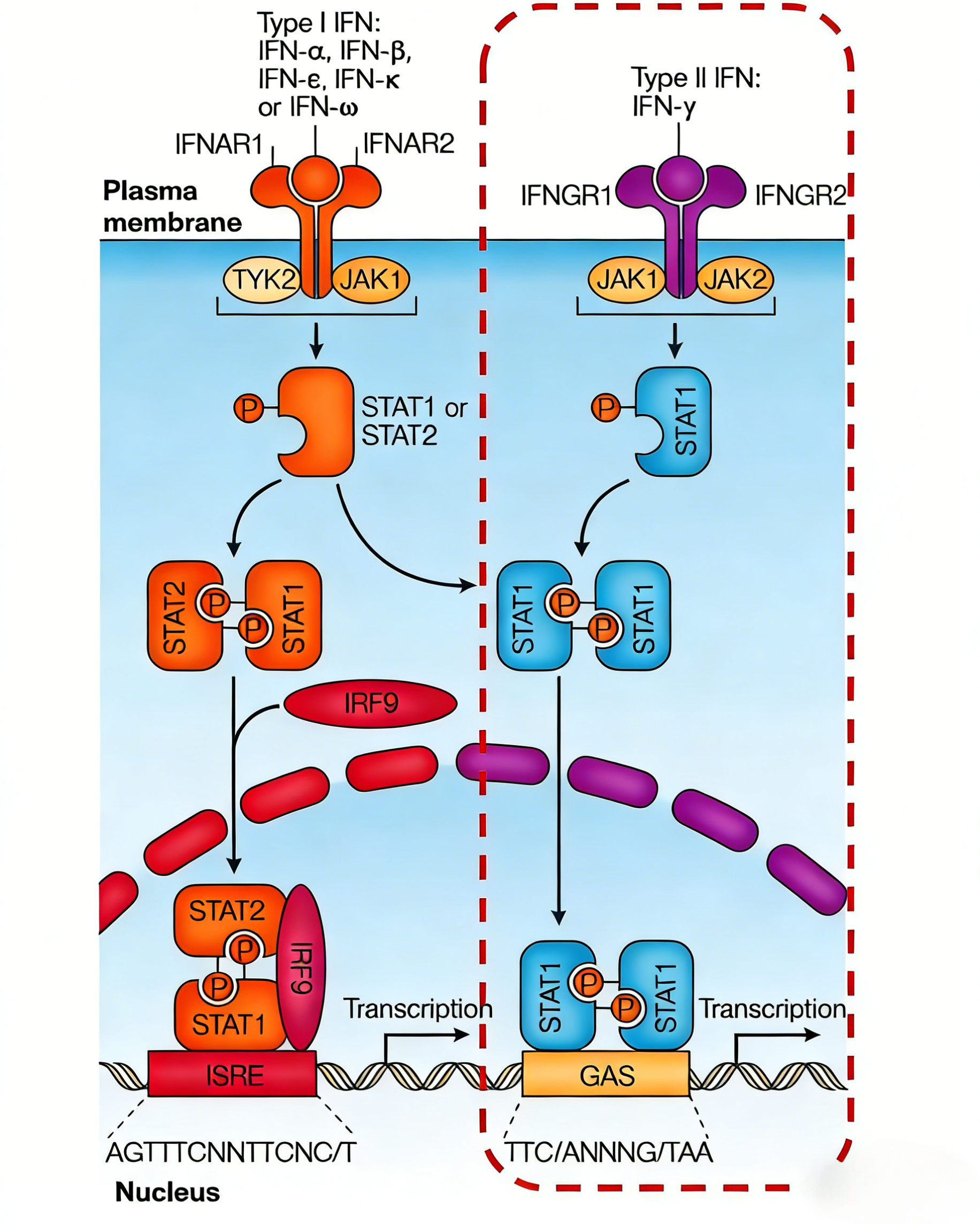
III. Molecular Mechanisms of Low-Dose IFN-γ-Induced Tumor Stemness
(1) ICAM-1 as a key mediator
Research indicates that low levels of IFN-γ initiate downstream signaling cascades by upregulating intercellular adhesion molecule-1 (ICAM-1) expression. ICAM-1, as an immunoglobulin superfamily transmembrane molecule, plays important roles in leukocyte-endothelial cell migration, intercellular interactions, and tissue homeostasis maintenance. In the tumor microenvironment, ICAM-1 can be induced by inflammatory cytokines such as IFN-γ and has been identified as a stem cell marker in various malignancies.
(2) Activation of the ICAM-1-PI3K-Akt-Notch1 signaling axis
Following low-dose IFN-γ-induced ICAM-1 upregulation, the PI3K-Akt signaling pathway is further activated, subsequently initiating Notch1 signaling. The Notch pathway is one of the core regulatory pathways maintaining tumor stem cell properties, and its activation promotes the expression of stemness-related genes and the epithelial-mesenchymal transition (EMT) process. Gene silencing experiments confirmed that inhibiting ICAM-1 expression significantly attenuates low-dose IFN-γ-induced stemness acquisition in tumor cells, demonstrating the essential role of ICAM-1 in this pathway.
(3) Association with the immune microenvironment of tumor stem cells
The properties of cancer stem cells (CSCs) depend on a specific immune microenvironment. Studies show that immune cells such as tumor-associated macrophages, myeloid-derived suppressor cells, and regulatory T cells form complex regulatory networks with tumor cells by secreting cytokines like TNF-α, TGF-β, and IL-6. Hypoxic environments further promote EMT and stemness maintenance by inducing HIF-1α expression. Tumor-associated fibroblasts secrete molecules such as TNC, HGF, and matrix metalloproteinases, which enhance CSC properties by activating Wnt and Notch signaling pathways. The ICAM-1-PI3K-Akt-Notch1 signaling axis identified in this study provides new molecular connections for understanding how IFN-γ integrates into this complex network.
IV. Research Significance and Clinical Translation Value
(1) Revealing the dual functional mechanisms of IFN-γ
This study is the first to elucidate that IFN-γ activates different signaling pathways in a dose-dependent manner: high levels of IFN-γ induce apoptosis through the JAK1-STAT1 pathway, while low levels induce tumor stemness through the ICAM-1-PI3K-Akt-Notch1 axis. This discovery unifies the contradictory roles of IFN-γ in the tumor microenvironment within a dose-effect framework, deepening our understanding of this cytokine's biological functions.
(2) Proposing ICAM-1 as a therapeutic target
The study confirms that ICAM-1 plays a central role in low-level IFN-γ-induced tumor stemness formation, suggesting it as a potential therapeutic target for patients with low IFN-γ levels in their tumor microenvironment. Targeting ICAM-1 could potentially block the pro-tumor effects of low-dose IFN-γ while preserving its anti-tumor activity at high doses.
(3) Research support value of detection tools
The Human IFN-γ Kit (HICA) was used in this study to accurately quantify IFN-γ concentrations under different experimental conditions, providing key data support for establishing dose-effect relationships and defining threshold values for low and high doses. Such detection tools can be used in subsequent clinical translation studies to monitor IFN-γ levels in patients' tumor microenvironments, informing personalized treatment strategies.
V. Which manufacturers provide the Human IFN-γ Kit (HICA)?
Nanjing UA-Bio Technology Co., Ltd. has independently developed the "Human IFN-γ Kit (HICA)", a high-performance in vitro detection platform specifically designed for studying Th1-type immune responses and macrophage activation key pathways. This kit aims to accurately and efficiently quantify the immunobinding activity of human interferon-gamma (IFN-γ) protein, providing stable and reliable standardized solutions for your research in anti-tumor immunity, infection immunity, autoimmune diseases, and immunomodulator development, including efficacy evaluation, mechanism studies, and biomarker analysis.
| Core Product Advantages |
|---|
| High purity and complete biological activity: The core components of the kit utilize highly purified, biologically active human IFN-γ protein verified through multidimensional quality control. This protein maintains the correct native homodimeric conformation and full receptor (IFN-γR1/IFN-γR2) binding capacity, accurately simulating IFN-γ-mediated immune activation signals under physiological conditions, ensuring the accuracy, reproducibility, and functional relevance of binding experimental data. |
| Exceptional batch-to-batch consistency and stability: Leveraging an internationally leading recombinant protein expression platform and highly standardized purification processes, combined with a stringent release quality control system, ensures the product's excellent long-term stability and outstanding batch-to-batch consistency. This provides solid and reliable quality assurance for your long-term, continuous critical experiments and high-throughput screening work. |
| Ready-to-use flexible detection platform: Based on optimized enzyme-linked immunosorbent assay (ELISA) principles, this kit provides pre-coated strips, highly specific detection antibodies, standards, and a complete set of optimized buffer systems. It features simple and fast operation, high sensitivity, and strong specificity, widely applicable to various research needs such as anti-IFN-γ antibody/receptor antagonist screening, neutralization activity determination, competitive binding assays, affinity analysis, and immunogenicity evaluation. |
| Complete solutions and professional support: We provide fully validated standard experimental protocols, typical dose-response curves, and detailed result interpretation guidelines to help you quickly establish stable and reproducible detection processes. Nanjing UA-Bio's professional technical team offers comprehensive technical consultation and support throughout your research design, experimental optimization, and data analysis. |
Nanjing UA-Bio Technology Co., Ltd. remains committed to providing cutting-edge, high-quality core reagents and tools for immunology, cell therapy, and innovative drug development. For detailed technical parameters, validation data, or specific application inquiries regarding the "Human IFN-γ Kit (HICA)" (Catalog No.: UA086045), please feel free to contact us anytime.
This article is reviewed and published by the technical expert team of UA
Disclaimer: This article partially utilizes artificial intelligence assistance in its creation. If any content involves copyright or intellectual property issues, please let us know and we promise to verify and remove it as soon as possible.
Purchase recombinant protein, choose Nanjing UA-Bio
UA protein focuses on providing various protein reagents, raw materials, and services required for drug research and development, cell therapy, gene therapy, and basic scientific research, including drug target proteins, immune checkpoint proteins, cytokines, tool enzymes, customized protein expression, and full-length transmembrane protein development. Youai is committed to providing customers with high-quality products and professional services, and building a High-tech Biological Enterprise with International Competitiveness.







 Business license (three certificates in one)