




Research Progress and Clinical Significance of KRAS G12D Target


The RAS gene family is the most widely mutated oncogene in tumors, accounting for approximately 20% to 30% of all tumor mutations, and includes three subtypes: KRAS, HRAS, and NRAS.
- Recent Advances
I. Overview of KRAS Signaling Pathway
The RAS gene family is the most widely mutated oncogene in tumors, accounting for approximately 20% to 30% of all tumor mutations, including three subtypes: KRAS, HRAS, and NRAS. Among these, KRAS gene mutations constitute about 85% of RAS family mutations and are more prone to promote tumor initiation and progression compared to other subtypes.
The functional state of the KRAS protein is regulated by the type of nucleotide it binds: when bound to GDP, KRAS is in an inactive state; when bound to GTP, it is activated. Mutant KRAS remains persistently in the GTP-bound activated state due to impaired GTP hydrolysis mediated by GTPase-activating proteins (GAPs). KRAS occupies a central position in signaling pathways, receiving signals from various upstream growth factor receptors and activating multiple downstream pathways, such as MAPK and PI3K, thereby promoting cell proliferation, migration, and metastasis, ultimately driving malignant tumor progression.
Due to the extremely high affinity of mutant KRAS for GTP and its smooth protein surface lacking ideal drug-binding pockets, KRAS has long been considered an "undruggable" target. In recent years, covalent inhibitors designed to target the cysteine residue introduced in the KRAS G12C mutant subtype have achieved breakthroughs, ushering in a new era of KRAS-targeted therapy.
II. Characteristics and Epidemiology of KRAS G12D Mutation
Among KRAS mutation types, G12D (approximately 35%), G12V (29%), and G12C (21%) are the three most common subtypes. Both KRAS G12D and G12C are point mutations at codon 12, differing in that G12D introduces aspartic acid, while G12C introduces cysteine. This amino acid difference leads to significant variations in their distribution across cancer types: G12C is more common in non-small cell lung cancer, whereas G12D predominates in colorectal and pancreatic cancers.
Research data show that about 37.6% of Chinese colorectal cancer patients carry KRAS mutations, with nearly 32.2% being the G12D subtype, which is more prevalent in patients under 65 years of age. KRAS mutations are considered an independent prognostic factor in colorectal cancer, highlighting their importance in tumorigenesis and patient outcomes.
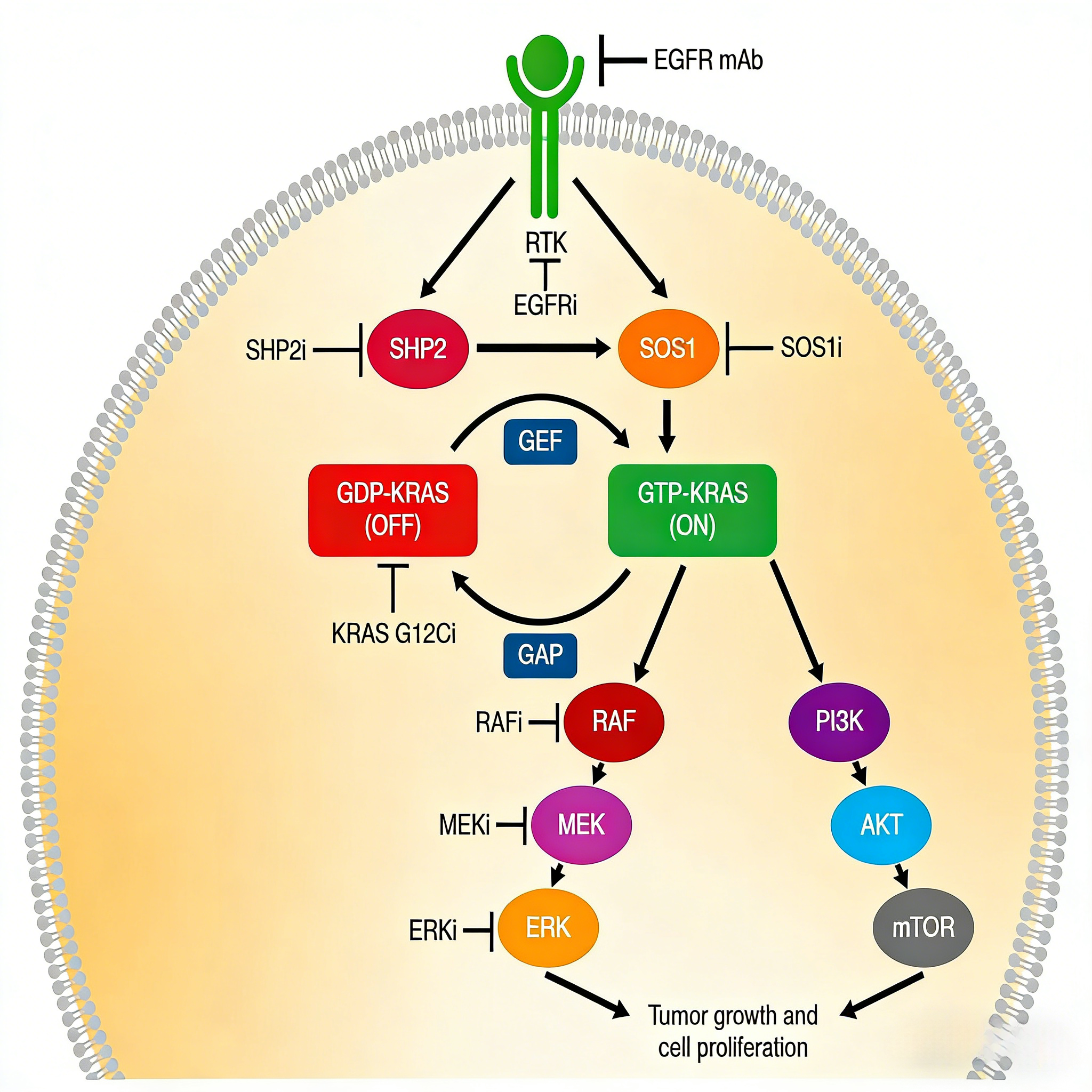
III. Research Progress in Targeting KRAS G12D
With a deeper understanding of the biological characteristics of KRAS G12D, targeted therapeutic strategies for this mutant subtype have become a research focus. Currently, multiple research institutions worldwide are advancing the development of small-molecule inhibitors for KRAS G12D, although most projects remain in the preclinical stage.
In recent years, some candidate drugs have entered clinical research. For example, certain selective KRAS G12D inhibitors have completed preclinical validation and are planned for clinical trials; others, such as KRAS G12D-targeting degraders, have initiated Phase I clinical studies to evaluate their efficacy in patients with advanced solid tumors carrying this mutation. Overall, the development of targeted drugs for KRAS G12D is still in its early stages, but their therapeutic potential in refractory tumors like pancreatic and colorectal cancers is highly anticipated.
IV. Application of KRAS G12D & cRAF Binding Analysis Tools
In the development of KRAS G12D-targeted drugs, assessing the binding capacity of mutant KRAS to downstream effector proteins is a critical step. cRAF, as an important downstream signaling molecule of RAS, is often used as an indicator for drug screening and mechanistic studies of its interaction with KRAS G12D.
The KRAS G12D & cRAF Binding Kit provides a standardized detection tool for such research, enabling the evaluation of small-molecule inhibitors' interference with the interaction between KRAS G12D and cRAF. This kit facilitates the accelerated screening and optimization of KRAS G12D-targeted drugs, promoting the clinical translation of therapeutic strategies for this target.
V. Summary and Outlook
KRAS G12D, as one of the most common subtypes of KRAS mutations, holds significant clinical importance in colorectal and pancreatic cancers. Despite the challenges in developing targeted therapies, advances in structural biology, medicinal chemistry, and molecular detection technologies have gradually progressed the development of KRAS G12D-targeted drugs. In the future, as more candidate drugs enter clinical stages, KRAS G12D-targeted therapies are expected to provide new treatment options for patients with relevant tumors.
VI. Which Manufacturers Provide KRAS G12D & cRAF Binding Kits?
Nanjing UA-Bio Technology Co., Ltd. (UA-Bio) has independently developed the "UniOne® TR-FRET Human KRAS G12D & cRAF Binding Kit", a high-performance analysis platform specifically designed to study the interaction between the KRAS G12D mutant and its downstream effector, cRAF. This kit is based on time-resolved fluorescence resonance energy transfer (TR-FRET) technology and is designed to accurately and efficiently assess the binding activity between human KRAS G12D mutant protein and the cRAF RAS-binding domain (RBD). It provides a stable and reliable standardized solution for tumor-targeted drug development, KRAS inhibitor screening, and mechanistic studies.
| Core Product Advantages |
|---|
| High Purity and Full Biological Activity: The core components of the kit employ highly purified and biologically active human KRAS G12D mutant protein and cRAF protein, validated through multi-dimensional quality control. Both proteins maintain correct native conformations and full binding functionality, accurately simulating the specific interaction between G12D mutant KRAS and downstream cRAF under physiological conditions, ensuring experimental data accuracy, reproducibility, and functional relevance. |
| Excellent Batch-to-Batch Consistency and Stability: Leveraging an internationally leading recombinant protein expression platform and highly standardized purification processes, combined with a rigorous quality control system, the product exhibits outstanding long-term stability and excellent batch-to-batch consistency. This provides a solid and reliable quality guarantee for long-term, continuous drug screening and mechanistic research. |
| Ready-to-Use Flexible Experimental Platform: Based on homogeneous TR-FRET technology, the kit adopts a simple "add-incubate-read" operation mode without cumbersome washing steps. Its optimized formulation is compatible with multi-well plate (96/384-well) automation platforms, making it suitable for various research applications such as high-throughput screening of KRAS G12D inhibitors, affinity determination, and competitive binding assays. |
| Comprehensive Solutions and Professional Support: We provide fully validated standard experimental protocols, typical dose-response curves, and detailed result interpretation guidelines to help you quickly establish stable and reproducible experimental workflows. Nanjing UA-Bio's professional technical team offers full-cycle technical consultation and support for research design, experimental optimization, and data analysis. |
Nanjing UA-Bio Technology Co., Ltd. is committed to providing cutting-edge, high-quality core reagents and tools for immunology, cell therapy, and innovative drug development. For detailed technical parameters, validation data, or specific application inquiries regarding the "UniOne® TR-FRET Human KRAS G12D & cRAF Binding Kit" (Catalog No.: UA086028), please feel free to contact us.
This article is reviewed and published by the technical expert team of UA
Disclaimer: This article partially utilizes artificial intelligence assistance in its creation. If any content involves copyright or intellectual property issues, please let us know and we promise to verify and remove it as soon as possible.
Purchase recombinant protein, choose Nanjing UA-Bio
UA protein focuses on providing various protein reagents, raw materials, and services required for drug research and development, cell therapy, gene therapy, and basic scientific research, including drug target proteins, immune checkpoint proteins, cytokines, tool enzymes, customized protein expression, and full-length transmembrane protein development. Youai is committed to providing customers with high-quality products and professional services, and building a High-tech Biological Enterprise with International Competitiveness.







 Business license (three certificates in one)