




KRAS G12C/cRAF binding assay: A novel tool for targeted drug screening and mechanism research


The RAS family genes are among the most frequently mutated oncogenes in human cancers, with KRAS mutations being particularly common and exhibiting high incidence in malignancies such as pancreatic cancer, colorectal cancer, and non-small cell lung cancer.
- Recent Advances
- Product Information
I. Central Role of KRAS G12C Mutation in Tumorigenesis
The RAS family genes are among the most frequently mutated oncogenes in human cancers, with KRAS mutations being particularly prevalent and exhibiting high incidence in malignancies such as pancreatic cancer, colorectal cancer, and non-small cell lung cancer. The KRAS protein, a small GTPase, precisely regulates downstream signaling pathways (e.g., the RAF-MEK-ERK cascade) through the transition between GTP-bound (active) and GDP-bound (inactive) states under physiological conditions, thereby controlling cell proliferation, differentiation, and survival.
The substitution of glycine to cysteine at position 12 (G12C) in KRAS is a well-characterized oncogenic mutation. This mutation impairs KRAS's intrinsic GTPase activity and its interaction with GTPase-activating proteins, leading to abnormal accumulation of KRAS in the GTP-bound active conformation, persistent activation of downstream signaling pathways, and driving tumor initiation and progression. The KRAS G12C mutation accounts for approximately 13% of lung adenocarcinomas and is also present in colorectal cancer and other solid tumors, making it an important molecular subtype for targeted therapy.
II. KRAS G12C and cRAF Interaction: A Critical Node in Signal Transduction
Upon activation, one of the most important downstream effector molecules of KRAS is the RAF family of kinases, with cRAF (RAF-1) being the core mediator of proliferative signaling. GTP-bound active KRAS specifically interacts with the RAS-binding domain of cRAF through its effector domain, recruiting cRAF to the cell membrane and inducing its activation, thereby initiating the downstream MEK-ERK kinase cascade.
The sustained activation caused by the KRAS G12C mutation directly manifests as abnormally enhanced or prolonged binding of KRAS-GTP to cRAF, rendering cell proliferation signals independent of upstream regulation. Therefore, the protein-protein interaction between KRAS G12C and cRAF is a central link in mutant KRAS-driven oncogenic signaling and a key functional indicator for evaluating the mechanism of action of KRAS G12C-targeted drugs (especially covalent inhibitors).
III. Design Principles and Application Value of the Human KRAS G12C & cRAF Binding Kit
In the development of KRAS G12C-targeted drugs and basic mechanism research, achieving precise and quantitative detection of the binding ability between mutant KRAS and its downstream effector cRAF is a key technology for evaluating the inhibitory effects of candidate compounds. The Human KRAS G12C & cRAF Binding Kit is a standardized detection platform designed specifically for this purpose.
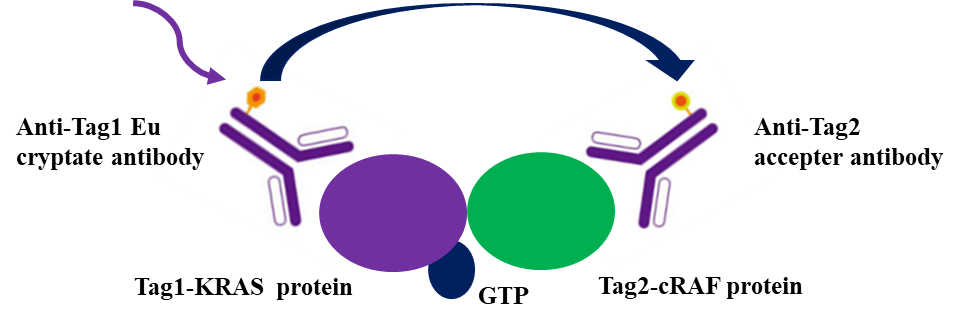
1. Detection Principle: The kit typically employs a homogeneous detection mode based on time-resolved fluorescence resonance energy transfer (TR-FRET) or AlphaLISA technology. Purified recombinant human KRAS G12C protein (with a specific tag) is mixed with cRAF protein (with a complementary tag). In the absence of inhibitors, the two proteins form a specific protein-protein complex. Upon adding donor and acceptor beads that recognize the respective tags, the beads come into proximity, exciting fluorescence resonance energy transfer signals and generating detectable light signals. The signal intensity is proportional to the amount of KRAS G12C-cRAF complex formed. When inhibitors (e.g., small molecules covalently binding to the G12C cysteine) that block this interaction are present in the system, the formation of the protein complex decreases, leading to a reduction in fluorescence signals.
2. Core Application Scenarios:
- Compound Screening and Evaluation: Can be used for high-throughput screening of small-molecule compound libraries that block KRAS G12C/cRAF interactions. By measuring the half-maximal inhibitory concentration (IC50), the inhibitory potency of candidate molecules can be quantitatively evaluated, providing critical data for hit discovery and lead optimization.
- Structure-Activity Relationship Studies: In the evaluation of structurally analogous compounds, the kit can be used to compare their inhibitory activity on this interaction, establishing correlations between molecular structure and inhibitory efficacy to guide rational drug design.
- Mechanism Validation Studies: After observing the inhibition of downstream signals (e.g., pERK) at the cellular level, the kit can be used to verify whether the candidate compound directly targets the KRAS G12C-cRAF binding step, confirming its mechanism of action.
- Covalent Binding Kinetic Analysis: By varying the pre-incubation time of compounds with proteins, the binding rate and irreversibility of covalent inhibitors can be evaluated, providing supplementary data for the druggability assessment of candidate compounds.
3. Technical Advantages: The detection system is performed in microplates, offering simplicity of operation, rapid reaction, no washing steps, and suitability for automation and high-throughput operations. Its homogeneous detection mode avoids the loss of low-affinity interactions caused by washing steps in traditional methods, more accurately reflecting the equilibrium state of protein-protein interactions.
IV. Translational Significance of the Kit in Targeted Therapy Research
The successful development of KRAS G12C covalent inhibitors (e.g., the clinical approval of sotorasib and adagrasib) has validated the feasibility of directly targeting KRAS mutants. However, drug resistance and the continuous optimization of new inhibitors remain research hotspots. The Human KRAS G12C & cRAF Binding Kit, as a direct detection tool reflecting target functional activity, holds significant translational value in the following aspects:
1. Discovery of Next-Generation Inhibitors: For novel inhibitors targeting the G12C mutation and other allelic mutations (e.g., G12D, G12V), their ability to block downstream signal initiation needs to be evaluated. This kit provides a direct functional readout.
2. Drug Resistance Mechanism Research: For patient samples that have developed resistance to existing KRAS G12C inhibitors, the kit can be used to assess whether KRAS-cRAF binding is restored due to secondary mutations, revealing the molecular mechanisms of resistance.
3. Exploration of Combination Therapy Strategies: When evaluating combination regimens of KRAS inhibitors with MEK inhibitors, SHP2 inhibitors, etc., the kit can confirm whether upstream targets are effectively inhibited, providing mechanistic explanations for synergistic effects.
V. Which Manufacturers Provide the Human KRAS G12C & cRAF Binding Kit?
Nanjing UA-Bio Technology Co., Ltd. (UA-Bio) has independently developed the "UniOne® TR-FRET Human KRAS G12C & cRAF Binding Kit", a high-performance analysis platform specifically designed to study the interaction between the KRAS G12C mutant and its downstream effector cRAF. Based on time-resolved fluorescence resonance energy transfer (TR-FRET) technology, this kit aims to accurately and efficiently assess the binding activity between human KRAS G12C mutant protein and the cRAF RAS-binding domain (RBD), providing a stable and reliable standardized solution for tumor-targeted drug development, KRAS inhibitor screening, and mechanism research.
| Core Advantages of the Product |
|---|
| High Purity and Intact Biological Activity: The core components of the kit are high-purity, high-biological-activity human KRAS G12C mutant protein and cRAF protein, verified through multi-dimensional quality control. Both proteins maintain correct native conformations and intact binding functions, accurately simulating the specific interaction between G12C mutant KRAS and downstream cRAF under physiological conditions, ensuring the accuracy, reproducibility, and functional relevance of experimental data. |
| Excellent Batch-to-Batch Consistency and Stability: Leveraging an internationally leading recombinant protein expression platform and highly standardized purification processes, combined with a stringent quality control system, the product exhibits outstanding long-term stability and excellent batch-to-batch consistency, providing solid and reliable quality assurance for long-term and continuous drug screening and mechanism research. |
| Ready-to-Use Flexible Experimental Platform: Based on homogeneous TR-FRET technology, the kit adopts a simple "add-incubate-read" operation mode without cumbersome washing steps. Its optimized formulation system is compatible with multi-well plate (96/384-well) automation platforms, flexibly applicable to high-throughput screening of covalent/non-covalent KRAS G12C inhibitors, affinity determination, and competitive binding experiments, among other research applications. |
| Comprehensive Solutions and Professional Support: We provide fully validated standard experimental protocols, typical dose-response curves, and detailed result interpretation guidelines to help you quickly establish stable and reproducible experimental workflows. Nanjing UA-Bio's professional technical team offers comprehensive technical consultation and support for your research design, experimental optimization, and data analysis. |
Nanjing UA-Bio Technology Co., Ltd. is committed to providing cutting-edge, high-quality core reagents and tools for immunology, cell therapy, and innovative drug development. For detailed technical parameters, validation data, or specific application inquiries regarding the "UniOne® TR-FRET Human KRAS G12C & cRAF Binding Kit" (Catalog No.: UA086027), please feel free to contact us.
This article is reviewed and published by the technical expert team of UA
Disclaimer: This article partially utilizes artificial intelligence assistance in its creation. If any content involves copyright or intellectual property issues, please let us know and we promise to verify and remove it as soon as possible.
Purchase recombinant protein, choose Nanjing UA-Bio
UA protein focuses on providing various protein reagents, raw materials, and services required for drug research and development, cell therapy, gene therapy, and basic scientific research, including drug target proteins, immune checkpoint proteins, cytokines, tool enzymes, customized protein expression, and full-length transmembrane protein development. Youai is committed to providing customers with high-quality products and professional services, and building a High-tech Biological Enterprise with International Competitiveness.







 Business license (three certificates in one)