




Application of KRAS G12V & SOS1 Binding Assay Kit in T Cell Recognition Mechanism Research


The KRAS G12V mutation is one of the most common driver mutations in refractory tumors such as pancreatic cancer and lung cancer. Due to the intracellular localization of the KRAS protein, traditional antibody drugs struggle to directly target it, making this target a long-standing therapeutic challenge.
- Recent Advances
I. Introduction
The KRAS G12V mutation is one of the most common driver mutations in refractory tumors such as pancreatic cancer and lung cancer. Since the KRAS protein is located intracellularly, traditional antibody drugs struggle to directly target it, making this a long-standing therapeutic challenge. Immunotherapy offers a new approach for such "undruggable" targets: T cells can recognize KRAS mutant peptides presented on the cell surface by HLA molecules, enabling precise elimination of tumor cells. However, the core challenge lies in engineering T cells or their derivatives to distinguish between mutant and wild-type peptides differing by just one amino acid. Recent studies using cryo-electron microscopy (Cryo-EM) have revealed the molecular mechanism by which T cell receptor-mimicking antibodies recognize KRAS G12V mutant peptides at an atomic level, providing critical insights for designing novel immunotherapeutic strategies. The Human KRAS G12V & SOS1 Binding Kit (GDP-loaded) serves as a key tool for studying the functional states of mutant KRAS proteins and holds significant value in understanding their biological properties and developing targeted therapies.
II. KRAS G12V Mutation and Immunotherapy Strategies
The KRAS G12V mutation occurs at codon 12 of the KRAS gene, substituting glycine with hydrophobic valine. This amino acid change disrupts GTPase-activating protein (GAP)-mediated GTP hydrolysis, locking KRAS in a constitutively active GTP-bound state that aberrantly drives downstream signaling pathways, promoting tumor cell proliferation and survival.
As KRAS is an intracellular protein, traditional antibody drugs cannot effectively target it. Immunotherapy leverages T cell recognition of antigen peptides presented on the cell surface by major histocompatibility complex (MHC/HLA) molecules, offering a viable approach for targeting intracellular proteins. The mutant peptide derived from KRAS G12V can be presented by HLA molecules on tumor cell surfaces, serving as a specific marker for T cell recognition. Based on this principle, immunotherapeutic strategies such as T cell receptor-engineered T cells (TCR-T) and T cell receptor-mimicking antibodies (TCRm Abs) are rapidly advancing.
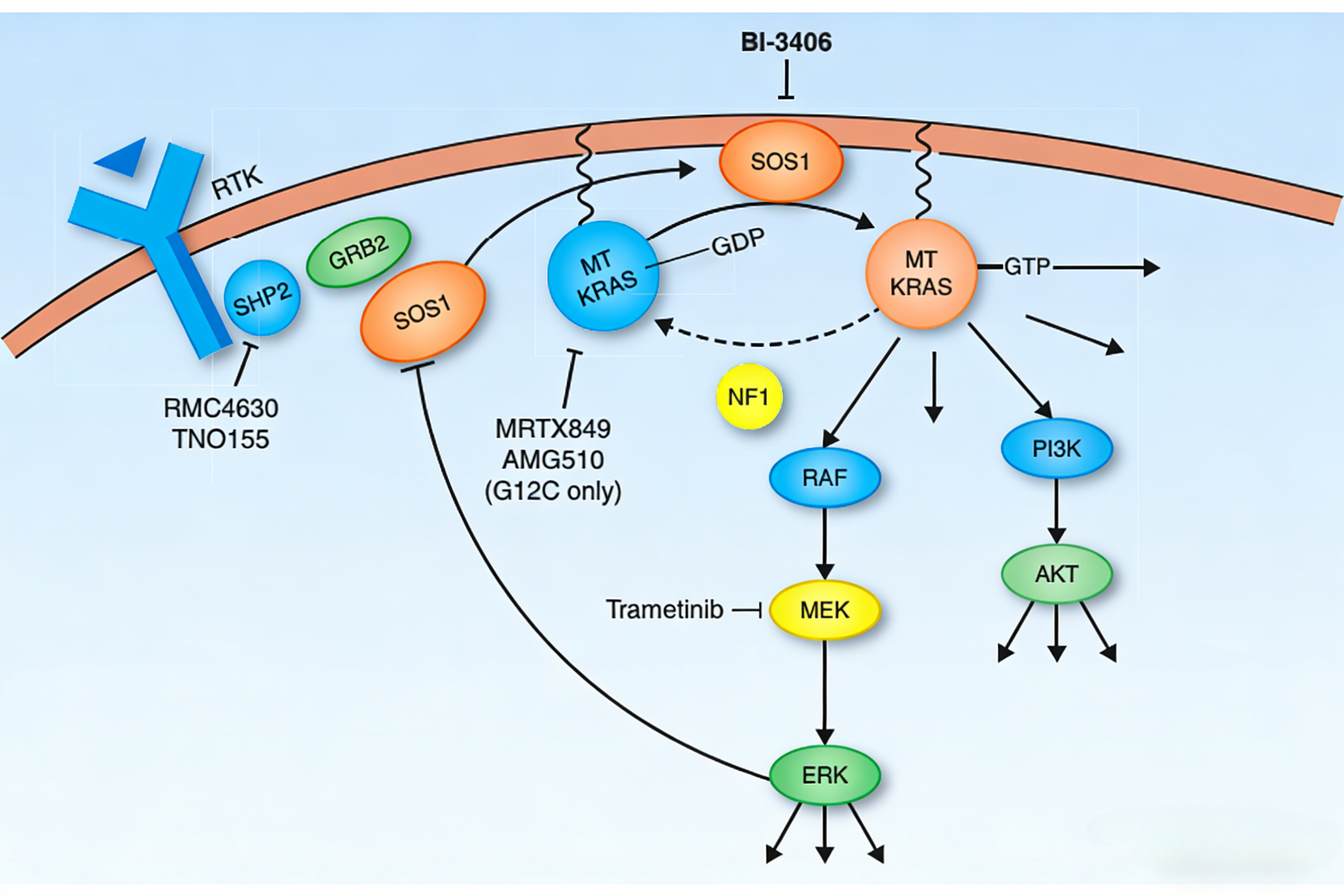
III. Structural Basis of T Cell Receptor-Mimicking Antibody Recognition of KRAS G12V
To elucidate how T cell receptor-mimicking antibodies precisely distinguish KRAS G12V mutant peptides from wild-type peptides, researchers used cryo-EM to resolve the high-resolution 3D structure of the antibody-peptide-HLA complex. Structural analysis revealed that the antibody binds to the C-terminal region of the peptide in a highly tilted manner, with its complementarity-determining region (CDR) loops directly targeting the critical G12V mutation site.
This unique binding mode unveils the molecular mechanism of precise recognition. Key amino acids in the CDR H3 and L2 regions form a loose hydrophobic "cage" structure. When targeting the KRAS G12V mutant peptide, the valine mutation—a hydrophobic amino acid—fits perfectly within this cage, stabilized by strong hydrophobic interactions. In contrast, the wild-type peptide's glycine lacks a side chain and cannot form effective interactions with the hydrophobic cage, preventing recognition.
This discovery reveals a novel immune recognition mechanism: the antibody achieves specificity not by detecting new chemical groups introduced by the mutation but by recognizing the hydrophobic features of the mutation. Hydrophobic forces dominate this process, offering important insights for designing immunotherapeutic molecules targeting other hydrophobic mutations.
IV. Role of Induced Fit in Antigen Recognition
The study also found that antibody binding induces significant conformational changes in the KRAS G12V peptide. In the unbound state, the peptide adopts a relatively flat conformation; upon antibody binding, the C-terminal region is pushed deeper into the HLA molecule's antigen-binding groove, displacing the entire peptide. This dynamic "induced fit" process further enhances the antibody's specificity for the antigen.
This finding suggests that developing T cell receptors or TCR-mimicking antibodies requires consideration of not only static molecular complementarity but also dynamic conformational changes during binding. The induced fit mechanism provides a new dimension for antibody engineering and explains why some in vitro affinity-optimized mutants may impair T cell function.
V. Applications of the Human KRAS G12V & SOS1 Binding Kit (GDP-loaded) in Research
In KRAS G12V-targeted therapy research, accurately assessing the functional state of the mutant protein and its interactions with upstream regulators is critical. The Human KRAS G12V & SOS1 Binding Kit (GDP-loaded) employs time-resolved fluorescence resonance energy transfer (TR-FRET) technology to detect interactions between KRAS G12V protein and SOS1.
SOS1, a guanine nucleotide exchange factor (GEF), is a key regulatory protein in KRAS activation, catalyzing the transition from GDP-bound to GTP-bound states. This kit leverages the specific conformation of KRAS G12V in its GDP-bound state to mimic physiological conditions where SOS1 recognizes its substrate. By quantitatively measuring binding activity, it can evaluate whether candidate compounds function by disrupting KRAS-SOS1 interactions or study how mutations affect binding kinetics between KRAS and upstream regulators.
VI. Summary and Outlook
This study, using cryo-EM, reveals for the first time the atomic-level mechanism by which TCR-mimicking antibodies recognize KRAS G12V mutant peptides, highlighting the dominant role of hydrophobic forces in precise recognition and the contribution of induced fit to antigen binding. These findings deepen our understanding of immune recognition principles and provide a structural foundation for developing safer, more effective T cell therapies (e.g., TCR-T, TCRm antibodies).
The Human KRAS G12V & SOS1 Binding Kit (GDP-loaded), as a key tool for studying KRAS G12V protein functionality, will play a vital role in elucidating mutant protein biology, screening novel targeting molecules, and exploring combination therapies. Moving forward, the integration of structural biology and immune engineering promises greater breakthroughs in precision immunotherapy for refractory mutations like KRAS G12V.
This article is reviewed and published by the technical expert team of UA
Disclaimer: This article partially utilizes artificial intelligence assistance in its creation. If any content involves copyright or intellectual property issues, please let us know and we promise to verify and remove it as soon as possible.
Purchase recombinant protein, choose Nanjing UA-Bio
UA protein focuses on providing various protein reagents, raw materials, and services required for drug research and development, cell therapy, gene therapy, and basic scientific research, including drug target proteins, immune checkpoint proteins, cytokines, tool enzymes, customized protein expression, and full-length transmembrane protein development. Youai is committed to providing customers with high-quality products and professional services, and building a High-tech Biological Enterprise with International Competitiveness.







 Business license (three certificates in one)