




Application of Human KRAS G13D & SOS1 Binding Kit in Upstream Target Research of KRAS


The KRAS gene is one of the most commonly mutated oncogenes in human cancers and is frequently found in various malignancies such as pancreatic cancer, colorectal cancer, and lung cancer.
- Recent Advances
I. Introduction
The KRAS gene is one of the most frequently mutated oncogenes in human cancers, appearing at high frequencies in various malignancies such as pancreatic cancer, colorectal cancer, and lung cancer. Although covalent inhibitors targeting the KRAS G12C mutant subtype have achieved breakthrough progress in recent years, clinical needs remain largely unmet for other mutant subtypes like G12D, G12V, and G13D. Given the structural challenges of directly targeting the KRAS protein, researchers have shifted their focus to upstream regulators of KRAS activation, with SHP2 and SOS1 emerging as key targets in the development of new therapeutic strategies. The Human KRAS G13D & SOS1 Binding Kit (GDP load), as a standardized tool for studying the interaction between mutant KRAS proteins and upstream regulators, holds significant value in understanding the biological characteristics of mutations and developing novel combination therapies.
II. Clinical Significance and Targeting Challenges of KRAS Mutations
The RAS gene family consists of three members: KRAS, NRAS, and HRAS, with KRAS mutations accounting for approximately 85% of all RAS mutations, making it the most common mutant subtype. In pancreatic cancer, the KRAS mutation rate exceeds 90%, while in colorectal cancer, it is around 50%. KRAS mutations disrupt the GTPase-activating protein (GAP)-mediated GTP hydrolysis process, causing the protein to remain persistently in the GTP-bound active state, abnormally activating downstream MAPK and PI3K signaling pathways and driving tumor cell proliferation and survival.
The long-standing challenges in targeting the KRAS protein stem from its unique structural features: a smooth surface lacking deep pockets for traditional small-molecule drugs to bind and an extremely high affinity for GTP at the picomolar level, making competitive inhibitors difficult to develop. It was not until 2013 that scientists discovered an allosteric pocket in the GDP-bound state of the KRAS G12C mutant protein, laying the foundation for covalent inhibitors. Currently, several KRAS G12C inhibitors have entered clinical use, but inhibitors targeting other common mutant subtypes like G12D, G12V, and G13D remain in the early stages of development.
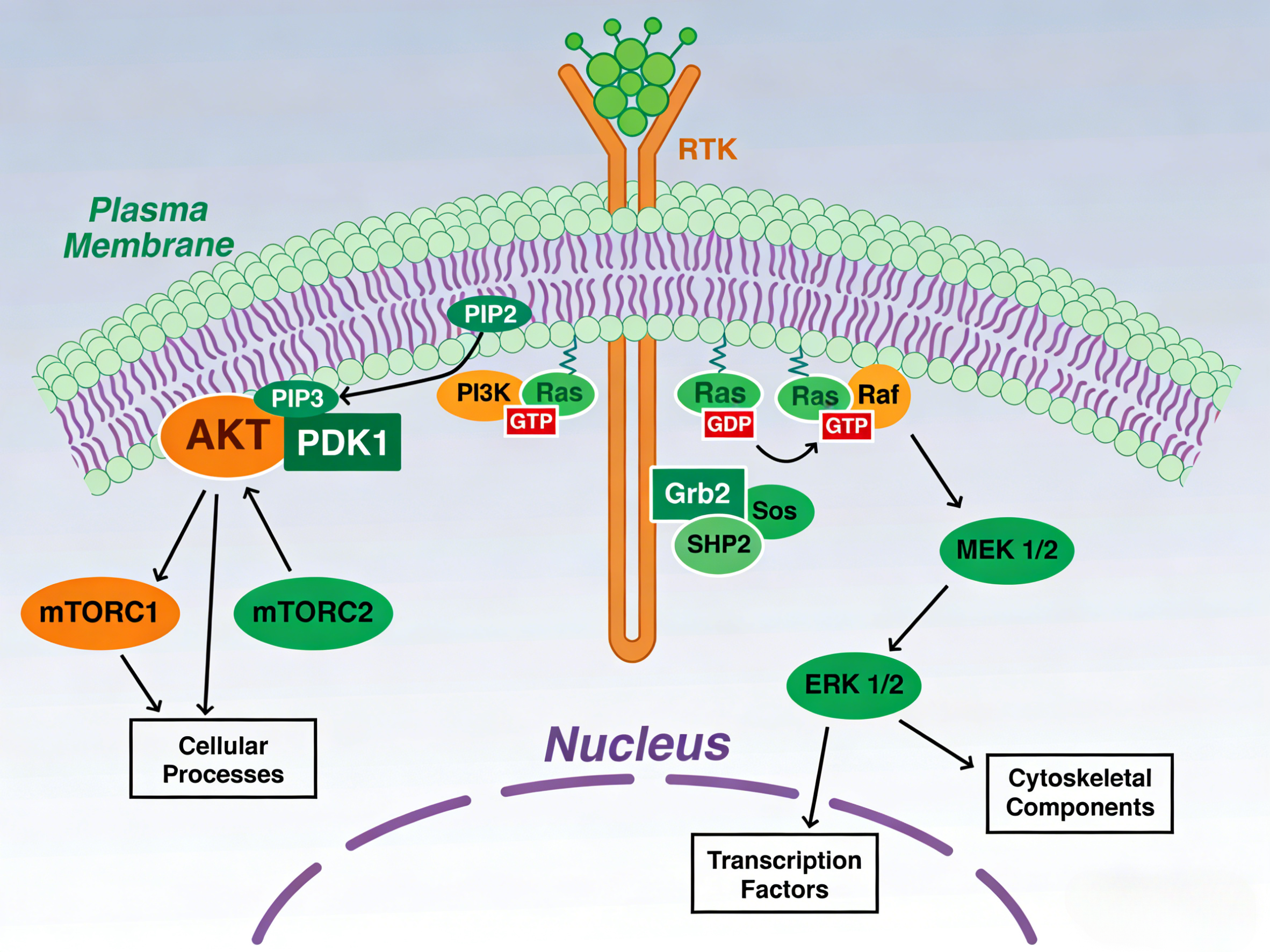
III. Regulatory Roles of Upstream Targets SHP2 and SOS1
Given the limitations of directly targeting KRAS, intervening in its upstream activation signals has emerged as an alternative strategy. SHP2 is a protein tyrosine phosphatase that plays a critical regulatory role in the RAS/MAPK signaling pathway by activating the SOS1-mediated RAS-GTP loading process. Studies have shown that SHP2 inhibitors exhibit particular sensitivity in KRAS G12C mutant tumors, suggesting their therapeutic potential for such cancers.
SOS1, as a guanine nucleotide exchange factor (GEF), is a core regulatory protein in the KRAS activation process. Its mechanism of action features a unique "processive" characteristic: once a single SOS1 molecule is activated, it can sequentially catalyze multiple KRAS molecules to complete GDP/GTP exchange, significantly amplifying signal output. Additionally, activated KRAS-GTP can bind to the allosteric site on SOS1, forming a positive feedback loop that further enhances signal transduction. This mechanism makes SOS1 an ideal target for intervening in the KRAS signaling pathway.
Preclinical studies have demonstrated that SOS1 inhibitors (e.g., BI-3406, BAY-293) exhibit broad-spectrum inhibitory effects on various KRAS G12 and G13 mutant models. More importantly, combining SOS1 inhibitors with MEK inhibitors or KRAS G12C inhibitors can produce significant synergistic effects, achieving more thorough signal inhibition and delaying resistance by simultaneously blocking the pathway from both upstream and downstream.
IV. Technical Principles and Applications of the Human KRAS G13D & SOS1 Binding Kit
The Human KRAS G13D & SOS1 Binding Kit (GDP load) is designed based on time-resolved fluorescence resonance energy transfer (TR-FRET) technology, specifically for detecting the interaction between the KRAS G13D mutant protein and SOS1. The core principle of this kit is to utilize the specific conformation of the KRAS G13D protein in the GDP-bound state, simulating the real conditions under which SOS1 recognizes its substrate.
The kit provides recombinantly expressed KRAS G13D and SOS1 proteins, labeled with donor (e.g., europium cryptate) and acceptor (e.g., XL665) fluorescent tags, respectively. When the two proteins specifically bind, the donor and acceptor come into close proximity, resulting in energy transfer upon excitation and generating a quantifiable fluorescent signal. The signal intensity is proportional to the amount of protein binding. If a test compound can interfere with the KRAS G13D-SOS1 interaction, the fluorescent signal weakens, enabling quantitative evaluation of the compound's activity.
In the development of SOS1-targeted drugs, this kit has multifaceted applications. During the compound screening phase, it can rapidly assess the inhibitory activity of numerous candidate molecules against the KRAS G13D-SOS1 interaction. In structure-activity relationship studies, it can compare the activity differences of structural analogs to guide compound optimization. In mechanism validation, it can confirm whether candidate compounds function by directly blocking protein-protein interactions. Additionally, the kit can be used to evaluate the binding characteristics of different KRAS mutant subtypes with SOS1, providing a tool for understanding mutation-specific functions.
V. Summary and Outlook
Intervening in upstream targets SHP2 and SOS1 offers new strategies for treating KRAS-mutant tumors. Unlike inhibitors that directly target specific mutant subtypes, upstream inhibitors can broadly cover multiple KRAS mutation types, benefiting a wider patient population. Combining them with direct inhibitors may achieve more thorough signal blockade and delay resistance. The Human KRAS G13D & SOS1 Binding Kit (GDP load), as a key tool for studying the interaction between KRAS G13D and SOS1, plays an important role in inhibitor screening, mechanism validation, and exploration of combination therapies.
This article is reviewed and published by the technical expert team of UA
Disclaimer: This article partially utilizes artificial intelligence assistance in its creation. If any content involves copyright or intellectual property issues, please let us know and we promise to verify and remove it as soon as possible.
Purchase recombinant protein, choose Nanjing UA-Bio
UA protein focuses on providing various protein reagents, raw materials, and services required for drug research and development, cell therapy, gene therapy, and basic scientific research, including drug target proteins, immune checkpoint proteins, cytokines, tool enzymes, customized protein expression, and full-length transmembrane protein development. Youai is committed to providing customers with high-quality products and professional services, and building a High-tech Biological Enterprise with International Competitiveness.







 Business license (three certificates in one)