




Application of Human KRAS G12C & VCB Binding Kit in the Study of Resistance Mechanisms to KRAS G12C Inhibitors


The KRAS gene is one of the most frequently mutated oncogenes in human malignancies, with approximately 30% of high-mortality tumors associated with KRAS mutations.
- Recent Advances
I. Introduction
The KRAS gene is one of the most frequently mutated oncogenes in human malignancies, with approximately 30% of high-mortality tumors associated with KRAS mutations. Due to its smooth protein surface and lack of typical drug-binding pockets, KRAS has long been considered an "undruggable" target. In recent years, covalent inhibitors targeting the KRAS G12C mutant subtype (such as sotorasib and adagrasib) have achieved major breakthroughs, gaining approval for clinical use and bringing hope to patients with KRAS mutation-driven malignancies. However, clinical data show that KRAS G12C inhibitors exhibit varying efficacy across tumors of different tissue origins, with some patients displaying primary resistance and others rapidly developing acquired resistance after treatment. Currently, there is a lack of clear sensitivity biomarkers to predict patient responses to KRAS G12C inhibitors, making precision therapy challenging. Therefore, in-depth exploration of the resistance mechanisms to KRAS G12C inhibitors and strategies to overcome them holds significant value for both basic research and clinical translation. The Human KRAS G12C & VCB Binding Kit (GDP load) serves as a standardized tool for studying the interaction between KRAS G12C protein and the VHL-E3 ligase complex, playing a crucial role in understanding mutant protein stability regulation and developing novel degradation strategies.
II. Clinical Challenges of KRAS G12C Inhibitors
KRAS G12C covalent inhibitors specifically bind to the allosteric pocket of the mutant protein in its GDP-bound state, locking it into an inactive conformation and blocking downstream signaling. Although the advent of these drugs marks the transition of KRAS from "undruggable" to clinical application, resistance issues have gradually emerged in clinical practice. Some KRAS G12C mutant tumor patients show no response to inhibitor therapy, exhibiting primary resistance, while others experience disease progression after initial treatment, indicating acquired resistance. There are also significant differences in the sensitivity of tumors from different tissue origins to KRAS G12C inhibitors, suggesting that the tumor microenvironment and tissue-specific factors may influence drug efficacy. These clinical challenges highlight the urgent need to understand resistance mechanisms, identify predictive biomarkers, and develop combination therapy strategies.
III. New Discoveries in KRAS G12C Resistance Mechanisms
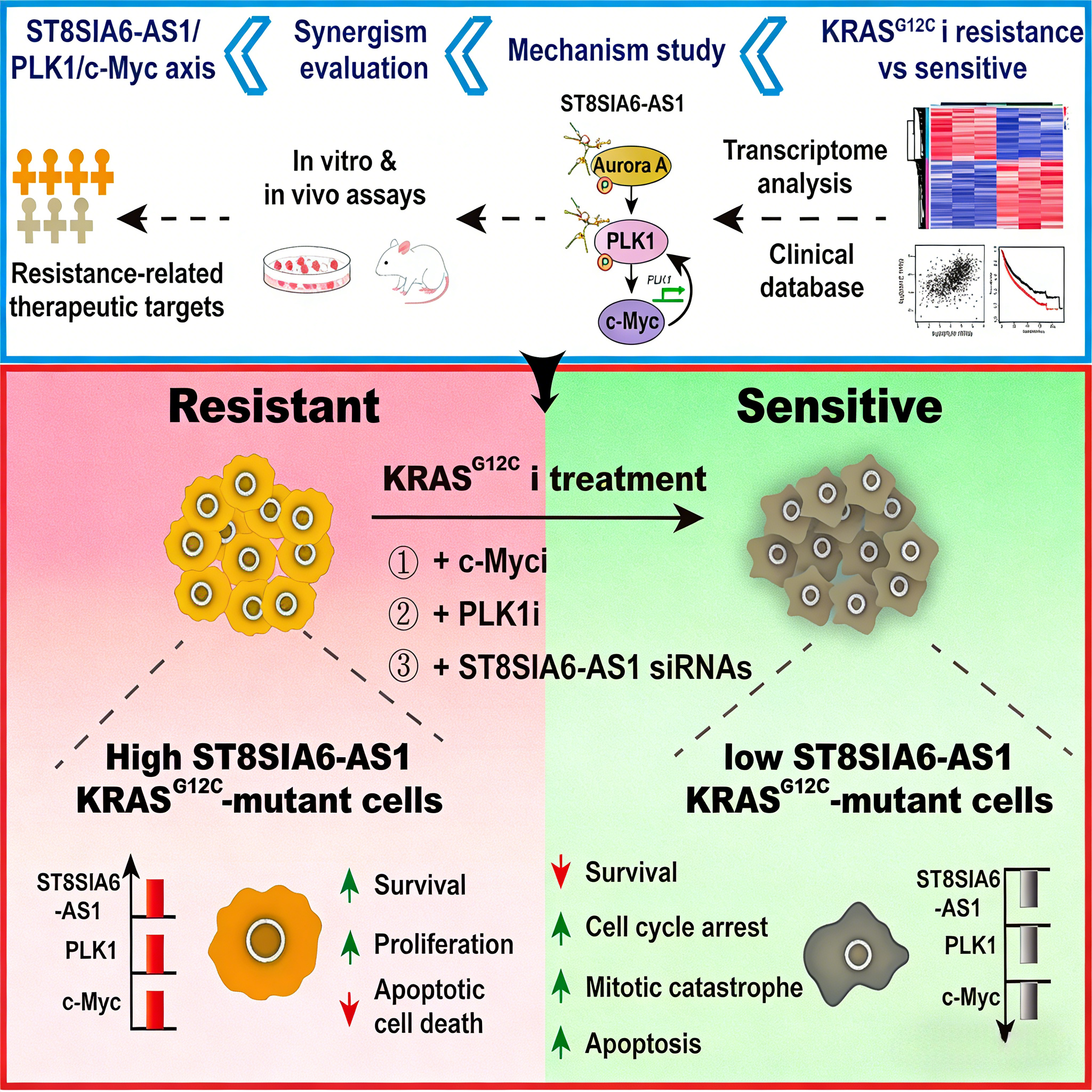
Recent studies have systematically revealed key genes and signaling pathways associated with resistance by constructing KRAS G12C inhibitor-resistant cell lines and combining whole-genome sequencing and transcriptome analysis. The research found that MYC target genes are abnormally activated in resistant cell lines, and the key G2/M phase regulatory protein Polo-like kinase 1 (PLK1) is significantly upregulated. Further mechanistic studies indicate that the long non-coding RNA ST8SIA6-AS1 is highly expressed in resistant cells and can directly bind to the serine/threonine kinase Aurora A and PLK1, promoting Aurora A-mediated phosphorylation and activation of PLK1. Activated PLK1 enhances phosphorylation at the S62 site of c-Myc protein, increasing its stability; upregulated c-Myc, as a transcription factor, can directly bind to the PLK1 gene promoter, inducing PLK1 transcription and forming a positive feedback regulatory loop.
The sustained activation of this ST8SIA6-AS1/PLK1/c-Myc signaling axis provides tumor cells with an alternative proliferation-driving signal when KRAS downstream ERK signaling is blocked by inhibitors, thereby mediating resistance to KRAS G12C inhibitors. The study confirms that high expression or activation of ST8SIA6-AS1, PLK1, and c-Myc is one of the key factors driving cellular resistance to KRAS G12C inhibitors.
IV. Novel Strategies to Overcome Resistance
Based on the above mechanistic discoveries, researchers have proposed combination targeting strategies. In nude mouse xenograft models, the combined application of KRAS G12C inhibitors and PLK1 inhibitors potently inhibits the growth of KRAS G12C mutant tumors and effectively overcomes established resistance. Similarly, silencing ST8SIA6-AS1 expression with siRNA significantly enhances the sensitivity of resistant cells to KRAS G12C inhibitors. These results demonstrate that simultaneously blocking KRAS itself and the ST8SIA6-AS1/PLK1/c-Myc signaling axis can achieve synthetic lethality, providing new treatment options for patients resistant to KRAS G12C inhibitors.
The study also suggests that the expression levels of ST8SIA6-AS1 and c-Myc may serve as potential biomarkers for clinically assessing the sensitivity and efficacy of KRAS G12C inhibitors. By detecting the expression levels of these molecules, it may be possible to screen for patients likely to benefit before treatment or to early identify the emergence of resistance during therapy.
V. Technical Principles and Applications of the Human KRAS G12C & VCB Binding Kit
In KRAS G12C targeted therapy and resistance mechanism research, accurately assessing KRAS protein stability and its interaction with E3 ubiquitin ligases is of great importance. The Human KRAS G12C & VCB Binding Kit (GDP load) is designed based on time-resolved fluorescence resonance energy transfer (TR-FRET) technology and is specifically used to detect the interaction between KRAS G12C protein and the VHL-ElonginC-ElonginB (VCB) complex.
The VCB complex is one of the most widely used E3 ubiquitin ligases and plays a central role in proteolysis-targeting chimera (PROTAC) technology. This kit utilizes the specific conformation of KRAS G12C protein in its GDP-bound state to simulate the ternary complex formation process when PROTAC molecules simultaneously bind to the target protein and E3 ligase. The kit provides recombinantly expressed KRAS G12C protein and VCB complex protein, labeled with donor fluorophores (e.g., europium cryptate) and acceptor fluorophores (e.g., XL665), respectively. When the test PROTAC molecule or positive control molecule simultaneously binds both, the donor and acceptor come into proximity, resulting in energy transfer and generating a quantifiable fluorescent signal. The signal intensity is proportional to the efficiency of ternary complex formation, thereby quantitatively reflecting the proximity and binding activity between KRAS G12C and VCB.
In resistance mechanism studies, this kit can be used to evaluate whether secondary KRAS mutations emerging after resistance affect its interaction with E3 ligases or to screen for novel PROTAC degraders capable of overcoming resistance.
VI. Summary and Outlook
This study is the first to reveal the central role of the ST8SIA6-AS1/PLK1/c-Myc signaling axis in KRAS G12C inhibitor resistance, providing new insights into resistance mechanisms. The strategy of combined targeting of KRAS and this signaling axis demonstrates significant efficacy in preclinical models, offering feasible solutions to overcome resistance. The Human KRAS G12C & VCB Binding Kit (GDP load), as a key tool for studying the interaction between KRAS G12C and E3 ligases, holds important application value in resistance mechanism elucidation and novel degrader development. In the future, with deeper understanding of resistance mechanisms and rapid advancements in PROTAC technology, targeted therapy for KRAS G12C is expected to achieve more durable efficacy and broader applicability.
This article is reviewed and published by the technical expert team of UA
Disclaimer: This article partially utilizes artificial intelligence assistance in its creation. If any content involves copyright or intellectual property issues, please let us know and we promise to verify and remove it as soon as possible.
Purchase recombinant protein, choose Nanjing UA-Bio
UA protein focuses on providing various protein reagents, raw materials, and services required for drug research and development, cell therapy, gene therapy, and basic scientific research, including drug target proteins, immune checkpoint proteins, cytokines, tool enzymes, customized protein expression, and full-length transmembrane protein development. Youai is committed to providing customers with high-quality products and professional services, and building a High-tech Biological Enterprise with International Competitiveness.







 Business license (three certificates in one)