




Research Progress on Resistance Mechanisms and Combination Therapy Strategies of KRAS G12D Inhibitors


The KRAS G12D mutation is one of the most common driver mutations in malignant tumors such as pancreatic cancer and colorectal cancer, with a significantly higher incidence than the KRAS G12C mutation.
- Recent Advances
I. Introduction
The KRAS G12D mutation is one of the most common driver mutations in malignancies such as pancreatic cancer and colorectal cancer, with a significantly higher incidence than KRAS G12C. Unlike G12C, the G12D mutation site lacks a cysteine residue available for covalent binding, posing greater challenges in developing highly selective inhibitors. In recent years, several non-covalent inhibitors (e.g., MRTX1133) and protein degraders (PROTACs) targeting KRAS G12D have entered preclinical or early clinical research stages. However, as research progresses, the issue of drug resistance inevitably emerges. A deep understanding of resistance mechanisms and the exploration of effective reversal strategies are crucial for maximizing the therapeutic value of these drugs. The Human KRAS G12D & VCB Binding Kit (GDP load), as a standardized tool for studying the interaction between KRAS G12D protein and the VHL-E3 ligase complex, holds significant application value in resistance mechanism analysis and the development of novel degraders.
II. Resistance Mechanisms of KRAS G12D Inhibitors
(1) On-target Mutations
Secondary mutations in the target itself are the most direct resistance mechanism for KRAS inhibitors. Studies show that mutations in key amino acid residues involved in KRAS G12D inhibitor binding can alter the conformation of the drug-binding pocket, leading to reduced inhibitor affinity. For example, the R68S mutation disrupts interactions between the Switch I and Switch II regions of the KRAS protein, enlarging the binding pocket and accelerating inhibitor dissociation. Additionally, mutations in the Switch II pocket region, such as Y96N/D and H95Q/R, can also interfere with drug-target binding.
(2) Target Gene Amplification
KRAS G12D gene amplification can lead to a surge in mutant protein expression, rendering conventional inhibitor doses insufficient to fully inhibit all KRAS molecules, thereby allowing drug escape. This mechanism suggests that more efficient degradation strategies may partially overcome such resistance.
(3) Bypass Signaling Activation
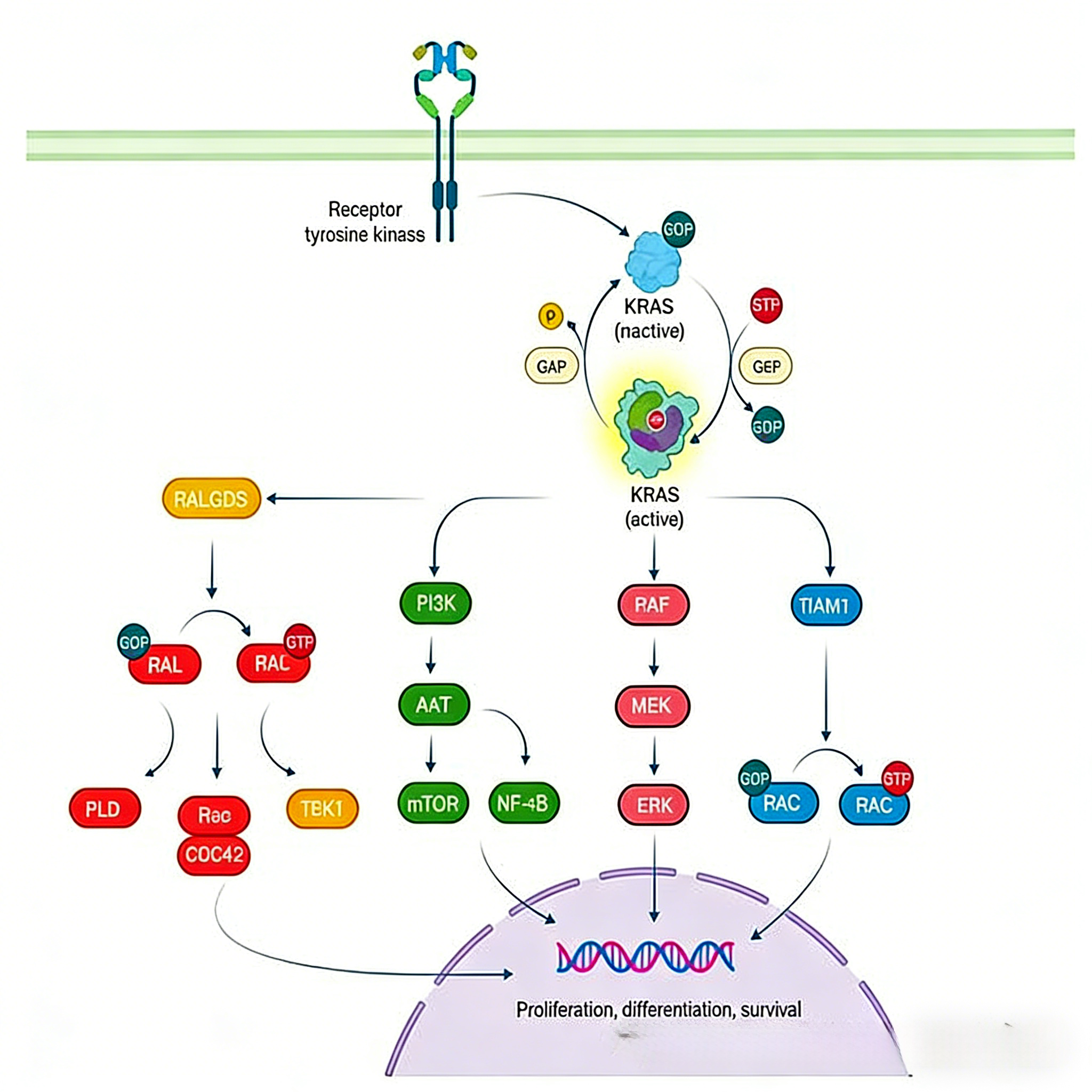
Activation of bypass signaling pathways is the most common non-targeted resistance mechanism in KRAS-targeted therapy. When KRAS G12D is inhibited, tumor cells can restore downstream signal output through various compensatory mechanisms. Feedback activation of upstream receptor tyrosine kinases (RTKs) is the primary pathway: prolonged KRAS inhibition can lift negative feedback regulation, leading to hyperphosphorylation of EGFR and its homologous receptors, which in turn activate wild-type RAS family members and reignite the MAPK pathway. Research confirms that downregulation of the EGFR feedback inhibitor ERRFI1 is a common adaptive change in pancreatic and colorectal cancers.
The PI3K/AKT/mTOR pathway, as a parallel signaling branch to the MAPK pathway, can compensate for the survival pressure induced by MAPK inhibition. Some resistant cells also undergo epithelial-mesenchymal transition (EMT), reducing dependence on KRAS inhibitors through phenotypic changes.
(4) Epigenetic and Metabolic Remodeling
Resistant cells may upregulate cancer stem cell markers such as CD24, suggesting that the acquisition of stem-like features aids in maintaining resistance. Additionally, increased proteasome activity may also contribute to resistance formation.
III. Strategies to Overcome Resistance
(1) Combining Upstream Inhibitors to Block Feedback Activation
To counter RTK-mediated feedback activation, combining upstream signal inhibitors can effectively block this compensatory mechanism. EGFR inhibitors (e.g., cetuximab) significantly enhance the efficacy of KRAS G12D inhibitors in colorectal and pancreatic cancer models. SHP2, a critical node in RTK signal transduction, can be targeted to block upstream signal transmission to KRAS. SOS1 inhibitors, by interfering with the GDP-GTP exchange process, exhibit synergistic effects when combined with KRAS G12D inhibitors.
(2) Combining Downstream Inhibitors to Block Signal Transmission
MEK/ERK inhibitors (e.g., trametinib) can block MAPK pathway output even when KRAS inhibition fails. PI3K/AKT/mTOR inhibitors (e.g., everolimus) target PI3K pathway activation as a resistance mechanism, effectively compensating for the limitations of single MAPK inhibition. CDK4/6 inhibitors (e.g., palbociclib), by intervening in cell cycle progression, further inhibit tumor proliferation when combined with KRAS inhibitors.
(3) Targeted Protein Degradation Strategies
Proteolysis-targeting chimeras (PROTACs) offer a novel approach to overcoming resistance. By simultaneously binding KRAS G12D protein and E3 ubiquitin ligases (e.g., VHL, CRBN), PROTAC molecules induce ubiquitination and proteasomal degradation of the target protein, potentially overcoming resistance caused by gene amplification or secondary mutations.
The Human KRAS G12D & VCB Binding Kit (GDP load) plays a key role in this development process. Based on time-resolved fluorescence resonance energy transfer (TR-FRET) technology, this kit is designed to detect interactions between KRAS G12D protein and the VHL-ElonginC-ElonginB (VCB) complex. The kit leverages the specific conformation of KRAS G12D protein in the GDP-bound state to simulate ternary complex formation when PROTAC molecules simultaneously bind the target protein and E3 ligase. By quantifying fluorescence signals, it evaluates the cooperative recruitment efficiency of candidate degraders, screens compounds capable of effectively inducing KRAS G12D degradation, and verifies whether resistance mutations affect interactions with E3 ligases.
(4) Immunotherapy Combination Strategies
KRAS G12D inhibitors alone can remodel the tumor microenvironment, increasing immune cell infiltration and providing a rationale for combining immune checkpoint inhibitors. Studies show that combining KRAS inhibitors with PD-1/PD-L1 inhibitors enhances anti-tumor immune responses.
(5) Metabolic Targeting and Nucleic Acid Drugs
Targeting the metabolic dependencies of KRAS-mutant tumors, glutaminase inhibitors can induce energy crises, enhancing the efficacy of KRAS inhibitors. Antisense oligonucleotides (ASOs) selectively target KRAS mutant transcripts, inducing their degradation and offering a new pathway to overcome protein-level resistance.
IV. Summary and Outlook
Resistance to KRAS G12D inhibitors involves multiple layers, including on-target mutations, gene amplification, bypass activation, and epigenetic remodeling, reflecting high complexity. Mechanism-based combination strategies, particularly combining upstream signal blockade with downstream pathway inhibition, have shown promising results in preclinical studies. Protein degradation technology, as an emerging direction, holds potential to fundamentally overcome multiple resistance mechanisms. The Human KRAS G12D & VCB Binding Kit (GDP load), as a key tool for studying KRAS G12D-E3 ligase interactions, holds significant value in resistance mechanism analysis and the development of novel degraders.
This article is reviewed and published by the technical expert team of UA
Disclaimer: This article partially utilizes artificial intelligence assistance in its creation. If any content involves copyright or intellectual property issues, please let us know and we promise to verify and remove it as soon as possible.
Purchase recombinant protein, choose Nanjing UA-Bio
UA protein focuses on providing various protein reagents, raw materials, and services required for drug research and development, cell therapy, gene therapy, and basic scientific research, including drug target proteins, immune checkpoint proteins, cytokines, tool enzymes, customized protein expression, and full-length transmembrane protein development. Youai is committed to providing customers with high-quality products and professional services, and building a High-tech Biological Enterprise with International Competitiveness.







 Business license (three certificates in one)