




KRAS G12C targeted therapy combined with VCB reagent kit application


The KRAS gene is one of the most common oncogenes in human tumors, frequently mutated in various solid tumors such as pancreatic cancer, colorectal cancer, and lung cancer.
- Recent Advances
I. Introduction
The KRAS gene is one of the most common oncogenes in human tumors, with high-frequency mutations observed in various solid tumors such as pancreatic cancer, colorectal cancer, and lung cancer. However, due to its unique protein structural characteristics, KRAS was considered an "undruggable" target for nearly four decades, with almost all targeted drugs failing against it. In recent years, with a deeper understanding of KRAS's biological functions and breakthroughs in drug development technologies, inhibitors targeting specific mutant subtypes have emerged, fundamentally changing this predicament. This article systematically reviews the molecular biological characteristics of KRAS, its oncogenic mechanisms, the evolution of therapeutic strategies, and explores the application value of the Human KRAS G12C & VCB Binding Kit (GTP load) in related research.
II. Molecular Biological Characteristics of KRAS
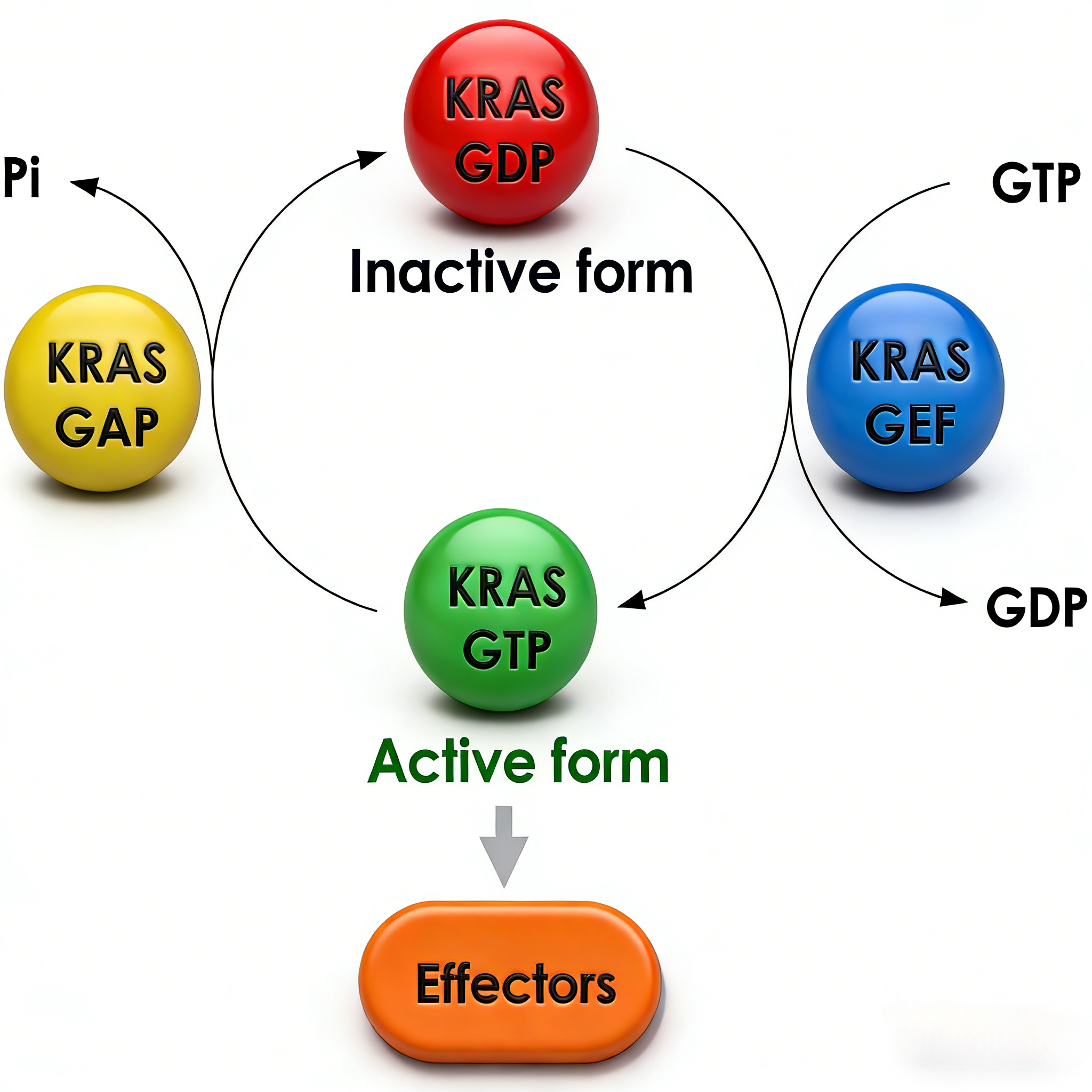
The KRAS gene encodes a small GTPase protein belonging to the RAS superfamily, which acts as a molecular switch in cellular signal transduction. KRAS protein exists in two forms: the inactive GDP-bound state and the active GTP-bound state. Under physiological conditions, KRAS transitions to the GTP-bound state upon receiving upstream growth factor signals, activating multiple downstream signaling pathways. After completing signal transduction, it hydrolyzes GTP through intrinsic GTPase activity and returns to the inactive state.
KRAS is one of the most frequently mutated oncogenes in solid tumors, with approximately 30% of tumors harboring KRAS mutations, including 90% of pancreatic cancers, 50% of colorectal cancers, and 25% of lung cancers. Mutations most commonly occur at codons 12, 13, and 61, with codon 12 mutations being the most prevalent. KRAS mutations impair the intrinsic GTPase activity of the protein, causing it to remain persistently in the GTP-bound active conformation, independent of upstream signal stimulation. This leads to abnormal activation of downstream signaling pathways, promoting tumor cell proliferation and survival.
III. KRAS Signaling Pathways and Oncogenic Mechanisms
Activated KRAS regulates multiple downstream effector pathways. The RAF/MEK/ERK pathway primarily controls cell proliferation and differentiation and is a key pathway in RAS-mediated tumorigenesis. The PI3K/AKT/mTOR pathway regulates cell survival and metabolism, playing a crucial role in anti-apoptosis. The RALGDS/RAL pathway is involved in cell cycle progression and vesicle transport. The coordinated activation of these three pathways drives the malignant phenotype of tumor cells. The complexity of these pathways and their feedback regulation have posed long-term challenges for targeted therapy.
IV. The Journey of KRAS-Targeted Therapy Exploration
Scientists have attempted various strategies to target KRAS, including interfering with its membrane localization, inhibiting downstream effector molecules, and blocking upstream regulatory nodes. Farnesyltransferase inhibitors (FTIs) were among the earliest approaches explored, but their clinical efficacy was limited because KRAS could escape inhibition through geranylgeranyltransferase (GGTase)-mediated alternative prenylation pathways. Inhibitors targeting downstream molecules such as RAF, MEK, ERK, and PI3K showed promise in preclinical studies but had limited efficacy as monotherapies due to pathway feedback activation and cumulative toxicity. These setbacks once made KRAS synonymous with "undruggable" targets.
V. Breakthrough in KRAS G12C Inhibitors
In 2013, scientists discovered an allosteric pocket in the GDP-bound state of the KRAS G12C mutant protein, laying the foundation for the development of covalent inhibitors. KRAS G12C inhibitors (e.g., sotorasib, adagrasib) specifically bind to this pocket and form covalent bonds with the mutant cysteine, locking the protein in an inactive conformation and thereby blocking downstream signal transduction. Clinical studies have shown that these inhibitors exhibit significant efficacy in KRAS G12C-mutant non-small cell lung cancer, marking the transition of KRAS from an "undruggable" target to clinical application.
VI. Technical Principles and Applications of the VCB Binding Kit
In KRAS G12C-targeted therapy and resistance mechanism research, accurately assessing the stability of mutant proteins and their interaction with E3 ubiquitin ligases is crucial. The Human KRAS G12C & VCB Binding Kit (GTP load) is based on time-resolved fluorescence resonance energy transfer (TR-FRET) technology and is specifically designed to detect the conformational features of KRAS G12C protein in the GTP-bound active state and its interaction with the VHL-ElonginC-ElonginB (VCB) complex.
This kit leverages the specific conformation of KRAS G12C protein in the GTP-bound state to simulate the formation of ternary complexes when PROTAC molecules simultaneously bind to the target protein and E3 ligase. The kit provides recombinantly expressed KRAS G12C protein and VCB complex protein, labeled with donor (e.g., europium cryptate) and acceptor (e.g., XL665) fluorophores, respectively. When a PROTAC molecule binds both, the donor and acceptor come into proximity, resulting in energy transfer and detectable fluorescence signals. The signal intensity is proportional to the efficiency of ternary complex formation, quantitatively reflecting the proximity and binding activity between KRAS G12C and VCB.
In drug development, this kit has multifaceted applications. It can be used to screen PROTAC molecules targeting the active-state conformation of KRAS G12C, optimize linker length and E3 ligand types, validate whether resistance-associated secondary mutations affect interactions with E3 ligases, and evaluate the impact of combination therapies on KRAS protein stability, providing experimental evidence for overcoming resistance. Compared to GDP-loaded detection kits, the GTP-loaded version is more suitable for studying degradation strategies targeting activated KRAS.
VII. Outlook
The success of KRAS G12C inhibitors provides valuable experience for drug development targeting other mutant subtypes. Direct inhibitors and protein degraders targeting G12D, G12V, G13D, and other mutant subtypes are rapidly advancing. The Human KRAS G12C & VCB Binding Kit (GTP load), as a key tool for studying the interaction between KRAS G12C active-state conformation and E3 ligases, holds significant application value in the development of novel degraders and the analysis of resistance mechanisms. In the future, with the synergistic development of direct inhibitors, upstream regulators, and protein degraders, precision therapy for KRAS-mutant tumors is expected to achieve even greater breakthroughs.
This article is reviewed and published by the technical expert team of UA
Disclaimer: This article partially utilizes artificial intelligence assistance in its creation. If any content involves copyright or intellectual property issues, please let us know and we promise to verify and remove it as soon as possible.
Purchase recombinant protein, choose Nanjing UA-Bio
UA protein focuses on providing various protein reagents, raw materials, and services required for drug research and development, cell therapy, gene therapy, and basic scientific research, including drug target proteins, immune checkpoint proteins, cytokines, tool enzymes, customized protein expression, and full-length transmembrane protein development. Youai is committed to providing customers with high-quality products and professional services, and building a High-tech Biological Enterprise with International Competitiveness.







 Business license (three certificates in one)