




Advances in KRAS Target Research and Therapeutic Breakthroughs


The KRAS gene is one of the most common oncogenes in human cancers, frequently mutated in various solid tumors such as pancreatic cancer, colorectal cancer, and lung cancer.
- Recent Advances
I. Introduction
The KRAS gene is one of the most common oncogenes in human cancers, frequently mutated in various solid tumors such as pancreatic cancer, colorectal cancer, and lung cancer. However, due to its unique protein structural features, KRAS was considered an "undruggable" target for forty years. In recent years, with a deeper understanding of KRAS biology and breakthroughs in drug development, inhibitors targeting specific mutant subtypes have emerged, fundamentally changing this landscape. This article systematically reviews the molecular biological characteristics of KRAS, its oncogenic mechanisms, its impact on the tumor microenvironment, and the latest advances in targeted therapies. It also explores the application value of the Human KRAS G12D & VCB Binding Kit (GTP load) in related research.
II. Molecular Biological Characteristics of KRAS
The KRAS gene encodes a small GTPase belonging to the RAS superfamily. Within cells, the KRAS protein dynamically transitions between inactive and active states: bound to guanosine diphosphate (GDP) in the inactive state and bound to guanosine triphosphate (GTP) in the active state, activating multiple downstream signaling pathways.
The transition between inactive and active states of KRAS is precisely regulated by two types of factors. Guanine nucleotide exchange factors (GEFs), such as SOS protein, catalyze the binding of KRAS to GTP, promoting its activation. GTPase-activating proteins (GAPs) facilitate the hydrolysis of GTP bound to KRAS into GDP, thereby inhibiting KRAS activity. This balance ensures the normal functioning of KRAS signaling pathways.
III. Oncogenic Mechanisms of KRAS Mutations
KRAS is the most frequently mutated oncogene in human cancers, accounting for 86% of RAS family mutations. In human cancers, KRAS mutations occur in nearly 90% of pancreatic cancers, 30-40% of colorectal cancers, and 15-20% of lung cancers, as well as in bile duct cancer, cervical cancer, bladder cancer, and other malignancies.
KRAS mutations primarily occur at codons 12, 13, and 61. Structural studies show that these mutations often impair KRAS's ability to hydrolyze GTP. For example, the KRAS G12D mutation replaces glycine with aspartic acid, disrupting GAP binding and inhibiting GTP hydrolysis. Due to reduced GTPase activity, more KRAS proteins remain in the GTP-bound active state, leading to sustained activation of downstream signaling pathways.
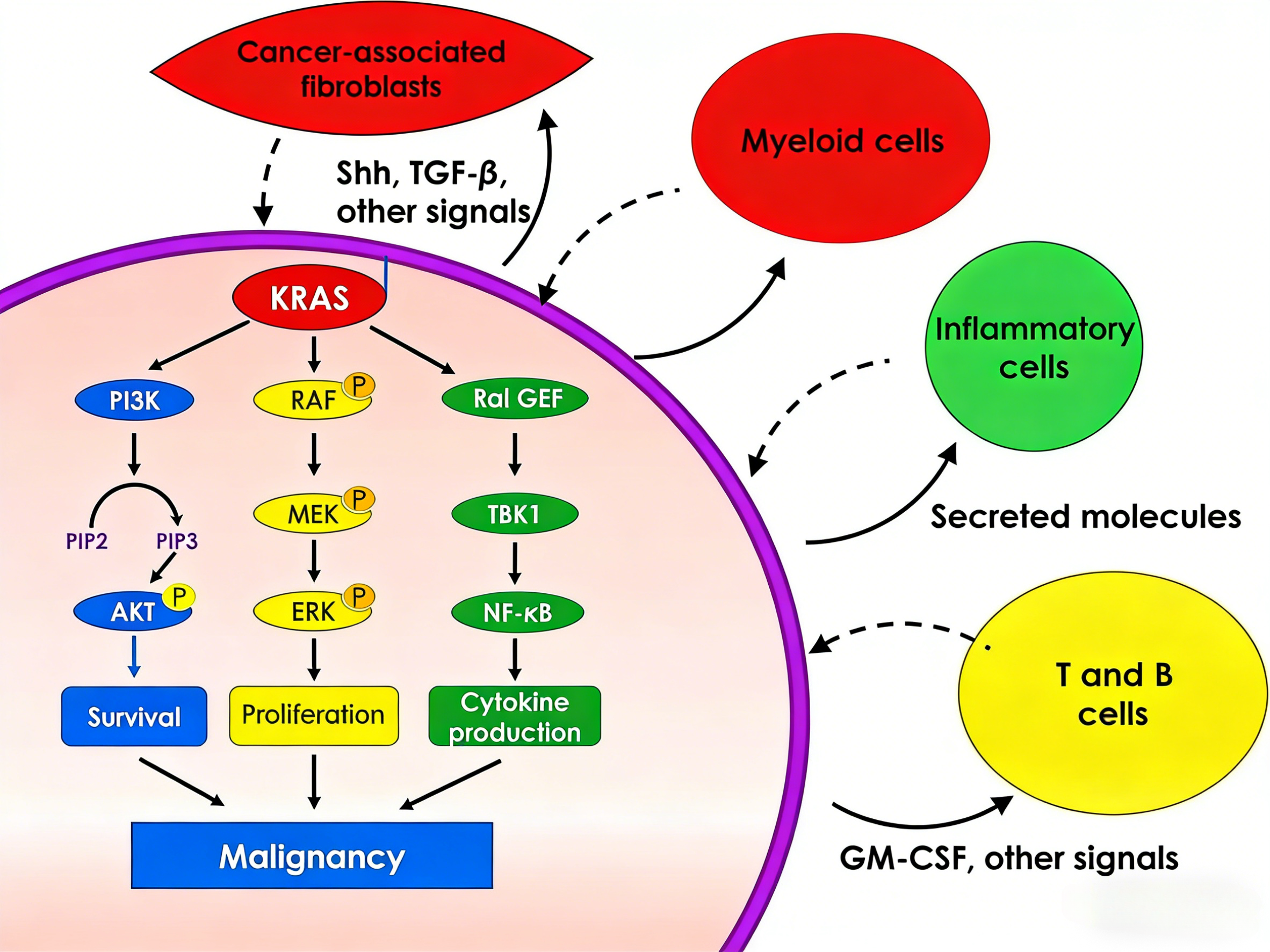
Activated KRAS regulates multiple downstream effector pathways. The MAPK signaling pathway primarily controls cell proliferation and differentiation; the PI3K signaling pathway regulates cell survival and metabolism; and the Ral-GEFs signaling pathway is involved in cell cycle progression and vesicle transport. The coordinated activation of these pathways drives malignant proliferation and survival of tumor cells.
IV. Impact of KRAS Mutations on the Tumor Microenvironment
Oncogenic KRAS mutations not only directly promote tumor cell proliferation but also profoundly influence the tumor microenvironment. KRAS-mutant tumor cells secrete various cytokines, chemokines, and growth factors, including IL-6, IL-8, IL-23, and CCL9. These factors reprogram stromal cells in the tumor microenvironment, creating a pro-tumor inflammatory milieu.
For example, IL-6 and IL-8 maintain an inflammatory phenotype in the stroma of pancreatic and lung cancers. Tumor-secreted granulocyte-macrophage colony-stimulating factor (GM-CSF) stimulates the infiltration of myeloid-derived suppressor cells (MDSCs), suppressing anti-tumor immune responses. These findings reveal new mechanisms by which KRAS mutations promote immune evasion through microenvironment remodeling, providing a theoretical basis for combining KRAS inhibitors with immunotherapy.
V. Breakthroughs in KRAS-Targeted Therapies
For decades, KRAS was considered "undruggable" due to its smooth protein surface, lack of deep pockets for small-molecule binding, and high affinity for GTP. Scientists explored various strategies to target KRAS, including disrupting its membrane localization and inhibiting downstream effectors, but clinical efficacy was limited.
In 2013, researchers discovered a druggable allosteric pocket in the GDP-bound state of KRAS G12C mutant protein, laying the foundation for covalent inhibitors. KRAS G12C inhibitors (e.g., sotorasib, adagrasib) bind this pocket, forming a covalent bond with the mutant cysteine and locking the protein in an inactive conformation, blocking downstream signaling. Clinical studies show significant efficacy in KRAS G12C-mutant non-small cell lung cancer, marking the transition of KRAS from "undruggable" to clinically actionable. Inhibitors targeting other subtypes (e.g., G12D, G12V, G13D) and protein degraders (PROTACs) are rapidly advancing.
VI. Technical Principles and Applications of the Human KRAS G12D & VCB Binding Kit (GTP load)
In KRAS G12D-targeted therapy and resistance mechanism research, accurately assessing mutant protein stability and its interaction with E3 ubiquitin ligases is crucial. The Human KRAS G12D & VCB Binding Kit (GTP load) uses time-resolved fluorescence resonance energy transfer (TR-FRET) to detect the conformational features of GTP-bound KRAS G12D and its interaction with the VHL-ElonginC-ElonginB (VCB) complex.
The kit leverages the specific conformation of GTP-bound KRAS G12D to simulate ternary complex formation when PROTAC molecules simultaneously bind the target protein and E3 ligase. It provides recombinant KRAS G12D and VCB proteins labeled with donor (e.g., europium cryptate) and acceptor (e.g., XL665) fluorophores. When a PROTAC binds both, energy transfer occurs, generating a quantifiable fluorescent signal proportional to ternary complex formation efficiency, reflecting KRAS G12D-VCB proximity and binding activity.
VII. Outlook
The success of KRAS G12C inhibitors provides valuable insights for targeting other mutant subtypes. With deeper biological understanding and exploration of combination therapies, precision treatment for KRAS-mutant tumors holds great promise. Combining KRAS inhibitors with immune checkpoint inhibitors (e.g., PD-1/PD-L1 antibodies) shows synergistic potential due to their microenvironment-modulating effects. The Human KRAS G12D & VCB Binding Kit (GTP load) is a key tool for studying KRAS G12D active-state conformations and E3 ligase interactions, aiding novel degrader development and resistance mechanism analysis. As more drugs advance clinically, the era of "undruggable" targets will soon end.
This article is reviewed and published by the technical expert team of UA
Disclaimer: This article partially utilizes artificial intelligence assistance in its creation. If any content involves copyright or intellectual property issues, please let us know and we promise to verify and remove it as soon as possible.
Purchase recombinant protein, choose Nanjing UA-Bio
UA protein focuses on providing various protein reagents, raw materials, and services required for drug research and development, cell therapy, gene therapy, and basic scientific research, including drug target proteins, immune checkpoint proteins, cytokines, tool enzymes, customized protein expression, and full-length transmembrane protein development. Youai is committed to providing customers with high-quality products and professional services, and building a High-tech Biological Enterprise with International Competitiveness.







 Business license (three certificates in one)