




Application of KRAS G12V & VCB Binding Kit in Targeted Therapy


The KRAS gene is one of the most frequently mutated oncogenes in human malignancies, with this mutation detected in approximately one in seven cancers.
- Recent Advances
I. Introduction
The KRAS gene is one of the most frequently mutated oncogenes in human malignancies, detectable in approximately one in seven cancers. Historically, targeting KRAS mutations has been extremely challenging, once considered an "undruggable" target. However, with advancements in basic research and drug development technologies, the successful development of the first KRAS G12C inhibitor has ushered in a new era of KRAS-targeted therapy. This article systematically reviews the discovery history of KRAS, its signaling mechanisms, mutation characteristics across different cancer types, and explores the application value of the Human KRAS G12V & VCB Binding Kit (GTP load) in related research.
II. Discovery History of KRAS
In 1964, researchers observed that rats infected with the Moloney murine leukemia virus rapidly developed sarcomas. In 1967, scholars found that rats inoculated with the erythroblastosis virus also exhibited similar transformations. These retroviral transforming genes were named Ha-ras and Ki-ras, respectively, with "ras" standing for Rat Sarcoma.
Although the term "oncogene" was proposed as early as 1969, it wasn't until 1982 that scientists first identified DNA sequences homologous to Ha-ras and Ki-ras genes in human bladder and lung cancer cells, formally confirming them as human oncogenes HRAS and KRAS. In 1983, the third member of the RAS family, NRAS, was discovered in human neuroblastoma. In 1984, the first clearly activated KRAS G12R mutation was identified in the tumor tissue of a lung squamous cell carcinoma patient. These early studies confirmed that the activation of the KRAS oncogene has a unique and complex connection with human cancer development.
KRAS is hailed as the "holy grail of cancer targeted therapy" for two reasons: first, KRAS gene mutations are highly prevalent in cancer patients, detectable in about one in seven cancers; second, tumor growth strongly depends on KRAS mutation pathways, while normal cells do not, making it an ideal target for therapy.
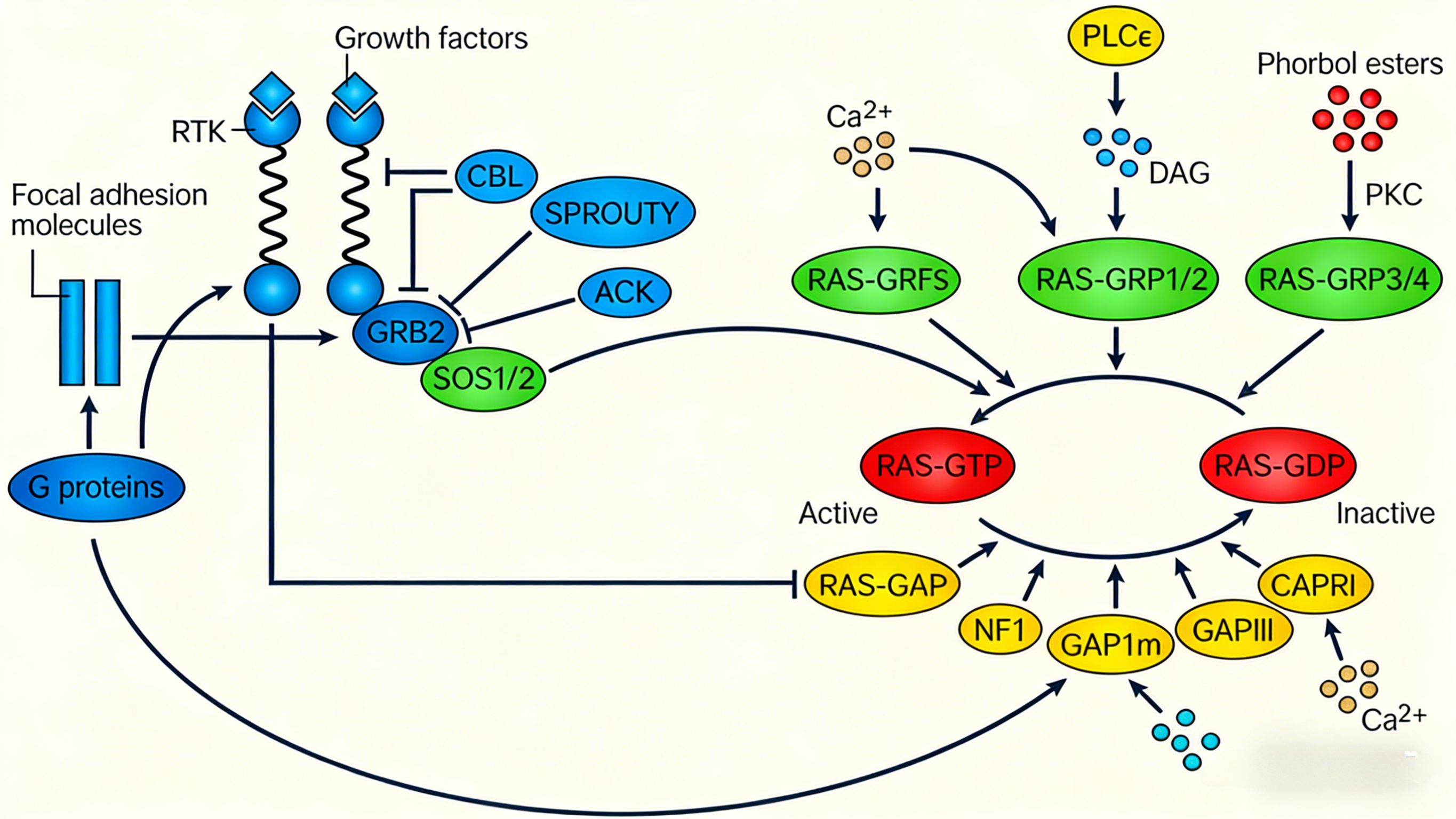
III. KRAS-Mediated Signaling Pathways
Activated KRAS regulates three major downstream signaling pathways. The MAPK kinase pathway, composed of the RAS, RAF, MEK, and ERK phosphorylation cascade, primarily regulates the cell cycle and proliferation. Its abnormal activation can promote excessive cell proliferation and differentiation. The PI3K-AKT-mTOR pathway is frequently upregulated in RAS mutations, promoting cell survival and enhancing anti-apoptotic capabilities. The TIAM1-RAC and RAL pathways are involved in cytoskeletal rearrangement and cell migration, respectively, with RAL also promoting RAS-dependent tumor growth.
Under normal conditions, KRAS precisely regulates multiple key aspects of the cell cycle. However, KRAS gene mutations can promote cancer development and progression through various activation pathways.
IV. KRAS Mutation Characteristics in Different Cancers
Although KRAS mutations are present in about one in seven cancers, their frequency varies significantly across different cancer types. Pancreatic cancer has the highest KRAS mutation frequency, exceeding 85%; colorectal cancer about 40%; non-small cell lung cancer about 30%; and cholangiocarcinoma about 20%.
In lung adenocarcinoma, the most common KRAS mutation is G12C, accounting for about 14%, followed by G12V. Notably, G12C is the most common mutation in smoking-related lung cancer patients, while G12D is most common in non-smokers. In pancreatic cancer, G12D and G12V are the primary mutation subtypes, accounting for 40% and 32% of all KRAS mutations, respectively. In colorectal cancer, right-sided colon cancer is more prone to KRAS mutations, with G12 mutations accounting for about 65%. Similar to pancreatic cancer, G12D and G12V are the most common.
The widespread presence of KRAS mutations in various malignancies makes drugs targeting this mutation potentially applicable across multiple cancer types.
V. Impact of KRAS Mutations on the Tumor Microenvironment
Subsequent studies have confirmed that KRAS mutations can profoundly affect the tumor microenvironment. In pancreatic cancer, KRAS mutations are considered a key factor in the formation of a generally immunosuppressive microenvironment. KRAS mutations can promote the release of immunosuppressive cytokines such as CSF-1, IL-4, and IL-6, fostering an immunosuppressive tumor environment. Additionally, KRAS mutations can induce tumor inflammation, increasing the mutation frequency of cancer cells. These findings indicate that KRAS mutations can independently or synergistically influence tumor growth, microenvironment formation, and response to immunotherapy.
VI. Technical Principles and Applications of the Human KRAS G12V & VCB Binding Kit (GTP load)
In KRAS G12V-targeted therapy and resistance mechanism research, accurately assessing the stability of mutant proteins and their interaction with E3 ubiquitin ligases is crucial. The Human KRAS G12V & VCB Binding Kit (GTP load) is based on time-resolved fluorescence resonance energy transfer (TR-FRET) technology, specifically designed to detect the conformational features of KRAS G12V protein in the GTP-bound activated state and its interaction with the VHL-ElonginC-ElonginB (VCB) complex.
The kit utilizes the specific conformation of KRAS G12V protein in the GTP-bound state to simulate the ternary complex formation process when PROTAC molecules simultaneously bind to the target protein and E3 ligase. The kit provides recombinantly expressed KRAS G12V protein and VCB complex protein, labeled with donor (e.g., europium cryptate) and acceptor (e.g., XL665) fluorescent groups, respectively. When the test PROTAC molecule binds both, the donor and acceptor come into proximity, resulting in energy transfer and quantifiable fluorescence signals. The signal intensity is proportional to the efficiency of ternary complex formation, quantitatively reflecting the proximity and binding activity between KRAS G12V and VCB.
In drug development, the kit can be used to screen PROTAC molecules targeting the activated conformation of KRAS G12V, optimize linker length and E3 ligand types, verify whether resistance-related secondary mutations affect interactions with E3 ligases, and evaluate the impact of combination therapies on KRAS protein stability, providing experimental evidence for overcoming resistance.
VII. Outlook
The success of KRAS G12C inhibitors provides valuable experience for drug development targeting other mutation subtypes. With deeper understanding of KRAS biology and exploration of combination therapy strategies, precision treatment for KRAS-mutant tumors is expected to achieve greater breakthroughs. The Human KRAS G12V & VCB Binding Kit (GTP load), as a key tool for studying the activated conformation of KRAS G12V and its interaction with E3 ligases, holds significant value in the development of novel degraders and resistance mechanism analysis. In the future, with more novel drugs and clinical advancements, the druggability of the KRAS target will continue to expand.
This article is reviewed and published by the technical expert team of UA
Disclaimer: This article partially utilizes artificial intelligence assistance in its creation. If any content involves copyright or intellectual property issues, please let us know and we promise to verify and remove it as soon as possible.
Purchase recombinant protein, choose Nanjing UA-Bio
UA protein focuses on providing various protein reagents, raw materials, and services required for drug research and development, cell therapy, gene therapy, and basic scientific research, including drug target proteins, immune checkpoint proteins, cytokines, tool enzymes, customized protein expression, and full-length transmembrane protein development. Youai is committed to providing customers with high-quality products and professional services, and building a High-tech Biological Enterprise with International Competitiveness.







 Business license (three certificates in one)