




UA-Glo® One-Luc Luciferase Assay System Technical Principle and Applications


The luciferase reporter gene assay is a widely used technique in molecular biology research, which quantitatively analyzes gene expression regulation by detecting the bioluminescent signals generated during the oxidation of substrates catalyzed by luciferase.
- Recent Advances
- Product Information
I. Introduction
The luciferase reporter gene assay is a widely used technique in molecular biology research, which quantifies gene expression regulation by detecting bioluminescent signals generated during the oxidation of substrates catalyzed by luciferase. The traditional dual-luciferase reporter system employs both firefly luciferase and Renilla luciferase, using internal reference correction to reduce experimental variability. The UA-Glo® One-luc Luciferase Assay System provides an optimized solution for gene regulation studies, drug screening, and signaling pathway analysis. This article systematically explains the principles of luciferase reporter genes, the advantages of dual-luciferase systems, common vector types, and applications.
II. Basic Principles of Luciferase Reporter Genes
The luciferase reporter gene assay detects bioluminescence released during the oxidation of luciferin, the substrate catalyzed by luciferase. Luciferase catalyzes the oxidation of luciferin to generate oxyluciferin, emitting yellow-green bioluminescence at a wavelength of 550-570 nm. The activity level of luciferase can be measured using a luminometer.
In experimental design, the transcriptional regulatory elements of interest are cloned upstream or downstream of the luciferase gene to construct a luciferase reporter plasmid. This plasmid is transfected into cells, and after appropriate stimulation or treatment, the cells are lysed to measure luciferase activity. By comparing changes in luciferase activity under different conditions, the responsiveness of regulatory elements to stimuli can be determined.
III. Principles and Advantages of the Dual-Luciferase Reporter System
The dual-luciferase reporter system utilizes two reporter genes: firefly luciferase and Renilla luciferase. Firefly luciferase, derived from beetles, has a molecular weight of 61 kDa, and its enzymatic activity depends on luciferin, oxygen, ATP, and magnesium ions. Renilla luciferase, derived from sea pansies, has a molecular weight of 36 kDa and requires only coelenterazine and oxygen to produce blue light at 480 nm. The distinct substrates and emission spectra of these enzymes allow for simultaneous detection in the same system without interference.
Single-reporter gene experiments are susceptible to external factors such as cell viability, transfection efficiency, and lysis efficiency, leading to biased results. The dual-luciferase system introduces an internal reference control, standardizing data by calculating the ratio of firefly luciferase activity to Renilla luciferase activity. Renilla luciferase typically serves as the internal reference, reflecting baseline levels of cell number and transfection efficiency. The Firefly/Renilla ratio effectively reduces systematic errors caused by experimental variations, enhancing data reliability.
IV. Common Vector Types
In the dual-luciferase reporter system, the two luciferases can be located on separate vectors or combined into a single vector.
(1) Dual-Vector System
For miRNA target validation studies, the pMIR-REPORT vector is commonly used to insert the target sequence of the miRNA of interest. This vector contains a firefly luciferase gene controlled by the CMV promoter, with a multiple cloning site in the 3'UTR region. The pRL series vectors constitutively express Renilla luciferase as an internal reference. A decrease in firefly luciferase activity indicates regulation of the inserted sequence by miRNA.
For studies on transcription factor-promoter interactions, the pGL4.20 vector is used to insert the target promoter sequence. This vector lacks a promoter, so luciferase expression depends entirely on the transcriptional activity of the inserted sequence. The pRL series vectors serve as internal controls.
(2) Single-Vector System
Combining both luciferase genes into a single vector further reduces experimental variability, as single-plasmid transfection ensures more uniform efficiency than co-transfection with two plasmids. A representative vector is pmirGLO, which places firefly and Renilla luciferase genes on the same plasmid, driven by different promoters to ensure consistent transfection ratios of the two reporter genes.
V. Technical Features of the UA-Glo® One-luc Luciferase Assay System
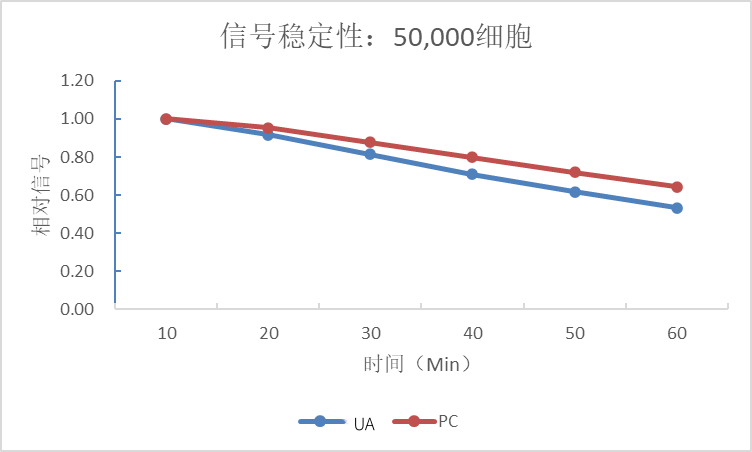
The UA-Glo® One-luc Luciferase Assay System provides an optimized detection solution for single- or dual-luciferase reporter gene experiments. Its core components include high-performance luciferase substrates and reaction buffers, supporting the detection of both firefly and Renilla luciferases. The system employs a homogeneous detection mode, offering simplicity, high sensitivity, and a wide linear range, suitable for high-throughput detection in 96- and 384-well plates. The reagents exhibit excellent signal stability, with luminescence lasting for hours after addition, facilitating batch processing. The system is compatible with common luciferase reporter vectors and can be directly applied to various research scenarios.
VI. Summary
The dual-luciferase reporter gene system significantly improves data reliability and reproducibility through internal reference correction, becoming a core technique in gene expression regulation research. From miRNA target validation and transcription factor regulation analysis to signaling pathway studies, this technology plays a vital role in various fields of molecular biology. The UA-Glo® One-luc Luciferase Assay System, with its optimized performance, provides stable and reliable technical support for related research.
VII. Which Manufacturers Provide the UA-Glo® One-luc Luciferase Assay System?
Nanjing UA-Bio Technology Co., Ltd. (UA-Bio) has independently developed the "UA-Glo® One-luc Luciferase Assay System", a high-performance homogeneous luminescence detection system specifically designed for reporter gene analysis. This system features optimized single-tube addition operations to accurately and efficiently quantify firefly luciferase reporter gene expression activity, providing a stable and reliable standardized solution for gene regulation, signaling pathway research, and drug screening.
| Core Product Advantages |
|---|
| High Sensitivity and Wide Dynamic Range: The system employs an optimized luciferase reaction system, generating stable and intense bioluminescent signals with exceptional sensitivity and a linear range exceeding seven orders of magnitude. It enables precise detection of low-abundance reporter gene expression while meeting the quantitative needs of high-activity samples, making it widely applicable to promoter analysis, transcriptional regulation studies, and high-throughput screening. |
| Excellent Inter-Batch Consistency and Stability: Leveraging an internationally advanced luminescence detection technology platform and standardized production processes, combined with stringent quality control, the system ensures high purity, long-term stability, and outstanding inter-batch consistency. It provides solid quality assurance for long-term and continuous reporter gene studies. |
| "Add-Read" Homogeneous Operation Mode: The system adopts a simplified "add-read" homogeneous operation mode, requiring only the addition of a single detection reagent to cell lysates, eliminating the need for complex stepwise additions or additional operations. The streamlined workflow significantly reduces experimental time and operational errors. Its optimized formulation is compatible with multi-well plate (96/384-well) automation platforms, making it suitable for high-throughput drug screening, signaling pathway analysis, and transcriptional regulation studies. |
| Stable and Long-Lasting Glow-Type Signals: The kit features a specially optimized formulation, producing uniform and stable "glow-type" luminescent signals with a half-life of several hours, providing ample time for large-scale sample detection and automated operations, ensuring data reliability and reproducibility. |
| Complete Solutions and Professional Support: We provide fully validated standard protocols, typical dose-response curves, and detailed result interpretation guidelines to help establish stable and reproducible experimental workflows. Nanjing UA-Bio's technical team offers comprehensive support for research design, experimental optimization, and data analysis. |
Nanjing UA-Bio Technology Co., Ltd. is committed to providing cutting-edge, high-quality core reagents and tools for immunology, cell therapy, and innovative drug development. For detailed technical parameters, validation data, or application inquiries regarding the "UA-Glo® One-luc Luciferase Assay System" (Catalog No.: UA079010), please feel free to contact us.
This article is reviewed and published by the technical expert team of UA
Disclaimer: This article partially utilizes artificial intelligence assistance in its creation. If any content involves copyright or intellectual property issues, please let us know and we promise to verify and remove it as soon as possible.
Purchase recombinant protein, choose Nanjing UA-Bio
UA protein focuses on providing various protein reagents, raw materials, and services required for drug research and development, cell therapy, gene therapy, and basic scientific research, including drug target proteins, immune checkpoint proteins, cytokines, tool enzymes, customized protein expression, and full-length transmembrane protein development. Youai is committed to providing customers with high-quality products and professional services, and building a High-tech Biological Enterprise with International Competitiveness.







 Business license (three certificates in one)