




Technical Principles and Applications of Mouse T Cell Activation Kit


T lymphocytes, as the core cells of adaptive immune responses, play an irreplaceable role in anti-infection, anti-tumor, and immune regulation.
- Recent Advances
- Product Information
I. Introduction
T lymphocytes, as the core cells of adaptive immune responses, play an irreplaceable role in anti-infection, anti-tumor, and immune regulation. The activation of T cells is the primary step in initiating immune responses, a process strictly regulated by dual signals. In adoptive immunotherapy and basic immunology research, how to efficiently activate and expand functional T cells in vitro has become a key technical requirement. The Mouse T Cell Activation Kit simulates the dual-signal mechanism in vivo, providing a standardized solution for in vitro activation of mouse T cells, widely used in CAR-T research, TCR-T development, and basic immunology experiments.
II. Dual-Signal Mechanism of T Cell Activation
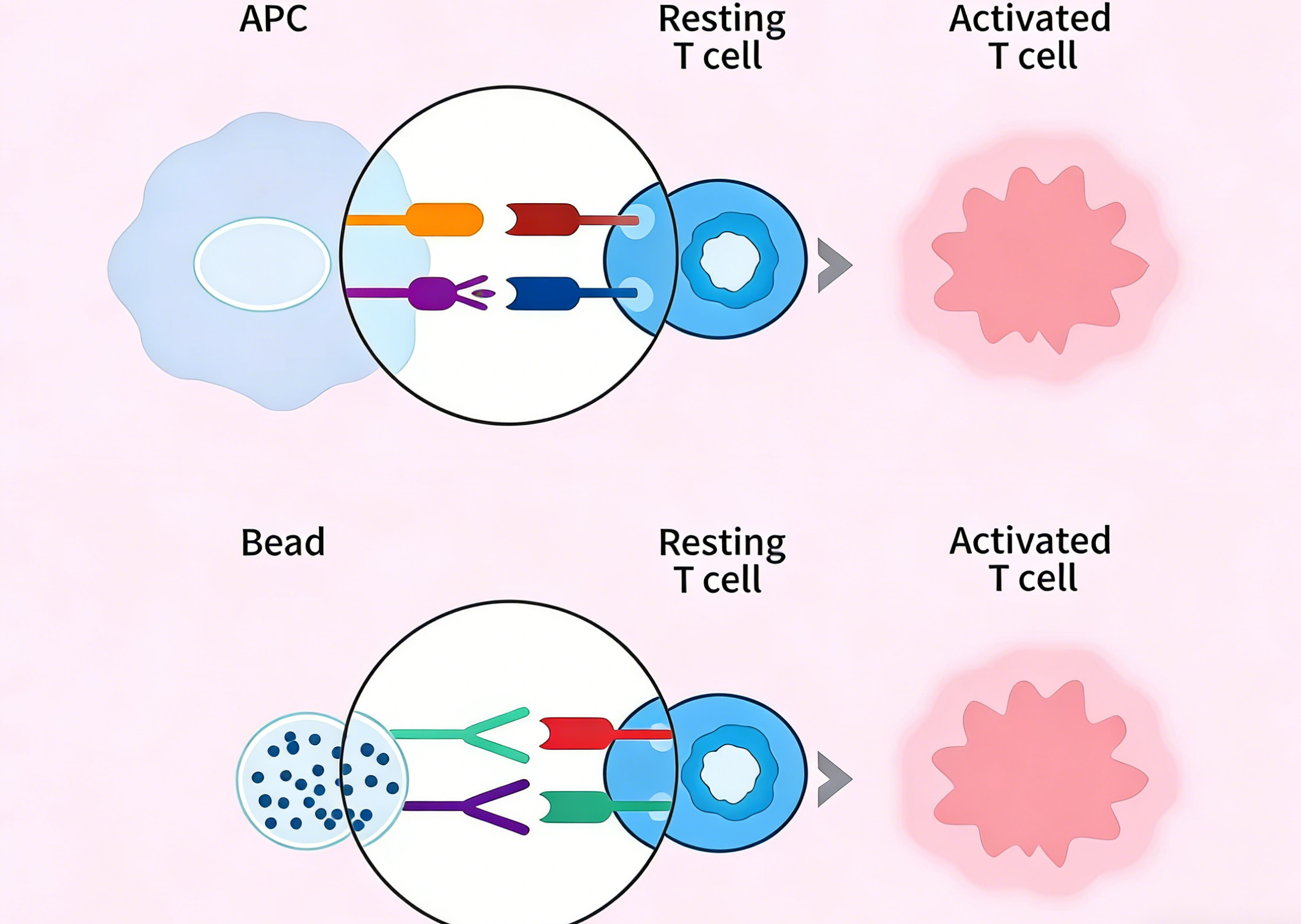
In vivo, complete activation of T lymphocytes requires two independent but synergistic signals. The first signal is triggered by the binding of the T cell receptor (TCR) to the specific peptide-MHC complex on antigen-presenting cells (APCs), determining the specificity of T cell responses. The second signal is a non-specific co-stimulatory signal generated by the interaction between co-stimulatory molecules on APCs and corresponding receptors on T cells. The interaction between CD28 and CD80/CD86 is the most critical co-stimulatory pathway, while other molecular pairs such as 4-1BB/4-1BBL and CD40/CD40L also regulate the degree of T cell activation and functional differentiation.
The biological significance of the dual-signal model lies in the fact that T cells receiving only the first signal without co-stimulatory signals not only fail to activate effectively but may enter a state of clonal anergy, which is an important mechanism for maintaining peripheral immune tolerance. The second signal enables complete T cell activation, cytokine secretion, and cytokine receptor expression, initiating subsequent proliferation and differentiation programs.
After receiving dual signals for complete activation, T cells require the synergistic action of various cytokines to proliferate and differentiate further. IL-2 is a key factor in maintaining T cell proliferation, while IL-7 and IL-15 participate in the maintenance of memory T cells. Without cytokine signals, activated T cells cannot proliferate effectively, ultimately leading to activation-induced cell death (AICD).
III. In Vitro T Cell Activation Strategies
In vitro experiments, the combined use of anti-CD3 and anti-CD28 antibodies is the most widely applied method to simulate the dual-signal stimulation in vivo. Anti-CD3 antibodies bind to CD3 molecules on T cell surfaces, cross-linking the TCR complex to trigger the first signal, while anti-CD28 antibodies bind to CD28 molecules, providing the co-stimulatory signal.
Current methods for in vitro T cell activation include soluble antibody stimulation and solid-phase carrier-bound antibody stimulation. Soluble antibodies are easy to use but have relatively low activation efficiency, and high concentrations of IL-2 may lead to T cell exhaustion. Solid-phase carrier-bound antibodies provide sustained and stable activation signals by coating antibodies on culture plates or conjugating them to magnetic beads.
IV. Technical Features of the Mouse T Cell Activation Kit
The Mouse T Cell Activation Kit is optimized for the characteristics of mouse T cells, providing a complete reagent system for in vitro activation.
The kit contains all functional components required for activating mouse T cells. Anti-CD3 antibody specifically binds to CD3 molecules on mouse T cells, providing the first activation signal, while anti-CD28 antibody binds to CD28 co-stimulatory molecules, providing the second activation signal. Both antibodies are purified to NA/LE grade, with azide and low endotoxin removal, ensuring direct cellular stimulation activity and avoiding interference from harmful components.
The kit also includes IL-2 cytokine to meet the proliferation needs of fully activated T cells. IL-2 is provided as a lyophilized powder, reconstituted before use, to stably maintain cell proliferation and functional phenotypes, preventing activation-induced cell death.
The kit offers different specifications suitable for 200 mL, 1 L, and 2 L culture systems, meeting diverse needs from small-scale experiments to large-scale cell expansion. All components undergo strict quality control to ensure batch-to-batch consistency and functional activity, guaranteeing the reliability of experimental results.
V. Operational Methods and Application Scenarios
The standard operating procedure of the Mouse T Cell Activation Kit includes antibody coating, cell preparation, activation system establishment, and effect detection. Anti-CD3 antibodies are pre-coated on culture plates to provide a solid-phase first signal. The cell suspension is mixed with anti-CD28 antibodies and IL-2, then transferred to coated wells for culture. After 2 days of culture, activation effects are verified through cell counting and flow cytometry detection of activation markers such as CD25.
The kit has broad applications in multiple research fields. In CAR-T and TCR-T preclinical research, it is used for in vitro activation of mouse T cells, laying the foundation for subsequent genetic modification and functional validation. In basic immunology research, it can be used to explore T cell activation mechanisms, signal transduction pathways, and subset differentiation regulation. In transplantation immunology and tumor immunology research, it is used to prepare effector T cells for adoptive transfer. In autoimmune disease models, it is used to activate autoreactive T cells for disease induction and study.
VI. Summary
The Mouse T Cell Activation Kit, based on the dual-signal activation principle, provides an efficient and controllable standardized tool for in vitro activation of mouse T cells through optimized anti-CD3/CD28 antibody combinations and IL-2 cytokine. Its NA/LE-grade antibodies ensure cellular compatibility, and flexible specifications meet various experimental needs, making it an indispensable key reagent in CAR-T preclinical research, basic immunology experiments, and disease model construction.
VII. Which Manufacturers Provide Mouse T Cell Activation Kits?
Nanjing UA-Bio Technology Co., Ltd. (UA-Bio) has independently developed the "CellXViva Mouse T cell Activation Kit", a high-performance cell activation platform specifically designed for in vitro expansion and functional research of mouse T cells. This kit employs an optimized antibody conjugation and stimulation system to efficiently and stably activate primary mouse T cells, providing standardized and reliable solutions for tumor immunology, autoimmune disease models, and preclinical efficacy evaluation.
| Core Product Advantages |
|---|
| Efficient Activation and Directed Expansion: The kit uses an optimized anti-mouse CD3/CD28 antibody conjugation system to simulate the natural stimulation signals of antigen-presenting cells (APCs), efficiently activating resting primary mouse T cells. The optimized activation system promotes rapid T cell proliferation while effectively maintaining T cell stemness and functional activity, making it particularly suitable for T cell preparation and expansion in mouse model studies. |
| Excellent Batch-to-Batch Consistency and Stability: Relying on an internationally leading cell culture reagent development platform and standardized production processes, combined with strict quality control systems, each batch of reagents ensures stable activation efficiency, consistent cell expansion capability, and excellent long-term stability, providing solid and reliable quality assurance for long-term and continuous mouse T cell research. |
| Flexible and Convenient Operating System: The kit provides a ready-to-use activation system with simple and quick operation. The optimized formulation is compatible with various culture containers (plates, flasks) and platforms, flexibly applicable to mouse T cell activation and expansion, immune function evaluation, T cell subset sorting, and preclinical efficacy research. |
| Serum-Free System Compatibility: The kit is specially optimized to be compatible with various commercial serum-free media, meeting the standardization needs of preclinical research and avoiding the impact of serum batch variations on experimental results. |
| Complete Solutions and Professional Support: We provide fully validated standard experimental protocols, typical expansion curves, and detailed result interpretation guides to help you quickly establish stable and reproducible mouse T cell activation and expansion processes. Nanjing UA-Bio's professional technical team offers comprehensive technical consultation and support for your research design, experimental optimization, and data analysis. |
Nanjing UA-Bio Technology Co., Ltd. is committed to providing cutting-edge, high-quality core reagents and tools for immunology, cell therapy, and innovative drug development. For detailed technical parameters, validation data, or specific application inquiries regarding the "CellXViva Mouse T cell Activation Kit" (Catalog No.: UA090032), please feel free to contact us.
This article is reviewed and published by the technical expert team of UA
Disclaimer: This article partially utilizes artificial intelligence assistance in its creation. If any content involves copyright or intellectual property issues, please let us know and we promise to verify and remove it as soon as possible.
Purchase recombinant protein, choose Nanjing UA-Bio
UA protein focuses on providing various protein reagents, raw materials, and services required for drug research and development, cell therapy, gene therapy, and basic scientific research, including drug target proteins, immune checkpoint proteins, cytokines, tool enzymes, customized protein expression, and full-length transmembrane protein development. Youai is committed to providing customers with high-quality products and professional services, and building a High-tech Biological Enterprise with International Competitiveness.







 Business license (three certificates in one)