




Fc Receptor (FcR): An Important Protein in the Process of Antibody-Dependent Immune Response


In the complex and sophisticated immune system of the human body, the Fc receptor (FcR) of antibodies is like a crucial "bridge" that connects antibodies with immune cells and plays an indispensable role in the process of immune defense. The FcR not only participates in the initiation and regulation of various immune responses, but also its unique structural and functional characteristics provide important clues for understanding the immune mechanism and developing novel immunotherapeutic strategies.
- Recent Advances
- Product Information
- Reference
In the complex and sophisticated immune system of the human body, the Fc receptor (FcR) of antibodies serves as a crucial "bridge" that connects antibodies with immune cells and plays an indispensable role in the process of immune defense. The FcR not only participates in the initiation and regulation of various immune responses, but its unique structural and functional characteristics also provide important clues for understanding the immune mechanism and developing novel immunotherapeutic strategies.
FcR
Antibodies, as important "weapons" of the immune system, have Fab fragments that can specifically recognize and bind to invading viruses, bacteria, or toxins, exerting a neutralizing effect to prevent further harm to the body by pathogens. However, the neutralizing effect alone cannot completely eliminate pathogens. At this point, the FcR comes into play. The Fc fragment of the antibody binds to the FcR on the surface of immune cells, activating the immune cells and initiating powerful immune clearance mechanisms such as antibody-mediated phagocytosis and antibody-dependent cellular cytotoxicity (ADCC), thereby effectively removing pathogens from the body.
FcR is widely expressed on the surface of various immune cells, including macrophages, dendritic cells (DC cells), neutrophils, natural killer (NK) cells, B cells, eosinophils, basophils, and mast cells. Different types of cells express different types of FcR, which specifically bind to the Fc fragments of corresponding antibodies, thereby triggering diverse immune responses and forming an important part of the precise regulation of the immune system.
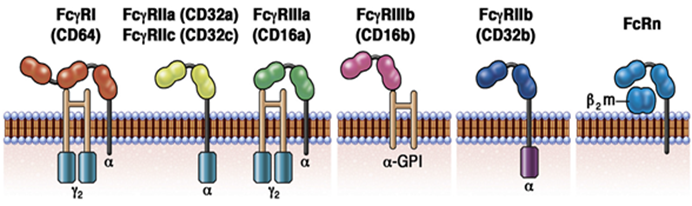
The Structure of FcR
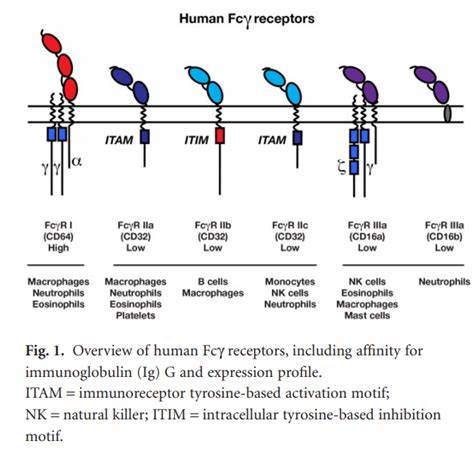
FcR is a class of cell surface proteins. Although they belong to different families, the members have similar structures. Each FcR contains an α chain located on the cell surface, which is responsible for specific binding to the ligand, and other chains that assist in transporting the FcR to the cell surface and transmitting signals, among which FcRγ is relatively crucial. FcRγ usually exists in a dimeric structure and is a transmembrane protein. Its transmembrane structure is connected to the α chain, and the intracellular domain contains an immunoreceptor tyrosine-based activation motif (ITAM) or an immunoreceptor tyrosine-based inhibitory motif (ITIM). These domains play a central role in mediating the FcR signaling pathway and determine whether immune cells are activated or inhibited.
FcR of IgG
As the most abundant type of antibody in the human body, the Fc receptor of IgG, FcγR, is divided into three subfamilies, FcγRI, FcγRII, and FcγRIII, according to the difference in affinity for the Fc fragment. Different subtypes of IgG have different abilities to activate FcγR. IgG1 and IgG3 have stronger activation abilities, while IgG2 and IgG4 are relatively weaker.
FcγRI (CD64) has a unique structure. The extracellular α chain contains three tandem Ig structures and is mainly expressed on monocytes, macrophages, and DC cells. Activated neutrophils and eosinophils also express it. It has a strong binding affinity for IgG1 and IgG3 and can effectively mediate antibody-dependent phagocytosis and ADCC of immune cells, playing an important role in the process of pathogen clearance.
FcγRII (CD32) exists in three forms: FcγRIIa, FcγRIIb, and FcγRIIc. FcγRIIa and FcγRIIc are mainly expressed on the surface of immune cells such as neutrophils and monocytes, transmitting immune activation signals. However, FcγRIIb is relatively special. Its intracellular domain is linked with an ITIM structure and is mainly expressed on the surface of myeloid cells and B cells. Once activated, it mediates immune inhibitory signals, which is crucial for the negative regulation of B cell functions, maintaining the balance of the immune system and preventing excessive activation of the immune response.
FcγRIII (CD16) has two subtypes in the body, FcγRIIIa and FcγRIIIb, with moderate and low affinities for IgG, respectively. FcγRIIIa is widely expressed in various types of white blood cells, playing a leading role in the ADCC of NK cells and the clearance of antibody-antigen immune complexes by macrophages; FcγRIIIb is mainly expressed in neutrophils and can stimulate neutrophils to release superoxide, enhancing immune defense.
FcR of IgE
FcεRI is mainly expressed on the surface of eosinophils and mast cells. After binding to IgE, it has a very high affinity, a low dissociation rate, and a dissociation half-life of approximately 20 hours. Its structure includes an α chain, a β chain, and an FcRγ dimer. The α chain is responsible for specific binding to the Fc structure of IgE, and the ITAM domains in the intracellular regions of the β chain and the FcRγ dimer are responsible for signal transduction. When FcεRI specifically binds to IgE, it activates mast cells, causing mast cells to degranulate and release cytokines and lipid mediators, playing a key role in allergic reactions and anti-parasitic immunity.
FcεRII (CD23), as another IgE receptor, belongs to the C-type lectin family and has a lower affinity for IgE compared to FcεRI. Currently, the research on its functions is still ongoing, but it also plays an important role in immune regulation.
FcR of IgA
FcαRI (CD89) is mainly expressed in monocytes, macrophages, neutrophils, eosinophils, and Kupffer cells. After cross-linking with antigens, it can induce endocytosis and phagocytosis, promote the release of inflammatory factors, and ADCC. In mucosal immunity, FcαRI plays a key role in protecting the body from pathogen invasion. Especially in mucosal tissues such as the respiratory tract and digestive tract, it is an important defense line against pathogens.
FcRn
FcRn has a structure similar to that of MHC-I molecules and is of great significance in the metabolism of IgG and the immune transfer between mother and baby. On the one hand, FcRn can mediate the transfer of IgG from the mother to the fetus through the placenta and the passage of IgG in breast milk through the intestinal cells of breastfed infants, providing important immune protection for newborns. On the other hand, FcRn can prolong the half-life of IgG antibodies in both adults and children. This characteristic has important application value in the design of antibody drugs, helping to improve the efficacy of antibody drugs. However, FcRn has a relatively weak effect on prolonging the half-life of IgG3, which also reflects the specificity of its interaction with different IgG subtypes.
Future Prospects
With the continuous in-depth study of the structure and function of FcR, its application prospects in the field of immunotherapy are becoming increasingly broad. Targeted drugs developed for specific FcR are expected to precisely regulate immune responses and treat a variety of diseases such as autoimmune diseases and cancers. For example, by regulating the activity of FcγRIIb, it is possible to attempt to inhibit the overly active immune response in autoimmune diseases; by utilizing FcγRIIIa to enhance the ADCC of NK cells, new cancer immunotherapy methods can be developed.
In addition, in-depth research on the molecular mechanism of the interaction between FcR and antibodies will help optimize the design of antibody drugs and improve their efficacy and safety. Combined with emerging gene editing technologies, precise regulation of the FcR gene can also be explored to further tap its potential in immunotherapy.
This article is reviewed and published by the technical expert team of UA
Disclaimer: This article partially utilizes artificial intelligence assistance in its creation. If any content involves copyright or intellectual property issues, please let us know and we promise to verify and remove it as soon as possible.
Purchase recombinant protein, choose Nanjing UA-Bio
UA protein focuses on providing various protein reagents, raw materials, and services required for drug research and development, cell therapy, gene therapy, and basic scientific research, including drug target proteins, immune checkpoint proteins, cytokines, tool enzymes, customized protein expression, and full-length transmembrane protein development. Youai is committed to providing customers with high-quality products and professional services, and building a High-tech Biological Enterprise with International Competitiveness.

1.Cellular and Molecular Immunology 9th Edition;
2.Roittis essential imuuology 13th edition;
3.Janeway's Immunobiology 9th Edition;






 Business license (three certificates in one)