




Technical Principles and Applications of Mouse Th1 Polarization Kit


Helper T cells are the central regulatory cells of the adaptive immune response, among which Th1 cells play a key role in combating intracellular pathogen infections and anti-tumor immunity.
- Recent Advances
- Product Information
I. Introduction
Helper T cells (Th) are central regulatory cells in adaptive immune responses, with Th1 cells playing a critical role in anti-intracellular pathogen infections and anti-tumor immunity. Th1 cells differentiate from naive CD4+ T cells in specific cytokine microenvironments, characterized by the expression of transcription factor T-bet and effector cytokine IFN-γ. The mouse Th1 polarization kit provides a standardized solution for in vitro induction of Th1 differentiation from naive T cells by mimicking in vivo differentiation signals, widely used in infectious immunity, autoimmune diseases, and tumor immunology research.
II. Differentiation and Development of Th1 Cells
T cells originate from hematopoietic stem cells in the bone marrow and then migrate to the thymus for differentiation and maturation. In the thymus, T cells undergo positive and negative selection, eventually developing into CD4+ or CD8+ single-positive T cells that enter peripheral lymphoid organs.
Naive CD4+ T cells begin to proliferate and express various cytokines upon receiving dual activation signals from antigen-presenting cells (APCs). The dual signals include: Signal 1 provided by TCR recognition of antigen peptide-MHC class II molecule complexes on APC surfaces; Signal 2 provided by costimulatory molecules such as CD28 interacting with CD80/CD86. Under dual signal stimulation, naive CD4+ T cells first differentiate into Th0 cells.
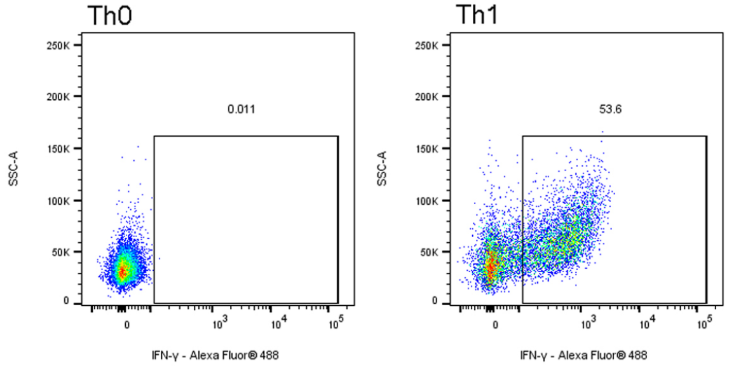
Th0 cells polarize into different functional subsets guided by cytokine signals in the microenvironment. Th1 polarization is driven by key cytokines IFN-γ and IL-12. IL-12 activates the STAT4 transcription factor, while IFN-γ activates STAT1, both inducing T-bet expression. T-bet, as the master regulator transcription factor for Th1 differentiation, directly initiates IFN-γ gene transcription while inhibiting signaling pathways toward Th2 and Th17 differentiation. Newly produced IFN-γ further enhances T-bet expression through positive feedback, consolidating the Th1 differentiation pathway.
III. Effector Functions of Th1 Cells
Th1 cells primarily exert effector functions through the secretion of characteristic cytokines, including IFN-γ, IL-2, and TNF-α.
Macrophage Activation: IFN-γ secreted by Th1 cells is the most potent activator of macrophages. Activated macrophages enhance phagocytic capacity and produce nitric oxide (NO) and reactive oxygen intermediates (ROI), effectively killing intracellular pathogens such as Mycobacterium tuberculosis and Leishmania. Meanwhile, CD40L expressed by Th1 cells binds to CD40 on macrophage surfaces, providing synergistic activation signals that further enhance macrophage function.
Promotion of Cellular Immune Responses: IL-2 secreted by Th1 cells promotes the activation and proliferation of CD8+ cytotoxic T cells, enhancing their ability to kill infected cells and tumor cells. IL-2 also acts on Th cells themselves, forming a positive feedback amplification loop.
Participation in Delayed-Type Hypersensitivity: The immune response mediated by Th1 cells is the cellular basis of delayed-type hypersensitivity (DTH). Sensitized Th1 cells release various cytokines upon re-exposure to antigens, recruiting and activating macrophages, leading to local inflammatory responses and tissue damage.
Regulation of Humoral Immunity: Th1 cells also assist in B cell activation and proliferation, promoting antibody class switching to produce opsonizing antibody subclasses that help phagocytes clear pathogens.
IV. Identification Markers of Th1 Cells
Th1 cell identification is based on multi-level molecular markers. Surface markers include CD3 and CD4 as the basis, with the characteristic chemokine receptor CXCR3. At the transcription factor level, the core marker is T-bet, encoded by the TBX21 gene. At the effector cytokine level, IFN-γ is the characteristic product.
Modern single-cell transcriptome sequencing technologies have further enriched the molecular signature profile of Th1 cells, enabling simultaneous detection of surface molecules, transcription factors, and effector molecules at the transcriptome level for precise subset identification and functional state assessment.
V. Th1 Cell Relevance to Diseases
In anti-infective immunity, Th1-mediated immune responses are crucial for controlling intracellular bacterial, viral, and protozoan infections. Th1 functional defects can increase susceptibility to pathogens such as Mycobacterium tuberculosis and Mycobacterium leprae.
In autoimmune diseases, excessive Th1 cell activation can mediate tissue damage. Diseases such as rheumatoid arthritis, type 1 diabetes, multiple sclerosis (MS), and chronic thyroiditis all show dominant Th1-type immune responses, with elevated IFN-γ levels correlating with disease activity.
In organ transplantation, Th1 cells participate in transplant rejection, with their secreted cytokine levels significantly elevated during rejection periods and reduced during immune tolerance periods.
In tumor immunity, Th1 cell-mediated cellular immune responses have anti-tumor effects. Higher levels of Th1 cell infiltration in the tumor microenvironment correlate with better patient prognosis, while dominance of Th2 and Treg subsets correlates with poor prognosis. This makes Th1 cells an important target for tumor immunotherapy.
VI. Technical Principles of Mouse Th1 Polarization Kit
The mouse Th1 polarization kit is optimized for in vitro directional differentiation of mouse naive CD4+ T cells, driving naive T cells toward the Th1 lineage by mimicking the in vivo Th1 polarization microenvironment.
Polarization Cytokine Cocktail: The kit contains recombinant mouse IL-12 as the initiation signal for Th1 differentiation, activating the STAT4 pathway and inducing T-bet expression. It also provides neutralizing anti-IL-4 antibodies to block deviation toward Th2 differentiation, ensuring unidirectional differentiation.
T Cell Activation Reagents: The kit provides functional-grade anti-mouse CD3 and anti-mouse CD28 antibodies to simulate the dual signal stimulation provided by antigen-presenting cells in vivo, ensuring effective activation of naive T cells. The antibodies can be used in soluble form or solid-phase coated form, adjusted flexibly according to the experimental system.
Expansion Support Components: The kit contains recombinant mouse IL-2 to support continuous proliferation and functional maintenance of activated Th1 cells. IL-2 is provided at an optimized concentration to avoid adverse effects on cell differentiation from too high or too low concentrations.
VII. Which Manufacturers Provide Mouse Th1 Polarization Kits?
Nanjing UA-Bio Technology Co., Ltd. (UA-Bio) has independently developed the "Mouse Th1 Polarization Kit", a high-performance cell culture system specifically designed for inducing and expanding mouse Th1 cells. This kit uses an optimized cytokine cocktail and stimulation protocol to efficiently and stably polarize mouse naive CD4+ T cells into functional Th1 cells, providing a standardized and reliable solution for tumor immunology, infectious immunity, and preclinical drug efficacy evaluation.
| Core Product Advantages |
|---|
| Efficient Polarization and Directional Differentiation: The kit uses an optimized cytokine cocktail (including IL-12, anti-IL-4, etc.) to mimic the microenvironment signals for in vivo Th1 cell differentiation, efficiently inducing mouse naive CD4+ T cells toward Th1 polarization. The optimized polarization system promotes Th1-specific transcription factor T-bet expression while maintaining cell effector function and interferon-γ (IFN-γ) secretion capacity, making it particularly suitable for T cell functional evaluation and immune mechanism exploration in mouse model studies. |
| Excellent Batch-to-Batch Consistency and Stability: Relying on an internationally leading cell culture reagent development platform and standardized production processes, combined with a stringent release quality control system, each batch of reagents exhibits stable polarization efficiency, consistent cell function, and excellent long-term stability. This provides solid and reliable quality assurance for long-term and continuous mouse Th1 cell research. |
| Flexible and Convenient Operating System: The kit provides a complete polarization protocol and optimized culture system, making operations simple and fast. Its formulation is compatible with various culture containers and platforms, flexibly applicable to multiple application needs such as mouse Th1 cell induction and expansion, immune function evaluation, cytokine secretion analysis, and signaling pathway research. |
| Complete Solutions and Professional Support: We provide fully validated standard experimental protocols, typical polarization efficiency data, and detailed result interpretation guidelines to help you quickly establish stable and reproducible mouse Th1 cell polarization processes. The Nanjing UA-Bio professional technical team offers comprehensive technical consultation and support for your research design, experimental optimization, and data analysis. |
Nanjing UA-Bio Technology Co., Ltd. is always committed to providing cutting-edge, high-quality core reagents and tools for immunology, cell therapy, and innovative drug development. For detailed technical parameters, validation data, or specific application consultations regarding the "Mouse Th1 Polarization Kit" (Catalog No.: UA090017), please feel free to contact us.
This article is reviewed and published by the technical expert team of UA
Disclaimer: This article partially utilizes artificial intelligence assistance in its creation. If any content involves copyright or intellectual property issues, please let us know and we promise to verify and remove it as soon as possible.
Purchase recombinant protein, choose Nanjing UA-Bio
UA protein focuses on providing various protein reagents, raw materials, and services required for drug research and development, cell therapy, gene therapy, and basic scientific research, including drug target proteins, immune checkpoint proteins, cytokines, tool enzymes, customized protein expression, and full-length transmembrane protein development. Youai is committed to providing customers with high-quality products and professional services, and building a High-tech Biological Enterprise with International Competitiveness.







 Business license (three certificates in one)