




Technical Principles and Applications of Mouse Th17 Polarization Kit


Th17 cells are a subset of CD4+ T cells characterized by the secretion of IL-17A as their signature effector molecule, and their differentiation is regulated by the transcription factor RORγt. Th17 cells play a critical role in autoimmune diseases and inflammatory disorders, while also maintaining important functions in intestinal mucosal homeostasis.
- Recent Advances
- Product Information
I. Introduction
Th17 cells are a subset of CD4+ T cells characterized by the secretion of IL-17A as their effector molecule, regulated by the transcription factor RORγt. Th17 cells play a pivotal role in autoimmune diseases and inflammatory disorders, while also maintaining intestinal mucosal homeostasis. Recent studies have revealed significant heterogeneity and plasticity in Th17 cells, with variations in pathogenicity and functional properties depending on differentiation conditions. The mouse Th17 polarization kit simulates in vivo differentiation microenvironments, providing a standardized solution for in vitro induction of Th17 differentiation from naive CD4+ T cells. It is widely used in autoimmune disease mechanism research and immunomodulatory drug screening.
II. Heterogeneity of Th17 Cell Differentiation In Vitro
In vitro studies show that Th17 cells induced by different cytokine combinations exhibit significant differences in their ability to induce autoimmune diseases upon adoptive transfer. Polarizing naive CD4+ T cells with IL-6 and TGF-β yields non-pathogenic Th17 cells, characterized by the expression of IL-10, c-Maf, and Ahr, which cannot induce tissue inflammation or autoimmunity upon transfer. When IL-1β and IL-23 are added to the polarization system, or when IL-6 and TGF-β are combined with IL-23, pathogenic Th17 cells are obtained, which highly express Csf2, Ifng, Tbx21, Il23r, and Gzmb and exhibit strong pathogenicity upon transfer.
Through temporal expression analysis and single-cell RNA sequencing, researchers have constructed a regulatory network for Th17 cells, confirming the central role of RORγt in differentiation. Additionally, transcription factors such as ATF3, BHLHE40, FOS, NR4A1, EOMES, and T-BET regulate the pathogenic Th17 program, while ETS1, BACH2, FOSL2, and RBPJ are involved in maintaining the non-pathogenic Th17 program.
Human T cell subsets contain counterparts to the in vitro-differentiated mouse Th17 cells. Th17 memory cells specific to Candida albicans produce IL-17 and IFN-γ but not IL-10, resembling pathogenic Th17 cells, whereas Th17 cells specific to Staphylococcus aureus produce IL-17 and IL-10 but not IFN-γ, resembling non-pathogenic Th17 cells. CXCR3+CCR6+ Th1* cells are similar to pathogenic Th17 cells and play a critical role in anti-mycobacterial infections.
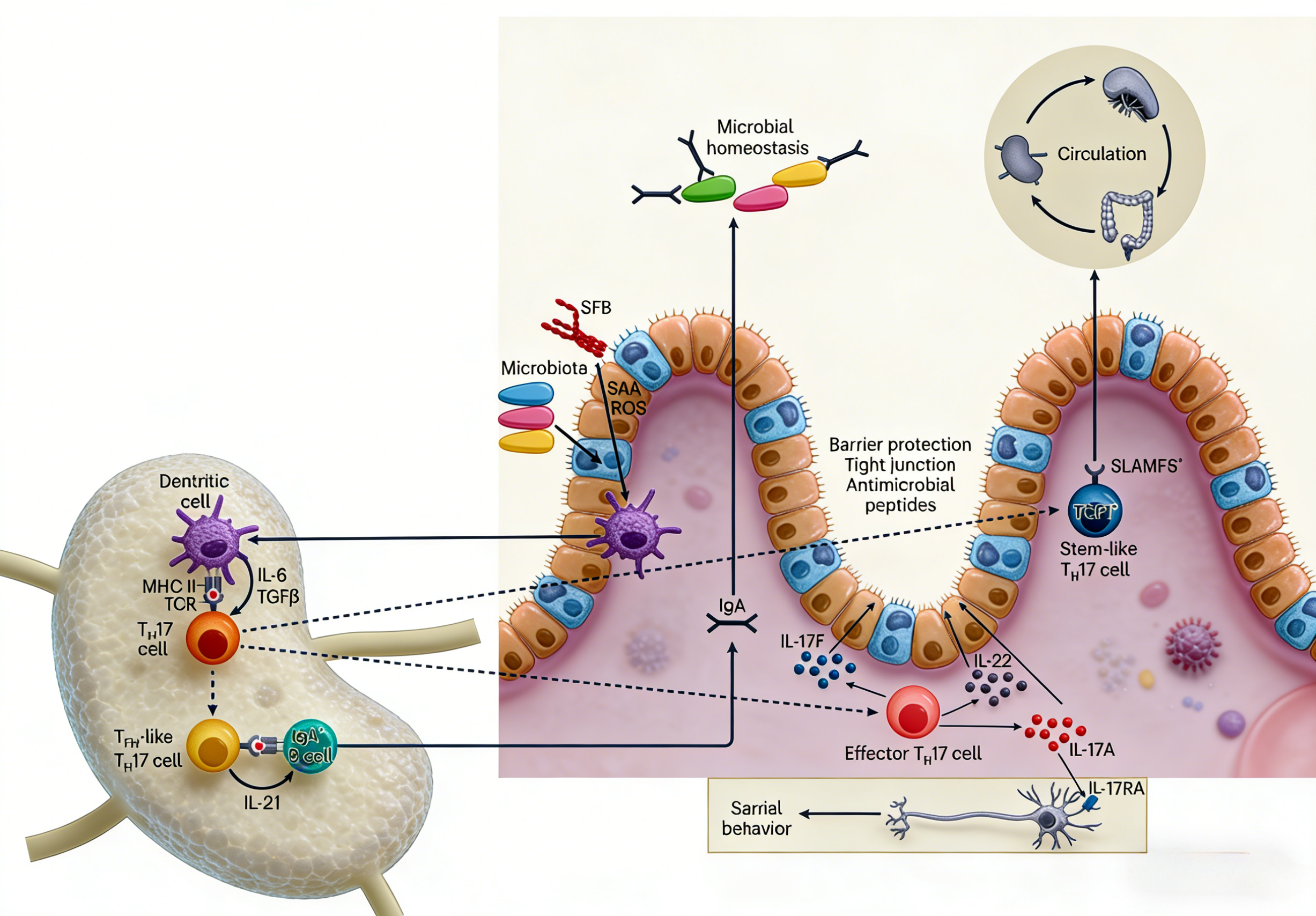
III. Heterogeneity of Tissue Th17 Cells Under Homeostasis
In vivo analysis using IL-17 fate reporter mice reveals the plasticity of Th17 cells. IL-23R plays a key role in the generation of pathogenic IFN-γ+ Th1/Th17 cells. During the resolution of intestinal inflammation and homeostasis restoration, Th17 cells upregulate the anti-inflammatory cytokine IL-10, promoting the generation of Tr1 cells, indicating that pathogenic Th17 cells can transdifferentiate into regulatory cells.
Single-cell RNA sequencing of Th17 cells from multiple tissues reveals tissue-specific transcriptomic signatures, suggesting that local microenvironmental factors such as nutrients, metabolites, and oxygen levels shape Th17 cell functional adaptation. Each tissue contains multiple functional subsets, including T follicular helper-like (Tfh-like), effector-like, stem-like, proliferative, interferon-stimulated gene-expressing, and Treg-like clusters, with high clonal relatedness, indicating dynamic interconversion among subsets within tissues.
IV. Technical Principles of the Mouse Th17 Polarization Kit
The mouse Th17 polarization kit is optimized for in vitro directed differentiation of naive CD4+ T cells, providing different polarization conditions to meet researchers' needs for non-pathogenic and pathogenic Th17 cells.
Non-pathogenic Th17 polarization system: The kit provides recombinant mouse IL-6 and TGF-β as core inducers to initiate RORγt expression and Th17 differentiation. This system yields Th17 cells with high IL-10 expression, suitable for studying Th17 cell functions in mucosal immunity and homeostasis maintenance.
Pathogenic Th17 polarization system: The kit additionally provides recombinant mouse IL-23 and IL-1β, which, when combined with IL-6 and TGF-β, induce Th17 cells with high pathogenic potential. This system yields cells with high expression of IFN-γ and granzyme B (Gzmb), suitable for autoimmune disease mechanism research.
T cell activation reagents: The kit provides functional-grade anti-mouse CD3 and anti-mouse CD28 antibodies to simulate the dual-signal stimulation provided by antigen-presenting cells (APCs) in vivo, ensuring effective activation of naive T cells. The antibodies can be used in soluble or solid-phase coated forms, adjusted flexibly based on the experimental system.
Expansion support components: The kit includes recombinant mouse IL-2 to support the sustained proliferation of activated Th17 cells. IL-2 is provided at an optimized concentration to avoid adverse effects on Th17 differentiation due to excessively high or low levels.
V. Which Manufacturers Provide Mouse Th17 Polarization Kits?
Nanjing UA-Bio Biotechnology Co., Ltd. has independently developed the "Mouse Th17 Polarization Kit", a high-performance cell culture system designed for inducing and expanding mouse Th17 cells. This kit employs an optimized cytokine combination and stimulation protocol to efficiently and stably polarize naive CD4+ T cells into functional Th17 cells, providing a standardized and reliable solution for autoimmune disease models, inflammation mechanism research, and preclinical drug efficacy evaluation.
| Core Advantages of the Product |
|---|
| Efficient Polarization and Directed Differentiation: The kit uses an optimized cytokine combination (including TGF-β, IL-6, IL-23, anti-IFN-γ, anti-IL-4, etc.) to mimic the microenvironmental signals for Th17 cell differentiation in vivo, efficiently inducing naive CD4+ T cells to polarize toward the Th17 lineage. The optimized polarization system promotes the expression of the Th17-specific transcription factor RORγt while maintaining effector functions and the secretion of Th17-type cytokines such as IL-17A, IL-17F, and IL-22, making it particularly suitable for autoimmune disease mechanism research and inflammatory disease model construction. |
| Exceptional Batch-to-Batch Consistency and Stability: Relying on an internationally leading cell culture reagent development platform and standardized production processes, combined with a stringent release quality control system, each batch of reagents exhibits stable polarization efficiency, consistent cell functionality, and excellent long-term stability, providing solid and reliable quality assurance for long-term and continuous mouse Th17 cell research. |
| Flexible and User-Friendly Operation System: The kit provides a complete polarization protocol and optimized culture system, ensuring simple and quick operation. Its formulation is compatible with various culture containers and platforms, flexibly applicable to multiple applications such as mouse Th17 cell induction and expansion, immune function evaluation, cytokine secretion analysis, and signaling pathway research. |
| Comprehensive Solution and Professional Support: We provide fully validated standard experimental protocols, typical polarization efficiency data, and detailed result interpretation guidelines to help you quickly establish stable and reproducible mouse Th17 cell polarization workflows. The Nanjing UA-Bio technical team offers professional technical consultation and support throughout your research design, experimental optimization, and data analysis. |
Nanjing UA-Bio Biotechnology Co., Ltd. is committed to providing cutting-edge, high-quality core reagents and tools for immunology, cell therapy, and innovative drug development. For detailed technical parameters, validation data, or specific application inquiries regarding the "Mouse Th17 Polarization Kit" (Catalog No.: UA090020), please feel free to contact us.
This article is reviewed and published by the technical expert team of UA
Disclaimer: This article partially utilizes artificial intelligence assistance in its creation. If any content involves copyright or intellectual property issues, please let us know and we promise to verify and remove it as soon as possible.
Purchase recombinant protein, choose Nanjing UA-Bio
UA protein focuses on providing various protein reagents, raw materials, and services required for drug research and development, cell therapy, gene therapy, and basic scientific research, including drug target proteins, immune checkpoint proteins, cytokines, tool enzymes, customized protein expression, and full-length transmembrane protein development. Youai is committed to providing customers with high-quality products and professional services, and building a High-tech Biological Enterprise with International Competitiveness.







 Business license (three certificates in one)