




Technical Principles and Applications of Mouse Treg Polarization Kit


Regulatory T cells are a subset of CD4+ T cells with immunosuppressive functions, playing a central role in maintaining immune system homeostasis, preventing autoimmune responses, and regulating the intensity of immune responses.
- Recent Advances
- Product Information
I. Introduction
Regulatory T cells (Treg) are a subset of CD4+ T cells with immunosuppressive functions, playing a central role in maintaining immune system homeostasis, preventing autoimmune reactions, and regulating the intensity of immune responses. Treg cells suppress the activity of effector T cells, antigen-presenting cells (APCs), and other immune cells through various mechanisms, ensuring that immune responses eliminate pathogens and abnormal cells without excessive activation that could damage normal tissues. The mouse Treg polarization kit simulates the in vivo induction microenvironment, providing a standardized solution for the in vitro directional induction of Treg differentiation from naive CD4+ T cells. It is widely used in autoimmune disease research, transplantation immunology, and tumor immunomodulation exploration.
II. Identification Markers of Treg Cells
Treg cells are identified based on multi-layered molecular markers. The most prominent phenotypic features are high expression of CD4 and CD25, as well as the specific expression of the transcription factor FoxP3. FoxP3 is not only a hallmark molecule of Treg cells but also a key regulator of their development and functional maintenance. Deficiency in FoxP3 can lead to scurfy mice and human IPEX syndrome, characterized by severe autoimmune pathology.
Additionally, Treg cells express various inhibitory molecules, including cytotoxic T-lymphocyte-associated protein 4 (CTLA-4), glucocorticoid-induced tumor necrosis factor receptor (GITR), and lymphocyte-activation gene 3 (LAG-3). These molecules play important roles in the immunosuppressive functions of Treg cells and are also used as functional markers for Treg cell identification.
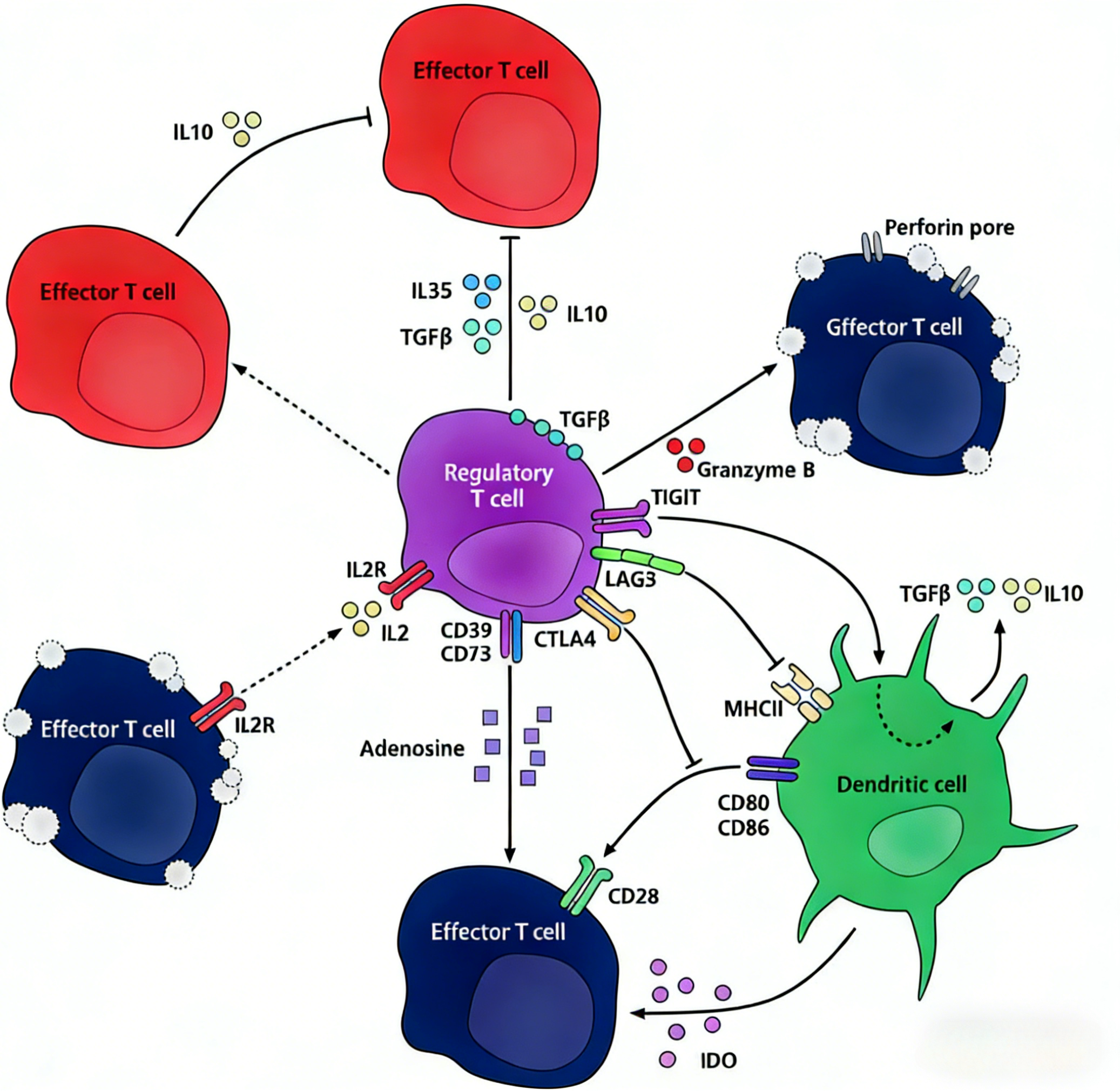
III. Immunosuppressive Mechanisms of Treg Cells
Treg cells employ multiple mechanisms to achieve multi-layered suppression of immune responses, ensuring the appropriateness of immune reactions and the maintenance of self-tolerance.
Cell-contact-dependent suppression: Treg cells transmit inhibitory signals through direct contact with other immune cells. CTLA-4 is a key molecule in this process, binding to CD80/CD86 on antigen-presenting cells. This not only delivers inhibitory signals to the Treg cells themselves but also reduces the expression of co-stimulatory molecules on APCs through trans-endocytosis, thereby weakening their ability to activate effector T cells. LAG-3 binds to MHC class II molecules on APCs, inhibiting their antigen-presenting function.
Secretion of inhibitory cytokines: Treg cells secrete various inhibitory cytokines, including IL-10, TGF-β, and IL-35. IL-10 suppresses the activation and function of macrophages and dendritic cells, reducing the production of pro-inflammatory cytokines. TGF-β inhibits the proliferation and differentiation of various immune cells while promoting the expansion of Treg cells themselves. IL-35, specifically secreted by Treg cells, suppresses the proliferation and function of effector T cells.
Metabolic interference mechanisms: Treg cells highly express CD25, enabling them to competitively bind IL-2 in the environment, depriving effector T cells of IL-2 utilization and thus inhibiting their proliferation and survival. Treg cells can also interfere with the signaling and energy metabolism of effector T cells by producing metabolites such as adenosine.
Extracellular vesicle-mediated suppression: Recent studies have found that Treg cells secrete extracellular vesicles such as exosomes containing miRNA, mRNA, and proteins, transmitting inhibitory signals to other immune cells and indirectly exerting immunomodulatory effects.
IV. Induction and Differentiation of Treg Cells
Naive CD4+ T cells can be directionally differentiated into induced Treg cells (iTreg) under specific cytokine microenvironments. TGF-β is the core inducer of Treg differentiation, promoting FoxP3 expression by activating the Smad signaling pathway. IL-2 enhances FoxP3 expression and maintains Treg cell survival and proliferation through the STAT5 signaling pathway. Co-stimulatory signals such as retinoic acid can further improve the efficiency of TGF-β-induced Treg differentiation.
Compared to natural Treg cells (nTreg), iTreg cells also express FoxP3 and possess immunosuppressive functions but may differ in stability, epigenetic modifications, and suppression mechanisms. The balance between retinoic acid receptor-related orphan receptor γt (RORγt) and FoxP3 regulates the mutual conversion of Treg and Th17 differentiation.
V. Role of Treg Cells in Immune Homeostasis
Treg cells play a central role in maintaining immune system homeostasis. By suppressing the activation and proliferation of autoreactive T cells, Treg cells prevent the onset of autoimmune diseases. During pathogen infections or tumor development, Treg cells timely suppress excessive immune responses, avoiding tissue damage and immunopathology. Treg cells also participate in regulating the formation and maintenance of immune memory, ensuring that the body can rapidly and appropriately initiate immune responses upon re-encountering the same antigen.
VI. Correlation Between Treg Cells and Diseases
Abnormal Treg cell function is closely related to the development of various diseases. Reduced Treg cell numbers or functional defects can lead to autoimmune diseases such as rheumatoid arthritis, systemic lupus erythematosus, and type 1 diabetes. Overactivation or excessive numbers of Treg cells may suppress the body's immune responses to pathogens and tumors, promoting chronic infections and tumor immune escape.
In the tumor microenvironment, Treg cells are often enriched and exert immunosuppressive effects, hindering anti-tumor immune responses and serving as a significant obstacle to tumor immunotherapy. In organ transplantation, donor-specific Treg cells can promote transplant tolerance and prolong graft survival.
VII. Which Manufacturers Provide Mouse Treg Polarization Kits?
Nanjing UA-Bio Technology Co., Ltd. (UA-Bio) has independently developed the "Mouse Treg Polarization Kit", a high-performance cell culture system specifically designed for inducing and expanding mouse regulatory T cells (Treg). This kit employs an optimized combination of cytokines and stimulation protocols to efficiently and stably polarize mouse naive CD4+ T cells into functional Foxp3+ Treg cells, providing a standardized and reliable solution for research in autoimmune disease models, transplantation immunology, and preclinical drug efficacy evaluation.
| Core Advantages of the Product |
|---|
| Efficient Polarization and Directional Differentiation: The kit uses an optimized cytokine combination (including TGF-β, IL-2, etc.) to simulate the microenvironment signals for Treg cell differentiation in vivo, efficiently inducing mouse naive CD4+ T cells to polarize toward the Treg lineage. The optimized polarization system promotes stable expression of the Treg-specific transcription factor Foxp3 while effectively maintaining the cells' immunosuppressive functions and cytokine secretion profiles, making it particularly suitable for autoimmune disease mechanism research, transplantation immune tolerance exploration, and immunomodulatory drug evaluation. |
| Excellent Batch-to-Batch Consistency and Stability: Relying on an internationally leading cell culture reagent development platform and standardized production processes, combined with a strict release quality control system, each batch of reagents ensures stable polarization efficiency, consistent cell function, and excellent long-term stability. This provides solid and reliable quality assurance for long-term and continuous mouse Treg cell research. |
| Flexible and Convenient Operating System: The kit provides a complete polarization protocol and optimized culture system, making operations simple and efficient. Its formulation is compatible with various culture containers and platforms, flexibly applicable to multiple application needs such as mouse Treg cell induction and expansion, immunosuppressive function evaluation, Foxp3 expression analysis, and signaling pathway research. |
| Complete Solutions and Professional Support: We provide fully validated standard experimental protocols, typical polarization efficiency data, and detailed result interpretation guides to help you quickly establish a stable and reproducible mouse Treg cell polarization process. The Nanjing UA-Bio professional technical team offers comprehensive and professional technical consultation and support for your research design, experimental optimization, and data analysis. |
Nanjing UA-Bio Technology Co., Ltd. is always committed to providing cutting-edge, high-quality core reagents and tools for immunology, cell therapy, and innovative drug research and development. For detailed technical parameters, validation data, or specific application consultations regarding the "Mouse Treg Polarization Kit" (Catalog No.: UA090022), please feel free to contact us.
This article is reviewed and published by the technical expert team of UA
Disclaimer: This article partially utilizes artificial intelligence assistance in its creation. If any content involves copyright or intellectual property issues, please let us know and we promise to verify and remove it as soon as possible.
Purchase recombinant protein, choose Nanjing UA-Bio
UA protein focuses on providing various protein reagents, raw materials, and services required for drug research and development, cell therapy, gene therapy, and basic scientific research, including drug target proteins, immune checkpoint proteins, cytokines, tool enzymes, customized protein expression, and full-length transmembrane protein development. Youai is committed to providing customers with high-quality products and professional services, and building a High-tech Biological Enterprise with International Competitiveness.







 Business license (three certificates in one)