




Technical Principle and Application of Human B Cell Polarization Cytokine Panel


B cells are a core component of the adaptive immune system, mediating humoral immune responses by differentiating into plasma cells to produce antibodies. Recent studies have revealed significant functional heterogeneity among B cells, with different subsets playing pro-inflammatory or anti-inflammatory roles in immune regulation, and their functional states are precisely modulated by cytokine networks in the microenvironment.
- Recent Advances
- Product Information
I. Introduction
B cells are core components of the adaptive immune system, mediating humoral immune responses by differentiating into plasma cells that produce antibodies. Recent studies have revealed significant functional heterogeneity among B cells, with different subsets playing pro-inflammatory or anti-inflammatory roles in immune regulation. Their functional states are precisely modulated by cytokine networks in the microenvironment. The human B cell polarization cytokine kit simulates various polarization conditions in vivo, providing a standardized solution for the in vitro directional induction of functional subsets from naive B cells. It is widely used in autoimmune disease mechanism research, vaccine development, and tumor immunology exploration.
II. Development and Differentiation of B Cells
B cells originate from multipotent hematopoietic stem cells in the bone marrow, where they undergo early development. Immature B cells generate diverse antigen recognition receptors through BCR gene rearrangement. In the bone marrow, immature B cells with high affinity for self-antigens undergo receptor editing or clonal deletion to establish central immune tolerance.
Transitional B cells that complete bone marrow development enter peripheral blood circulation and further mature into naive B cells (NBCs) in the spleen. NBCs migrate to peripheral lymphoid organs, including lymph nodes, tonsils, and mucosal lymphoid follicles in the digestive tract, awaiting antigen stimulation.
When NBCs recognize specific antigens via BCR, they are activated with the cooperation of helper T cells (Th). Activated B cells follow two differentiation pathways: entering germinal centers (GC) to undergo somatic hypermutation and affinity maturation, differentiating into high-affinity plasma cells or memory B cells; or rapidly differentiating into short-lived plasma cells in extrafollicular environments to produce early antibody responses. Under IFN-γ conditions, some B cells express the T-bet transcription factor and persist long-term as memory B cells.
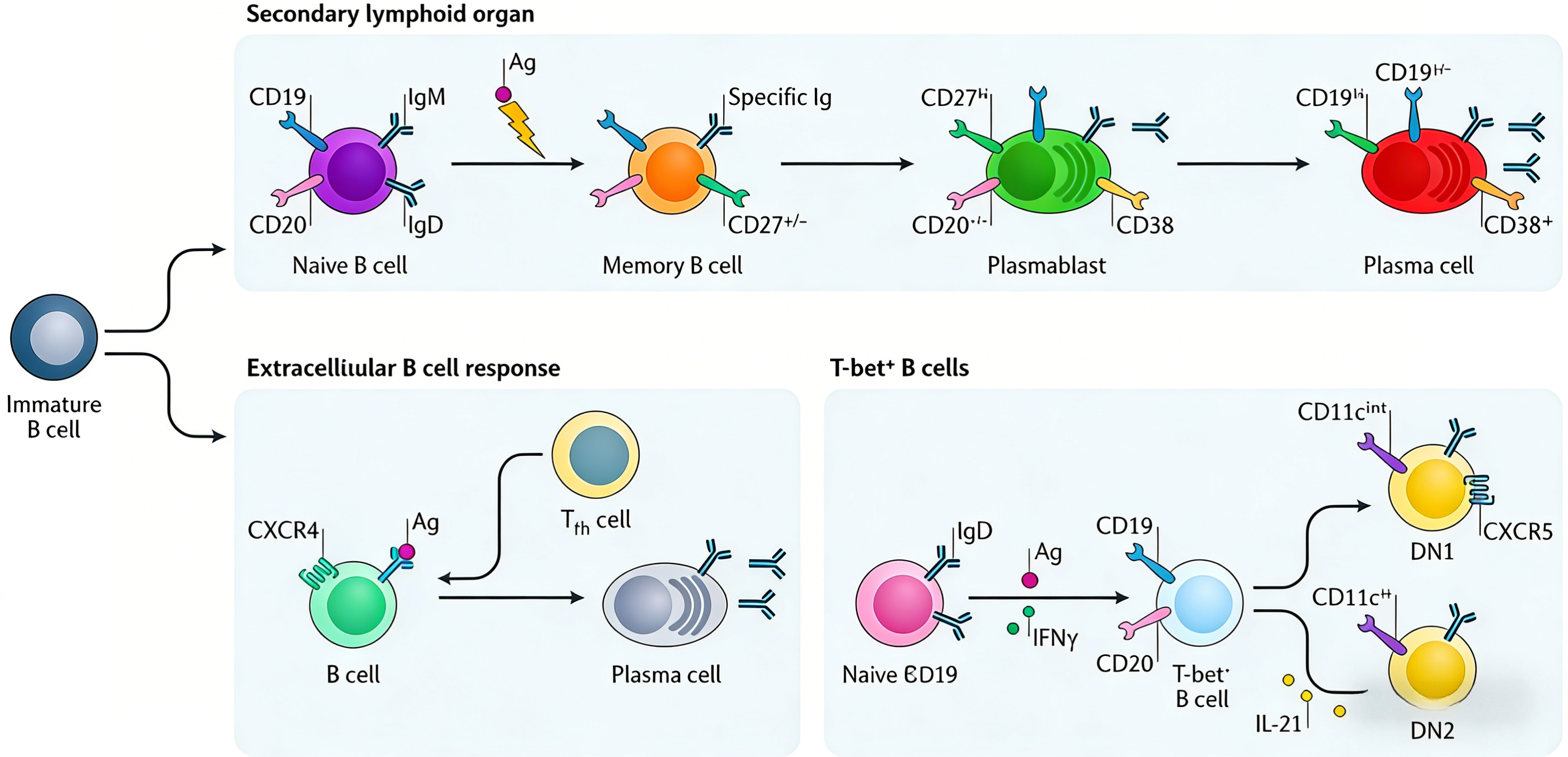
III. Functional Heterogeneity of B Cells
Traditionally, B cells were thought to mediate humoral immunity primarily through antibody production. However, recent studies have unveiled a broader functional spectrum of B cells. Based on functional characteristics, B cells can be categorized into effector B cells and regulatory B cells (Bregs).
Effector B cells promote immune responses through multiple mechanisms: acting as antigen-presenting cells (APCs) to present antigens to CD4+ T cells, facilitating Th1 and Th17 differentiation; secreting pro-inflammatory cytokines like IL-6 and TNF-α; and producing specific antibodies for humoral immunity. These effector functions play protective roles in anti-infection immunity but may contribute to tissue damage in autoimmune diseases.
Regulatory B cells (Bregs) are a subset with immunosuppressive functions, primarily mediated by inhibitory cytokines such as IL-10 and TGF-β. Bregs can suppress effector T cell proliferation, promote Treg differentiation, and inhibit dendritic cell function, playing a critical role in maintaining immune tolerance and suppressing excessive inflammatory responses. Deficiencies in Breg quantity or function are associated with various autoimmune diseases.
IV. Regulatory Signals for B Cell Polarization
The differentiation of B cell functional subsets is precisely regulated by cytokine networks in the microenvironment, with different cytokine combinations driving B cells toward specific functional polarizations.
Pro-inflammatory B cell polarization: IL-21 is a key factor promoting B cell differentiation toward effector phenotypes, inducing B cell proliferation, plasma cell differentiation, and antibody production. IL-6 synergistically enhances B cell effector functions. IFN-γ induces T-bet expression, promoting B cell polarization toward Th1-helper phenotypes. IL-4 and IL-13 drive B cells toward Th2-helper phenotypes, participating in allergic responses.
Regulatory B cell polarization: IL-10 is the core factor for Breg differentiation and functional maintenance. IL-10, in synergy with CD40 signaling, induces B cells to acquire immunosuppressive capabilities. IL-35 and TGF-β also participate in Breg induction. Additionally, BAFF and APRIL signaling are crucial for B cell survival and regulatory function maintenance.
V. Technical Principles of Human B Cell Polarization Cytokine Kit
The human B cell polarization cytokine kit is optimized for the in vitro directional differentiation of human primary B cells, simulating different polarization microenvironments in vivo to drive naive B cells toward specific functional subsets.
Pro-inflammatory B cell polarization system: The kit provides recombinant human IL-21 as the core induction factor, promoting B cell proliferation and plasma cell differentiation. Optional recombinant human IL-6 enhances effector functions, recombinant human IFN-γ induces T-bet+ B cells, and recombinant human IL-4 or IL-13 drives Th2-helper phenotype B cells. The kit includes corresponding neutralizing antibodies to ensure unidirectional differentiation.
Regulatory B cell polarization system: The kit provides recombinant human IL-10 as the core Breg induction factor, combined with CD40 agonists to simulate T cell helper signals. Optional recombinant human IL-35 and TGF-β enhance Breg differentiation efficiency. BAFF can be selectively added to support B cell survival.
B cell activation reagents: The kit includes functional-grade anti-human CD40 antibodies and CpG TLR agonists, simulating in vivo T cell helper and pathogen-associated signals to ensure effective B cell activation.
Expansion support components: The kit contains recombinant human IL-2 and IL-15 to support sustained proliferation and functional maintenance of activated B cells, provided at optimized concentrations to avoid interference with polarization direction.
VI. Which Manufacturers Provide Human B Cell Polarization Cytokine Kits?
Nanjing UA-Bio Technology Co., Ltd. (UA-Bio) has independently developed the "Human B Cell Polarization Cytokine Kit", a high-performance cell culture system specifically designed to induce and regulate human B cell differentiation. This kit employs optimized cytokine combinations to efficiently and stably drive human B cells toward specific functional subsets (e.g., antibody-producing plasma cells, memory B cells, or regulatory B cells), providing standardized and reliable solutions for research in humoral immune regulation, antibody drug development, and autoimmune diseases.
| Core Product Advantages |
|---|
| Efficient Polarization and Directional Differentiation: The kit utilizes carefully balanced cytokine combinations (including IL-2, IL-4, IL-10, IL-21, BAFF, CD40L, etc.) to simulate microenvironmental signals for B cell differentiation and germinal center reactions in vivo. It efficiently induces human B cells to differentiate toward target functional subsets. The optimized polarization system promotes B cell activation, proliferation, class switching, and antibody secretion while maintaining the functional characteristics and phenotypic stability of specific subsets. |
| Exceptional Batch-to-Batch Consistency and Stability: Leveraging an internationally leading cell culture reagent development platform and standardized production processes, combined with a rigorous quality control system, each batch of reagents ensures stable polarization efficiency, consistent cell function, and excellent long-term stability. This provides solid and reliable quality assurance for long-term and continuous human B cell research. |
| Flexible and User-Friendly Operating System: The kit provides a complete polarization protocol and optimized culture system, offering simple and quick operation. Its formulation is compatible with various culture vessels and platforms, flexibly applicable to human B cell induction, antibody secretion analysis, class switching studies, signaling pathway exploration, and immune regulation function evaluation. |
| Comprehensive Solutions and Professional Support: We provide thoroughly validated standard experimental protocols, typical differentiation data, and detailed result interpretation guidelines to help you quickly establish stable and reproducible human B cell polarization processes. Nanjing UA-Bio's professional technical team offers full-process technical consultation and support for research design, experimental optimization, and data analysis. |
Nanjing UA-Bio Technology Co., Ltd. is committed to providing cutting-edge, high-quality core reagents and tools for immunology, cell therapy, and innovative drug development. For detailed technical parameters, validation data, or specific application inquiries regarding the "Human B Cell Polarization Cytokine Kit" (Catalog No.: UA090012), please feel free to contact us.
This article is reviewed and published by the technical expert team of UA
Disclaimer: This article partially utilizes artificial intelligence assistance in its creation. If any content involves copyright or intellectual property issues, please let us know and we promise to verify and remove it as soon as possible.
Purchase recombinant protein, choose Nanjing UA-Bio
UA protein focuses on providing various protein reagents, raw materials, and services required for drug research and development, cell therapy, gene therapy, and basic scientific research, including drug target proteins, immune checkpoint proteins, cytokines, tool enzymes, customized protein expression, and full-length transmembrane protein development. Youai is committed to providing customers with high-quality products and professional services, and building a High-tech Biological Enterprise with International Competitiveness.







 Business license (three certificates in one)